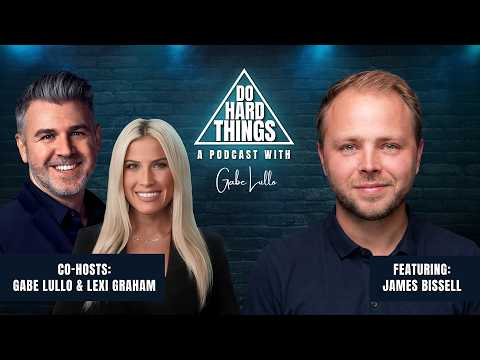
[0:00]I'm Gabe Lulo and welcome to the Do Hard Things podcast. We're talking to go-to market leaders and entrepreneurs who've conquered the challenges, the hustle, and the grind.
[0:09]Get ready for real talk, real insights and no fluff.
[0:16]But the hardest thing in the world right now is not actually closing deals, it's actually getting somebody's attention.
[0:20]If you don't have that hook within that first five to 10 seconds, guess what? They're going to scroll to the next one.
[0:26]You need to go in and you need to make it sound like yourself. That's the biggest piece of the puzzle and I promise you, we can all tell.
[0:32]The people that are trolls and the people that are haters, never done the thing that you're doing.
[0:37]I love doing this podcast because I get a front row seat to some of the greatest minds in sales.
[0:44]Gone are the days of saying stay in your lane. When you're an executive leader and you're an enterprise-wide leader, there are no lanes.
[0:51]You've got to be partners. Curiosity is like when the type of questions you ask is sometimes the value that you bring.
[0:57]I need you to tell me when you're ready to buy or what you're ready to do. And I think it's changed so much into like adding more value and if you're not doing that, then you're definitely going to come off as desperate.
[1:08]High pressure selling is like a dinosaur tactic at this point.
[1:11]No parent is like, oh, you should be a salesperson when you grow up, right? Everyone is like a doctor, lawyer, whatever crap. It's never sales people.
[1:19]It's not your job to motivate people. It's your job to find motivated people.
[1:25]It's not talkiness, it's not arrogance, it's confidence knowing I know this and I know that I can help.
[1:31]From where I started to where I am today is all because I learned how to sell.
[1:35]And there's too many people who've only been doing this for five freaking minutes. Sit down, close your mouth, actually go out there and get yourself beat up. Then come back and tell me if something is dead or not.
[1:46]See, that is exactly why I started this podcast because right there, that's the epitome of do hard things.
[1:56]Welcome back to the Do Hard Things podcast with Lexi and Gabe. Today's guest, James Bissel, is a two-time VP of Sales turned founder, who's built a sales skills optimization platform after spending 15 years proving what actually works in B2B sales.
[2:12]James went from SDR to AE to VP of sales twice and in his proudest role at the HR Tech startup Staff Circle, he increased annual recurring revenue by 1000% and grew the customer base from 15 to 175 customers through multiple funding rounds.
[2:30]Now, as the founder of a platform with 400 plus lessons, sales coaching and AI agents, James helps reps, sales leaders and founders implement his proven playbook.
[2:40]His track record speaks for itself, increasing win rates by 75%, taking teams from six to 60 meetings booked per month in 45 days, moving teams from zero to 100% target attainment and reducing time to close by 64%.
[2:57]James is also an author and podcast host, who's all about operationalizing what actually drives pipeline and revenue. James, welcome to the show.
[3:06]Welcome back everyone to the Do Hard Things podcast with your host Gabe and Lexi. We just heard your bio, James. We are so excited you're here. How are you doing, man? How's everything going across the pond?
[3:16]Yeah, doing good, living the dream, all of the fun that we just spoke about before we jumped on, so I won't bore the listeners with all the detail, but yeah, definitely relevant for the podcast name, do hard things.
[3:26]Yeah, I can't wait to hear some of these stories in this show and, you know, we always start the show with the origin story, right? We want to know what makes you tick and and where you started and what got you passionate about this, but you know, when people I talk to in sales specifically, right? People don't go to college to be a sales person, right? There's always this weird, interesting way of getting into this, you know, career of ours.
[3:46]So let's start with your journey, right? Like I said, not everyone's thinking about getting in the sales. So you started as an SDR, you made your way all the way up to the top. What's that origin story? How'd you get into it?
[3:56]Yeah, so I um, I a bit of a rough start to life. Um, and left school with no qualifications and then, you know, start paying paying my way. So I did like classic like warehouse jobs. I did a little, uh, I did a few weeks at McDonald's, um, and, um, and then did some like laboring, like construction, you know, work, which is great in the summer when the sun's out, getting a good tan, uh, you know, 17, 18 years old.
[4:26]And then in the winter, when it rains, which is pretty much most of the year here in the UK, uh, you know, you want to get indoors. So, um, I went and somehow got a job in this like pyramid scheme type sales setup where you knock on people's front doors at home.
[4:39]Um, I guess in, you know, in the US, you guys will do like, they'll sell like knives and things like that.
[4:44]It's a bit like that over here, but, um, it was signing people up to charities. You get no salary. It's commission only long old days.
[4:53]Um, did that for a little while and then moved into inside sales, like, again, we would call it back then telemarketing. We were cold calling 60 of us for like T-Mobile and Orange and, you know, uh, shows shows my age there.
[5:07]Um, and then yeah, just SDR, uh, and then moved through the ranks. So I think it's like two of the things I talk a lot about with with people and like on, uh, you know, on our podcast is like really if I think back to that journey, like the two things that really helped was an obsession with learning.
[5:20]Like anybody can learn anything. Like I do genuinely believe that, you know, my, my partner's a dentist.
[5:25]She didn't wake up one day and just start pulling people's teeth out, right? She was showing how to do it and then coach and then every year she does reinforcement, uh, you know, training.
[5:34]Um, so I think like, a big part of it is just me being obsessed.
[5:38]Um, I still am to this day, but I always like, I'm always trying to learn something new.
[5:43]And then just strong work ethic, like nobody owes us anything, like we have to go out there and fight for it.
[5:49]If it was easy, the opportunity would be rubbish for us, right? It's not, it's epic, but we have to go and work for it. So, you know, I always had this mentality, I will always outwork the metrics and I'll always outwork everybody else.
[6:00]And if I apply that with the learning piece, um, yeah, just helped me go from SDR, AE, VP, and now now what we do now.
[6:12]That's awesome. And like you said, you went from SDR, AE, VP of sales. What was the key mindset shift at each stage that allowed you to keep leveling up?
[6:22]Yeah, so definitely like the scrappy like just natural nature of like having to go and get things done.
[6:29]Like I, you know, I did a little bit of time at BT 120,000 employee org, right?
[6:33]Um, but majority of my career has been in early stage startups.
[6:38]Like staff Circle, which is my first VP job, there were seven of us in the business, maybe 12 customers, no sales playbook, no best practice, you know, handful of customers, no case studies, that kind of stuff.
[6:50]Just that mentality of, you know, again, nobody owes me anything, I just need to go and figure it out. So like from a mindset perspective, just go out there and just like make it make it happen, get shit done.
[7:01]Uh, otherwise if I sit back and wait for it to come my way, probably never will. I definitely won't come my way, but, you know, I'll be gone before it, it doesn't make its way to me, right?
[7:09]Sales is a performance game, so definitely just like having a mentality of not sitting back, um, not waiting for the sales enablement team to, you know, launch it at SKO, like, just go out and make something happen.
[7:22]I love that. I mean, every new rep that comes into our org and asked me, hey Gabe, what's the number one piece of advice when you get started?
[7:27]I always say make up in numbers, what you lack in skill.
[7:31]Double everything on the sales floor. Whoever's sitting next to you, if they're making 50 calls, you're making 100. Just make up in that work ethic that you lack in skill and guess what? You'll be more skilled in in very short order, right?
[7:44]So I love that working out the coming out of there. So let me ask you this, right?
[7:48]I have this belief and I want to know if it resonates with you and also what your thoughts are on shifting from rep to leader.
[7:56]I always like to say, you know, every great rep doesn't mean they're going to be a great leader, but every great leader needs to have been a great rep in their early stage. Do you believe in that and what what do you feel that big differentiator is to go from rep to VP of sales and and where does that look like?
[8:33]Yeah, so there's a couple of things come to mind there. Um, you typically look up in the org.
[8:37]Right? So you don't typically look down and go, I'm going to go and speak to the underperformers. You want to go and like, you know, I again, I believe you become the people you spend your time around. So you go and spend the time with the the people in the top, you know, top part of the leaderboard.
[8:52]You'll, you know, enough over a long enough period, you will, you know, end up just naturally saying the things that they do, like they do, you know, in the way that they do.
[9:00]Um, so I think like, yes, you do need to have been good at executing the job itself when you step up. I got a customer, uh, that works for a massive public company and their line manager has never been in sales before.
[9:13]So one has no confidence in the feedback that they're giving them, but also struggles to go to them, which is why they come to me in coaching sessions is because they need to soundboard things, which is just terrifying, right?
[9:25]But I guess that's just the way that they've they've built their business. Um, and then, yeah, I just think that look, the tagline of my business is nobody gets a degree in B2B sales and a lot of people think it's tough getting into sales.
[9:37]Um, and not getting any training. Wait till you become a VP of sales. Wait till you become a sales leader, um, because all of the stuff that got you there, but well, actually some of the stuff will be helpful.
[9:48]But I remember when I stepped up to be a VP, like the pandemic was like three months in. I'd never been a sales leader before. I'd never sold HR Tech before.
[9:55]I worked in startups, so most of them didn't even have HR. It was a CEO.
[10:00]Um, so I had to learn the persona, the market's falling apart, all of that kind of good stuff.
[10:04]I got the VCs breathing down my neck. No one said, hey, look, just take two weeks, buddy, just read this like sales leader playbook.
[10:10]Here's how you recruit. Here's how you onboard. Here's how you have tough conversations. Here's how you run a forecast. Here's how you deliver a message to the board, managing up.
[10:19]None of that stuff. You just learn that stuff on the go. And the problem is, is you're not talking about pipeline anymore. You're talking about human beings and you start, yeah, messing that up. You start messing with people.
[10:30]And and delivering feedback in a bad way. Like it's, one, it's bad to the business, but two, you can really do some like, you know, harm to people, like mentally, if you don't do it in the right way, right?
[10:40]So I think a lot of people and I used to say this for a bit, and I have changed my opinion on it.
[10:44]Um, a lot of people think the SDR role is the hardest role in the company. I don't see that anymore. I think the VP of Sales is the hardest role.
[10:52]You usually get a number that's made up in a spreadsheet from investors, and anyone can build a spreadsheet business. And then you're told to go and do that, which is usually hugely inflated on last year's number.
[11:04]And you don't get the head count to do it. You've got to, you can't hire the reps from MongoDB and Salesforce. You've got to hire the the juniors that, you know, you know, maybe need a lot of work.
[11:13]You're still selling it's just and all the skills that go with it, they're so different. So I think being a being a sales leader today is probably the toughest job in the entire company for that exact reason.
[11:26]I like that take. And I want to talk more about playbooks. You mentioned before being at a company that had no playbook.
[11:30]Companies still don't have them today. Yet you were able to create your proven sales playbook. What's actually in it and what makes it different from every other sales methodology out there?
[11:43]Yeah, so anyone that's listening in the sales leadership role, you'll know and you'll maybe you'll laugh at this, but as sales people, we're usually really good at finding the gray area in our compensation plan.
[11:51]If there's a way we're finding double bubble, I'll find it and I'll rig rig the game, right?
[11:57]So when I started to build teams, um, my my process was how do I give them the path to success.
[12:03]If you think about like a production line, let's take, I don't know, a BMW, there's this massive conveyor belt, right?
[12:09]And at one end, there's some massive pile of parts and at the other end there is a black M5 that you can drive away with. And there's just different stations on the way.
[12:18]Right? And if you're looking to improve the production line, you see these like classic like Ford movies as like a platform and the executives and the consultants are looking down on these different functions, right? And they're looking in, inspecting and making recommendations.
[12:31]And for me, that's the playbook is like, okay, if I think about pipeline creation, where's the gray area?
[12:39]How do I get it to a point where those reps can teach me what good looks like?
[12:44]So take cold calling, like, how do we open a call? Who do we call? How do we handle objections? What do we do after the call? What do we do before the call?
[12:52]All of like all of those little nuances, think about them long and hard.
[12:56]You don't have to, like, have this stuff within the next 30 days. Build it and then just train, develop, coach your people to that and then hold them accountable.
[13:05]Then move on to the next stage of the production line until you get to the end and it's like, cool. When I hire people now, I just got to ramp them and give them this path to success.
[13:14]And if you follow it, you'll be successful. If you don't, you probably won't. And I want to, I'm going to figure that out really, really quickly, around like compliance.
[13:24]But I got to give them the playbook, otherwise they're just going to go off and run their own plays and if I've got 10 reps doing 10 different things, coaching is tough, forecasting is tough and scaling is tough. So that's my my thought on the playbook.
[13:35]And again, I go into like 20, 30 sales people orgs, and I run our programs and I'm like, dude, can you send me over the ICP or the personas or whatever? And they're like, oh, we don't have that.
[13:45]I'm like, okay, what about stages, steps and exit criteria? Oh, we were hoping you could help with us. I'm like, how have you got to 20 people in the sales org?
[13:53]Right? And I'm starting to wonder, actually, is your process, your forecasting problem? Is it just lack of clarity on the process and then having a compliance document that people are aligned to?
[14:02]Do they actually need like training or do they just need the playbook to follow? You know? So, again, usually just something really small like that sometimes they can help move the needle.
[14:12]But when you're in the in the trenches, I, you know, you guys probably talk about this a lot like I do, but, you know, you spend too much time in the business and working on the business.
[14:20]You just take a step back a second and go, where are the gaps? Can I plug them? You can move the needle pretty quick.
[14:26]Absolutely. You're like the Henry Ford of sales, man, that assembly line, right? I I absolutely love it.
[14:30]I love it. Exactly. Well, I watched that film, I was like, that's just that just makes so much sense, right?
[14:35]Exactly. All right, so let's talk staff circle for a moment, right?
[14:40]You increased ARR by a thousand percent, right? Growing from 15 to 175 customers. Walk us through like a couple things that you did there. You have to tell us all your secret sauce. I'm sure you don't have the time for it, but I'd love to hear what are one or two tidbits on where you really started and what you needed to fix at that early stage.
[14:59]Yeah, so wherever I go, I take the playbook, I swap out the variables.
[15:02]I didn't do this the first time because I hadn't had didn't have that, you know, the scars from making those mistakes.
[15:08]So I was like, cool, where's the product? What's the target? Where's the list? Where's the tools? Let's just go do this thing, right? And then the first three months were terrifying.
[15:17]Um, not just because of the state of the the economy, but then like having these VCs and things like that and reporting directly to the CEO. So, first couple of months were were terrible.
[15:26]Um, and then I was like, right, like, put myself in the buyer's shoes. I've never sold HR before. I never beat like really known many HR people.
[15:32]Um, so I started to round up the very small number of customers we did have and started doing lunch and learns. So I'd bring them and I didn't, I I wasn't sure if it was going to work out. First one blew us away.
[15:43]Like she turned up with a deck and she was like, let me take you through the day in a life of a HR person, but let me tell you this first, like they want to be transformational, but they're stuck being transactional.
[15:51]They got papers all over their desk, they can't even see the color of their desk. And that so we did all these like little mini interviews, started on saying, what's it like to be that person?
[16:00]So then when we go out to market, we can use empathy and we can really align the narrative, the messaging, everything directly to that to, you know, build authority and credibility.
[16:10]So we started to do that stuff and then I was like, most of these HR people don't have a seat at the table, but they want to.
[16:15]You know, the chief people officer, the CHRO, maybe, but most orgs, it's the HR director that, you know, the door's closed and they're left on the outside, but they want to be in there.
[16:25]So a couple of things came to mind with us, well, if we need to get somebody in that room pitching the business case, well, we have to give them the business case. So we started co-creating this business case with them so that if we weren't invited into the boardroom and they weren't invited into the boardroom, what was being presented was as if I was in there.
[16:42]And this is before like digital sales rooms and everything came out. This was just like a Google Docker or Word Doc, one or two pages. Um, and then we just got really good at making our our our HR contacts champions.
[16:54]And and making them feel comfortable to take us to different people in the organization to mitigate risk. I guess we call that multi-threading.
[17:03]Um, and make them feel really comfortable that they're making the right decision, again, because they're not your natural, I like, I want to do this, I like it, I've got budget, I'm going to sign it off.
[17:11]We had to figure out how do we enable these people to go in their organization and and tell the value story for us. And when we figured that out, um, it still wasn't a home run, but we had reps with like 50, 60, 70% win rates.
[17:26]Um, doing deals like in record time, lots of five-year contracts.
[17:30]When people like struggled to get people to sign a 12-month contract, you know, and I think again, that just came from good clarity on the playbook and then just upskilling the team on how to multi-thread, how to do deep discovery, how to build a business case.
[17:44]That's awesome. And I want to talk more about pipeline generation. So you were able to take a team from six to 60 meetings per month in 45 days. What do you think was the biggest bottleneck there and how do you think people can fix that if that's something you're seeing across the board?
[18:02]I don't want to say it was easier, but my baseline.
[18:06]I mean, there was, there was a, I couldn't really get much worse to be fair, like I'm still in contact with the reps at my last org now, some of them anyway.
[18:14]But yeah, we had, there was five reps in seat, we actually went down to four just because of, you know, there wasn't, you know, a bad fit.
[18:19]I go into the details. So I actually went down in head count.
[18:22]Um, but there was a previous, uh, consultant in place and just part-time. So I didn't really have the capacity to give it everything it needed, but these guys weren't making any cold calls.
[18:31]We were selling enterprise. We were selling something that they typically don't think of.
[18:36]Most people like I didn't even know this stuff existed and we're just sending emails and they were pretty much copy-paste.
[18:42]There was about 450 sequences in HubSpot, um, and a fully loaded Zoom info account. You can imagine what was happening.
[18:50]Yeah. Um, and in fact, even internal emails were going into spam and I was like, okay, we got banned. I'm banning email. No more email.
[18:59]Okay. We're going to, we're going to teach how to make cold calls.
[19:03]Um, I locked them away. We went around the whiteboard. We picked the three personas. We got intimate with them. What do they care about? Like I've got this little framework that we use. So like we filled in these boxes.
[19:10]And then we wrote scripts and I said, cool, every day, regardless of your seniority and salary and role, AEs, enterprise AEs, SDRs, we are going to do 30 minutes of role play every single day.
[19:22]We're going to smash the phones apart every single day in these cool blocks, and at 5:00 till 6:00, I'm going to do sales training with you every single day.
[19:30]And I just obsessed over it with them. And most people like, shit, that's like an entire day a week.
[19:34]Like one training people, but off the sales floor. But I had to do it because I had to change a bunch of behaviors.
[19:40]And as a result, funnily enough, we just read load of phone calls. We spoke to load of people. We told them, you know, why, why we're really good, the positive outcomes we generate and surprise, surprise, people wanted to learn more.
[19:49]Yeah. Like it really isn't that that that hard if you put the right things, but it's putting the time in doing the hard things, getting the job done. Stuff that you can't automate, usually drives.
[20:01]You know, pipeline and revenue.
[20:04]I love this. Yeah, I'd love to know, what was the reaction of the higher enterprise and AEs that were you were telling to cold call? Were they on board or did it take convincing?
[20:14]Well, the ones that stayed, um, took it very well.
[20:20]Uh, and the ones that didn't, obviously didn't. And so you can probably imagine how these conversations went, but yeah, these are elite. These guys were hungry, right? They wanted to be elite, desperate.
[20:28]You know, when I, when I quit that job 11 months later to start this business, yeah, I always wanted to start this business, but what made me feel comfortable is I'd almost been able to retire myself.
[20:36]Yeah, I do think a lot of sales leaders if they had the mentality, how do I retire myself?
[20:41]If I can get to that point, I would have built an elite team. And they were coming to call reviews or deal reviews, you know, 10, 11 months later saying, hey, I know exactly what you're going to say.
[20:50]We're going to listen to the IBM call and I know what you're going to say when we get to 30 minutes in. I listen to it back and there's a massive opportunity and I missed it. That's definitely something I need to work on.
[21:00]Like they became more self-aware where before they were like, it's Monday morning. I'll just kick out 500 emails and then, you know, I'll jump on the forecast meeting and I'll just, you know, I'll I'll commit a bunch of deals that slip or never happen.
[21:11]It was a complete shift in mentality, but again, I had to come back to the raw core basics.
[21:18]Build the playbook, train them, hold them accountable to it, and then get intimate with them. What do they want? What do they care about? They wanted to be great.
[21:25]So they had a lot of them had, they weren't buzzing for it.
[21:28]There's very few of us that enjoy picking up the phone. I'm one of them. I actually don't mind doing it. I think it's quite exciting.
[21:33]Um, but they did it anyway and did it aggressively because they wanted to go places. And that's important when you're recruiting.
[21:39]Absolutely. So let's switch gears and talk about length of sales cycles.
[21:45]Because right now it's longer than ever before. Right? You know, with the money being so tight in in the world and and, you know, people are hesitant and AI coming in and there's a lot of, obviously, we all know uncertainty, especially in the sales divisions of companies.
[22:00]The sales cycles are becoming longer and longer, right?
[22:03]There's more AEs and closers seen and meeting CFOs in in Zoom rooms, right? And and in closing calls than ever before.
[22:13]So you helped in scenarios, I mean, you've helped company, you know, increase their close rate by 64%. I mean, that's massive.
[22:21]So what are those big time wasters in most of those sales cycles that you're seeing and how how can we eliminate those now, again, when it's so much more important than ever before?
[22:31]Yeah, and I would just, if you're a sales leader listening to this, I would actually go and properly listen to a call. Don't just have like Gong on one screen while you're doing Facebook or whatever, like actually listen to what's happening.
[22:42]When a prospect says something, are your people actually genuinely curious? And again, Gabe, I got a question I wanted to ask you, but I'm going to come back to that.
[22:47]You said something really interesting a minute ago. Can we just can we just go back to that a second? And I think we've lost our way a bit in sales with being good communicators and being present because we've got our AI note taker.
[22:58]But I still have these white boards everywhere I go. So when people are saying things, I go to any page, any page I look at from when I'm out selling, here's a perfect example. There's like four bullet points and one of the bullet points has got an aggressive underline under it.
[23:10]I don't want to interrupt you when you're talking, but I'm I'm like, just paraphrasing. So when you stop, I'm like, I want to go over here in a second, but can we just go back? You said something really interesting. I just want to use that as like a visual aid and then I'll just dial back into it.
[23:26]So if you actually want to accelerate, you know, the sales process, if you want to reduce time to close, one, you need to make sure you're actually qualifying opportunities that can go places fast.
[23:36]Yeah, like, what is the business impact? Is there hair on fire? Is the, is the fire at the back door? Is it 250 meters down the garden that can wait? Like, where is the the urgency here?
[23:46]And I do think some people say you don't create urgency. I think you can create urgency if you help them calculate the cost of their problem. Maybe see a better way of doing it. And if they're emotionally connected to that, then I've seen people, you know, do things really quickly.
[24:00]Um, but then also like sales people burn a lot of time in the mid to late stage of the sales process because they have clarity on what's actually going on.
[24:07]So if you take like medic, for example, if you take like decision and paper process, if you actually stop and have a conversation and be like, hey, Lexi, you know, typically at this stage we want to best understand how you guys are going to go about making a decision.
[24:18]I'm probably going to influence that a little bit in disguise to rig the game, but then also like what's infosec look like? What about legal? Can you guys run those by the way at the same time or can legal only start when infosec ends because there might be changes to the contract.
[24:32]Some customers can do both at the same time, some can't. Can you maybe give me that? Last time you did this, like what really slowed us down? What can we do to mitigate?
[24:40]Having those conversations, when I can actually get access to the process, I call them the three Ds, like discover document drive. If I actually know what they are, I can then just work on things in the background and make things happen faster. And that was one of the things that seen it. Yeah, we reduced the time to close by 64%.
[24:57]And I'm talking world's biggest companies, like Amazon, huge organizations, we're just buying stuff a lot faster. Hundreds of thousands of employees.
[25:04]Because we got clarity on what needed to happen and we went out of our way to be helpful because those people have got day jobs, and we did a lot of the work for them and enable them to go and have those conversations.
[25:14]That's so important. I mean, what you just said is, you're not, like I said, I I have a hard time saying that to creating urgency.
[25:19]Long people like look at it as a manipulation, right? Oh, you're manipulating. Well, no, you're uncovering urgency.
[25:27]Right? Like that's the, the way to create urgency is to uncover it. And the way to uncover urgency is just by asking those questions. And everything you're asking is not a sales question, it's a process question, right?
[25:38]Like how does it work for you? Can legal and can our conversation run in parallel? You know, what slowed down on deals before?
[25:44]Like those are just process questions and just like every company has its own titling and nomenclature, they also have their own processes and procedures and all you're doing is asking those so you can uncover where you can, you know, put your time and attention to close the deal and it's, and it's, it's so simple, right? When you when you break it down the way you did. So thanks for doing that.
[26:05]So there are two scenarios that I hear a lot. The team can close when they get the deals, but they're struggling building that pipeline, or on the flip side, they're getting a ton of lead generation, but they aren't converting anyone. What do you think is harder to fix?
[26:21]Oh, uh, that's a really, really good question. Um, I think, well, partly depends on the maturity of the business, um, and the buyer, because if you've got a really easy buyer, uh, I, someone that sits up that has a seat at the table, um, it's a little bit easier.
[26:38]Um, but I do think a lot of pipeline generation today just comes down to and I don't want to say reps are lazy, but like making like thinking you can make like 20 strategic cold calls a day.
[26:50]When you've got like a five or 10% pickup rate, I don't care how strategic they are, if you're not speaking to anybody, it's going to be really hard to build pipe.
[26:58]Um, so I've just found either with the teams that I've built or like the some of the programs that we run is actually just setting the standards of like reverse engineering your numbers.
[27:07]Okay, Gabe, you know, you need to do 250k this quarter, your average deal size is 50k, so you need five deals one. Your win rate's 25%, so you're going to need to generate 25 opportunities. How many dials to get an opportunity? 107.
[27:20]Got it. How do I actually build that into a daily plan? I actually built these, um, shameless plug. But I built these little planners called Hit Your Numbers.
[27:28]It's about taking big, scary numbers and breaking them down into daily tasks.
[27:32]Like if I look at, I don't know, Monday, there's a section called PG goals, and it's like, what are my PG goals?
[27:37]Make 50 dials, 25 emails, 15 voicemails and a LinkedIn post. If that's what I've calculated that drives my my number.
[27:46]I just write that down every day because I I I think there's a lot of value in writing stuff down. Like I know there's AI and stuff, but when I write it down, I feel like it really goes in and reinforces it.
[27:54]And then I'm like, cool, throughout the day I'm just like blocking my time on my calendar to align to that. And I'm just executing it. Anything above that is a brute sheet bonus.
[28:02]So sometimes it just like allowing the sales reps to actually know what do they need to do every day, break that big number down, and then just go and execute it. And again, you can sometimes just fix that problem pretty quick just by, you know, good documentation and then some compliance with that where the sales process can sometimes be a bit harder to fix.
[28:20]Uh, just because there's a lot of moving parts to it, you know, again, I think one of the problems a lot of sales reps face in today's world is organizations, if we're like cultural values perspective, they'll have things like collaboration.
[28:32]So like it sounds great to put it on the wall and things like that, but sales people now we've got massive stakeholder groups because it goes to the COO for approval and they're like, oh yeah, have you run it by Gabe's team and and Lexi's group as well.
[28:44]And what about finance ops and security? Have they, oh, I haven't done. Okay, you can do that now.
[28:50]So like just like these cultural values that are actually making things a little bit harder for us as well. So there's all these nuance of that to get into it as well.
[28:56]So, yeah, I don't want to say pipeline is an easy fix, but it, it can be a lot easier than trying to fix a, you know, the rest of the sales process.
[29:04]I love that book, Hit Your Number. Let's get the link to that book, uh, in the show, uh, in the comments because I that's so important, right?
[29:11]An apple a day, right? That's how I look at sales, right? You just an apple a day. You have to know your number every single day and you have to hit it and master the mundane is the way to be that and just, you know, you know the ultimate goal and you can break it down through math, math of sales and you just do that every single day. You you'll be very much on target if not over, right?
[29:29]Yep, 100%.
[29:32]So you, you work with reps, obviously, sales leaders. Let's talk to the founders that you work with, right? Because there's a lot of big gaps.
[29:39]What I guess here's the question, when you're working with a founder, right? Especially a company that maybe has a sales team and there's a little bit of a disconnect.
[29:48]And they're bringing you in, where do you work with that founder and how do you help them really lead their sales organization and the needs that they need essentially when you work with them?
[2:59:59]Yeah, I think a lot of it comes from like, I was really lucky at staff Circle. One of the the VC firms that we had, um, they introduced me to one of the NEDs that ends up sitting on our board.
[3:00:10]Really old school dude, still kind of in contact with him now. And he, um, you know, I used to have one-to-ones with him.
[3:00:18]And, you know, he taught me a couple of things about, you know, managing up, like being a good communicator to to leadership and to the to the board and exec team and stuff. And but also, um, building get well plans.
[3:00:27]So like rather than just going in and being like, oh, we're going to miss our number for the third quarter is like actually having like a three-page narrative that talks to that, the plan like you get, okay, if I'm not feeling very well, I need to make sure I get to bed at like 9:00 every day. I've been going to bed at midnight, vibe coding, that's probably not helping.
[3:00:43]I've stopped taking my vitamins and drinking plenty of water, in fact, I can't remember the last time I had a glass of water, so I better start doing that a couple of times a day.
[3:00:49]Getting some good sunlight and some exercise three times a week and maybe I'll start to feel better.
[3:00:54]Little things like that, right? So I think with the the founders is about, especially if majority of them are like a techies is just like setting the expectations of one, not everybody wants to buy your baby.
[3:01:07]And if you struggled to swallow that pill, it's just reinforce that nobody wants to, not everyone wants to buy it right now.
[3:01:13]So we need to understand like where are we really focusing? What's a big bet that we're going to place over the next couple of quarters?
[3:01:20]And then what are we going to do to enable our team to go out and do that effectively and reminding them that just because you've got a finance degree or a legal degree or a degree in whatever it might be, people fall into sales.
[3:01:31]My son might one day grow up for, he's two at the moment. All he cares about is fire engines and poor patrol and stuff like that, but he'll probably listen to my podcast and have to go, you know what, I'm going to be like that, Danny, I'm going to be a sales person. And I'm maybe I've got 16 years to get him ready for it.
[3:01:46]But most of us stumble into this thing called sales and we build great careers, some of us because we figure it out most don't, but it just reinforcing that your brand new product that nobody's probably heard of because it's new category or you're late to market.
[3:02:00]It's highly differentiated but nobody knows the value of that differentiation, yeah, it's not going to be fixed overnight. And you need to go back to your investors and also pass this message on to them.
[3:02:09]Because most of them are financial analysts, so they just build, yeah, spreadsheet businesses and don't realize what it's like to go and do this stuff. So it's about just managing up, setting expectations but then communicating a really clear plan of what we're going to do to fix this and move the business forward and just setting expectations personally.
[3:02:27]There's obviously a lot of moving parts to it afterwards, but I think a lot of time is just about, you know, being a good communicator.
[3:02:32]Again, something very few of us get any proper training on how to do it, when to do it, why it's important.
[3:02:37]Yeah, absolutely.
[3:02:40]Is there something you're seeing that sales leaders are doing right now that's actively hurting rep performance?
[3:02:45]Yeah, saying things like, oh, you need to be better at discovery.
[3:02:49]Lexie, you need to start multi-threading. I read a blog. I read a blog. HubSpot wrote this blog on multi-threading. You should do some more of that. And Gabe, I think you should, um, you should tell more stories.
[3:03:00]Cool. We we all know what to do. Yeah.
[3:03:04]None of us know how to do it. Why don't you show me? You know, I used to get on the phones with the guys, even at staff Circle, I had eight, 10 people report to me. And like what I remember this Thursday afternoon, like a couple of meetings just like canceled.
[3:03:17]I just ripped 147 dials.
[3:03:20]Like in like three and a half, four hours.
[3:03:23]I want to show my people I can do it. So then when I stand up in front of them at QBR, SKO or whatever, when my back's against the wall and we're, you know, going through a tough patch.
[3:03:32]You know, I've been here and done it. So when people say, oh, my boss is on my case, he's asking me to make 40 cold calls, I'm like 40 cold calls.
[3:03:39]Jeez, bless you. Like, I remember having to make 100 cold calls and getting in the car for two hours, drive to the other side of my territory and get no show, have to drive two hours back.
[3:03:48]You know, like it's just, uh, yeah, it's just it's mind-numbing. So stop telling your people what to do.
[3:03:55]They probably know it because there's a bunch of gurus on LinkedIn that talk about what to do all the time.
[3:04:00]Most people don't know how to do it. So sit them down, show them how to do it, role play with them, reinforce it, listen to their calls, give them feedback.
[3:04:24]You know. And that way your people are still getting training. You've got somebody that's good at it delivering the training. But you're not having to spend hours building it, running it, and doing the follow-up.
[3:04:33]That's awesome.
[3:05:01]So the second time you said that on the show, and I have a picture on the other side of my wall that says, get shit done.
[3:05:07]And I just, it's so funny and I just, it's just so great. You're awesome.
[3:05:10]I was going to get t-shirts. I will get t-shirts. Get shit done. Let's do it. For our next podcast, we'll make sure.
[3:05:17]Yeah. On it. Well, James, thank you so much. If someone's listening right now, rep, leader, founder, and they know their sales motion is broken. What's the first question they should ask themselves to start going in the right direction?
[3:05:30]When was the last time you actually stepped back and looked at it?
[3:05:36]Like I kicked off a program the other day with a new team and like ICP, lack of the limited playbook they did have was quit before before the pandemic.
[3:05:43]Like they've made little changes, but like a lot of when we did like a win-loss analysis, I do this audit with like, who are the last 10 customers that you've won? Who are the last 10 customers you've you've renewed or expanded?
[3:05:54]And then we apply the medic framework over the top of that, and then I go and look at active pipeline. There's so many deals outside of those characteristics.
[3:06:05]And I'm like, do we actually need to just reset for a second on how we're going to market versus? I don't know if you guys see this all the time, but it drives me bonkers. I'm in a WhatsApp group with like 300 go-to market leaders in the UK. Um, and all they're asking in there is, oh, where are you guys getting your data these days? Or should I move from sales left to gone or should I do this? I'm like, dude, like, have you actually just thought about like, maybe just cutting some of those for a second and just investing it into your people? Even if it's yourself, like just you making the time to train them.
[3:06:33]Like, if it was as easy as us going onto the website, putting our credit card into Gong, Zoom info, and a digital sales room tool, like we'd all do it. I'd spend the 100K right now.
[3:06:42]It's not that simple, right? So it's just like get a reality check. Like we're, we're in the people business. We need to invest in our people so that we can go and help other people invest in themselves and their business.
[3:06:54]Um, and that takes skill. Um, and unfortunately, there's no magic switch that you can turn on to make that happen. It takes time.
[3:07:01]So, yeah, I just, I probably just take a step back, look at what's going on. We'll be setting the team up for success. Are we setting our customers and prospects up for success? If not, probably start there.
[3:07:09]Awesome. Cheers guys.