[0:07]Hey everybody, Timbo Jordan here with another Oracle's video where we bring in really smart people to try to teach you something. One of the biggest conversation pieces, one of the hottest topics that people talk about as Amazon sellers or e-commerce marketplace sellers, is how do we start direct to consumer. How do we create our own sales, have our own customers, have our own sales pipeline. Shopify is really in my opinion, the easiest way to start that process. It's fairly intuitive, it's fairly simple and you can actually have your own website, selling your own product pretty quickly. But, it's not for everybody. I think that too many people think, oh, I'm selling on Amazon, I should immediately sell on Shopify. It's not always the case. While we should be trying to do that, you have to time it correctly and you have to do it correctly. One of the most impactful pieces of information that I've ever got as an Amazon seller about how, when, why, where, and when to sell on Shopify was by the homie Colin Foster. Colin lives down in South Florida, he's got a great tan, but he's also a pretty smart dude when it comes to Shopify because that's what he does. He's never been an Amazon seller, he's not an Amazon seller, but he's got a lot of experience working with marketplace sellers like Amazon. In putting their products into Shopify the right way. So I asked him to come on now and he's going to talk about the biggest mistakes that Amazon sellers make when they're selling on Shopify, so Colin, it's all you. Thanks guys, glad to be here. My name is Colin Foster and I am the co-founder and director of product selection over at Brain Power where we help brands and private label sellers expand from Amazon to Shopify. And today I'm going to be talking about the top five mistakes that Amazon sellers make when expanding from Amazon to Shopify. Now, this is an extremely important topic for a lot of you because there's a considerable amount of Amazon sellers that would like to sell on Shopify, but they're not really sure how, they're not sure what to even really start with because it's basically like speaking an entirely new language. And essentially what I want to do is prepare you to understand what that type of expansion is even going to look like for you, what to expect, what are some of the mistakes, all these all these great things that are really going to give you a lot of knowledge and a lot of valuable insight into how you're going to make the expansion into this new sales channel. So let's go ahead and get started. So the first thing that I want to talk about, the very first mistake that people make when expanding from Amazon to Shopify is not picking the right product. And that's the root of what my role is at Brain Power is I look at the products that all of the brands and private label sellers come to us with and make the determination on whether or not those products are going to make a good option to expand from Amazon to Shopify. So I'm going to give you some of the criteria that I look at when it comes to picking a successful product on Shopify when it comes to at least from expanding from Amazon. So the first thing that you want to look for in a product is does it have a unique selling proposition. Now for those of you who don't know what that is, uh a USP or a unique selling proposition is what makes your product unique to the marketplace. If you're have operating in a competitive landscape like cosmetics or pet products or baby products or something like that, what is it about your product that makes it different. Now the reason why that's really important is because in most cases, if you're an Amazon seller coming on to Shopify, you're probably going to be using a traffic platform like Facebook or Instagram. And on those platforms, you're not really competing for keywords like you are on Amazon, you're really competing for attention, so your product in and of itself has to be a type of product that commands attention. Is it exciting? Is it something that excites people? Because most of the time the intent for the people that are on Facebook and Instagram, they don't really have a high intent to buy your product like they would on Amazon. When somebody goes on Amazon to look for your products, they're already pretty much certain of what they're looking for. When you're operating on a platform like Facebook or Instagram, you don't have that luxury. You have to stop people in their tracks and get them to want to buy your product. So at the root, you want to make sure that your product has the ability to captivate that. It doesn't mean that it has to be a completely revolutionary product, but you want to look for something that is something unique. So, for example, we have something that we use called the toothbrush test. And basically the toothbrush test is based on the premise that if a product improves or replaces the way a problem is solved, it can be sold on Shopify. So if you took a regular old toothbrush and you put it on Facebook or Instagram, it's probably not going to get that much attention. People have seen toothbrushes, it's not something that they don't see at the grocery store when they go to the drugstore, right? But maybe if you had an electric toothbrush that had a bundle and or, you know, a water pick and something that kind of gave it a little bit more pizazz, right? It was like, oh, this is a pretty cool little bundle. That might be something worth testing, but what if you had something like a hands-free toothbrush, right? They do exist if you haven't checked them out, but they do exist and if you have a hands-free toothbrush, that's something that the marketplace has never seen before, right? Like, or at least it's not it's not a common thing that you would see in the marketplace, so just the product itself would help you to make a little bit more of an impression on your potential consumer. So that's the first thing we look at is a strong unique selling proposition. Can you captivate attention with your product? So that's the first thing. The next thing we want to look at is how much are you charging for your product? We would call this the average order value or the AOV, right? So if you have a product, let's say you are selling a product and it is only $20, okay? The cost of traffic on a lot of these platforms, Facebook, Instagram and even Google, for a $20 product, if it's not consumable, that means you that would mean you would have to be profitable on your first sale. And the likelihood of you being able to sell a $20 product profitably on the first sale and that's the only purchase you're going to get for your from your consumer, it's really not likely that it's going to happen. I'm not saying it's impossible, but at the end of the day, what we're trying to help you do with these conversations, is help you to understand risk. I want to help you mitigate the amount of risk that you're taking in your business. So I would propose that it's too risky for you to take a product that only sells for $20 and is a non-consumable, and if you don't have any other products to sell people in the future, it's really not worth the risk because you're going to have to be profitable on the front end on the first purchase with a very small average order value. Even if you have great margins, it's it's probably going to be tough. But if you do have multiple products that you can sell people, let's say, for example, you are selling bath products, right? Maybe bath products aren't the most unique all the time and maybe you don't have a high average order value, but if you have a really nice ecosystem of other products you're selling people, if you give people a good experience and they enjoy the quality of your products, you can now sell them things in the future, which would be a great way to to acquire customers and then sell them something long term. Or if you have a consumable. So if you're selling a cosmetic product, maybe you're not even maybe it's $20, $30, $40. Maybe you're not profitable on the front sale, but on the back end, you're selling a consumable, so people will come through and they will buy the purchase by the they will purchase the product again. So those that's another area that you want to look at. What is your average order value of your product, right? How much are you selling it for? Can you absorb the cost of traffic and marketing on these platforms in relation to how much you're charging? Do you have other products that you can sell people so that even if the cost of of acquiring customers might not be profitable, it's worth getting the data and and getting those customers so that you can sell them other products in the future, and lastly, if you don't have any cross-selling products or multiple SKUs, is your product a consumable? Those are the four things you really want to look at at the product level and it's really one of the things that people never really think about, right? If you go to maybe an agency or something and you tell them, hey, I want to sell my my my phone charger, or my phone case on on, you know, on Shopify, there's a very high likelihood you're not going to be able to compete in the landscape of Facebook and Instagram with a phone case or a cell phone charger or a spatula, right? So that's something you really need to take into consideration about your product. Take it take a second to really think about the product the problem that your product solves. Is it unique? Does it captivate attention? Doesn't have any of the other metrics that you're looking for. So that's the first mistake is not picking the right product and it can really make or break the success of your campaigns when you're expanding from Amazon to Shopify. The second thing that you want to look at or the second mistake that a lot of Amazon sellers make when it comes to expanding from Amazon to Shopify is they don't have the proper content or the proper volume of content. Content is the backbone. It is literally the backbone of any expansion from Amazon to Shopify and the reason why is because there are so many places that you have to use the content in your Shopify ecosystem. We'll be discussing that topic a little bit further about the ecosystem, but at the root of everything, you need content to fuel any efforts you're going to be making on Shopify. You have to put your content on landing pages. You have to put it in emails, you have to use it for advertising. I'm going to speak about that a little bit more. You have to put it in some of the other functionalities of your website, text message marketing, newsletters, blog, there is no shortage of places where you're going to need content. And to be honest with you, most Amazon sellers that come to us, especially on the private label seller side, a lot of them have A plus content and product photos, but that that just won't do it. That that just won't be sufficient. You cannot just take a product listing on Amazon, make that your Shopify store and expect it to convert the same way. The nature of the traffic is different, right? Remember we discussed in the last on the first mistake is, people are usually searching for your products, right? With Amazon on Shopify, they're they're more than likely not. So you have to make sure that you have adequate content when it comes to fueling your Shopify expansion. Now, I discussed a little bit about advertising, the reason why content is so important with context to the advertising you're going to be doing on like Facebook or Instagram is because on Facebook and Instagram, unlike Amazon, where again, where you're competing for keywords, on Shopify or on Facebook and Instagram, you're competing for attention. You are trying to get people to click that ad as much as possible. So what does that involve in order to make sure that happens? It involves a lot of testing. And the only way you can really test different variations of content is to have a pretty deep content library. So there's all different types of content like user-generated content, basically people doing a box opening or a testimonial or review, you can have GIF images, static images, video images. There's or video videos. There's all different types of content you can use to make sure that you are fueling this ecosystem in a way that makes it so you have the best chance for success, okay? The third thing, the third mistake that most people um make when they expand from Amazon to Shopify is lacking the proper proper what we would call digital infrastructure, right? What does your ecosystem look like? I always tell new Amazon sellers or Amazon sellers that are looking to come on to Shopify, um, there is a big difference between a Shopify store and a Shopify ecosystem. You see, Amazon takes care of a lot of the digital infrastructure for sellers, um a lot of the things, you know, emails, customer service, all that great stuff, right? But with Shopify, you own the digital infrastructure, so if you think that you're just going to send traffic to a website and that's the only thing you have to do in order to build this online business, you're going to be disappointed because it takes a lot more than that. You want to make sure you have the right email infrastructure set up. You want to make sure that you have the proper customer service infrastructure set up. You want to make sure that you have your logistics taken care of. You want to make sure that you are prepared to build an actual business. Keep in mind, just because you build credibility on Amazon, that credibility will not transfer more than likely over to Shopify. Your Shopify store essentially becomes a brand new startup if you don't have any brand equity coming from Amazon over to Shopify. So you have to make sure that your Shopify store is actually equipped. One of the biggest problems that Amazon sellers have and I'm sure a lot of you have probably heard this. They'll hire an agency to um take to to drive traffic or to send traffic to their website. And by the end of their relationship with the agency, the person will you'll probably hear something to the effect of, oh, I spent $50,000 or $40,000 or $20,000 and I have nothing to show for it. I didn't get any sales, I didn't get any type of bump in in in any type of success that I'm looking for on Shopify. In most cases, the problem is not the traffic. It's just you're sending people to a place that is not really equipped to handle that traffic. You're not collecting data so that you can maximize your email revenue. You're not sending people emails after they purchase so that you can measure the amount of or so that you can generate more sales after the first purchase. These are the things that actually contribute to building a high-quality Shopify ecosystem. So lacking proper digital infrastructure is probably one of the biggest contributors to failure when it comes to people sending traffic to your website. In most cases, 90% of the time, if you're sending Facebook if you're sending traffic from Facebook, the problem is not the Facebook. What I like to um give a good analogy for some of you watching this, just to put it in context for you. I like to use something called the billboard test, okay? I want you to imagine that you own a business, right? You own a business, um a physical business off of a highway. And you put a billboard on the highway. And the billboard says something really cool and it attracts a ton of attention. And people are stopping, you know, families are stopping the drive on their trip to Disney World or wherever they're going and they're getting off the exit because your billboard is so good that they want to go see what's in your store. Now, when they get off the exit and they go to your store, nobody's buying anything. Is the problem the billboard or is the problem the store? In most cases, I think all of you would agree, it's the store, it's not the billboard. Think of your traffic and as it relates to coming from Google, Facebook, or Instagram, in the same way, if you're getting traffic to your store and nobody's purchasing, there's a very high likelihood it's not the traffic, it's the store. So your digital infrastructure is an extremely important part of making the expansion from Amazon to Shopify, so it's something you want to make sure is sound, efficient, and has the capacity for high levels of growth. The fourth thing, and this is a this is more of a psychological thing when it comes to Amazon to Shopify expansion with Amazon sellers, is the level of expectations, right? As we know, when you're on Amazon, and I've mentioned this a couple times, you are really competing for keywords, right? There's predictable traffic, you know how many people are searching for your product. There are a lot of things that contribute to the fact that you're kind of expecting to not only be profitable on the front end, but the traffic is going to kind of drive itself. With Shopify and the nature of the traffic that you're going to be driving, your expectations have to be a little bit more flexible. You probably aren't going to be profitable right off the bat. You're probably not going to launch your first, you know, ad and all of a sudden you're going to be making money and profitable on the front end. You again are building somewhat of a startup, right? You're going to have to go through the growing pains of testing and understanding how to build this ecosystem. It's a really long-term investment. This is not a turn on the switch, the lights go on and all of a sudden you start making money. A lot of people have a tendency to think that when they launch their Shopify store, if I had to analogize it, they think they're competing in, you know, this New York City and there's all these other businesses that they're competing with. But that's really not the case. Usually when you start your Shopify store, if you're not driving any traffic to it, you're not in the city, you're not in the middle of Manhattan, you're in the middle of the Sahara Desert. Nobody knows who you are, nobody knows anything about your product. There's no warm traffic, meaning there aren't people searching for you, right? You can't you probably don't have any search engine optimization, um on your website. So, the expectations that you really need to have are, this is not just me doubling my sales overnight. This is me investing my time, energy and resources into building a long-term business model and a long-term business that can generate revenue over time with work and optimization over that time period. Whereas with Amazon, it's a little bit more direct. You're you're you're buying a lot of the credibility, literally, because of the fees and everything else you're paying to Amazon. You're buying the credibility of Amazon, you're buying their traffic with two billion visitors per month. Amazon has the traffic for you to capture, right? That doesn't exist for Shopify, you have to pay for it. So again, it's really not so much a technical thing, it's just something you want to internalize about your psychology with moving to this. Do not come into a Shopify expansion expecting that all of a sudden you're going to go from zero to profitable overnight. This is something that's going to take time, it's going to take a pretty high level of resources, and more importantly, it's going to take a lot of effort on your behalf to make sure that you take care of your customers, that you take care of your digital infrastructure, like we mentioned before, and really put the effort forth to make sure that it's a good success. And lastly, I would say is the amount of work. That's the number that I say that that's the number five mistake um that people make is the amount of work that it's going to involve. And it kind of piggybacks off the last one, but it it's still important because outside of the expectations, I want people to understand, this takes time, okay? This is something that is not going to happen overnight, like I just said, but you're going to have a lot of testing, right? Since you own a lot of the digital infrastructure, this is a great point to make in regards to the amount of work it's going to take. Your emails aren't aren't going to just, they they work, right? They do work to certain to a certain extent, but there's certain key metrics that you want to achieve, there's certain things that you want to have have happened. Sometimes some of them work right away, but others you need time and testing to make sure that you optimize them. The same way you would optimize a listing, think of the same way you optimize your landing page, you optimize your ads, you optimize your emails, you optimize your upsells. There's so many different things that you have to keep track of and that's one of the things that kind of intimidates people about making that expansion is there's so much that you have to really manage. Um, but in a lot of cases, the the number one thing you want to understand is that is part of the work, right? That's the work you have to do to get this channel to actually function properly. So one of the things you want to make sure is that you either have a good amount of educational resources that you're willing to put the time into learning. Maybe you're working with a consultant, maybe you're working with an agency, for some people, it's a whole different discussion about whether you should even be working with an agency, but the fact of the matter is, if you if you have the right product, if you follow a lot of the other key mistakes, or try and avoid some of the key mistakes that I made that I told you the Amazon sellers make when expanding for Amazon to Shopify, this part should really be the easiest part because I know a lot of Amazon sellers they have the work ethic. A lot of them have built their businesses from scratch, they've put the time in, so the work is really not um so much a mistake, it's just the the ease of use that people I think expect when it comes to Shopify. It's it's actually more difficult than Amazon in a lot of ways. So I think that understanding that if you work hard and you you educate yourself on how to leverage this platform properly, you will avoid that mistake of kind of thinking that it's going to be a walk in the park, you're going to turn the lights on and you're going to become a profitable sales channel overnight. So those are the top five mistakes that Amazon sellers make when it comes to expanding from Amazon to Shopify. I hope this has helped you. I hope you guys can leverage it and use these tools and this insight to make sure that you make the best choice because at the end of the day, a lot of Amazon sellers have a FOMO when it comes to making the expansion for Amazon to Shopify. They feel like they're missing out, they feel like there's just a whole bunch of money that exists that they're that their Amazon business could be making money on. And a lot of the case it can be true, but there's a lot of cases where it's probably not necessarily the best option and I hope these mistakes can highlight some areas where your product strengths or weaknesses might exist so that you don't um improperly invest time, money, and resources. So I'm happy to share this with you guys and I hope it help. Take care. So it's easy to come on and do content about this is how you do things. But it's also equally important to hear how you shouldn't do things. The biggest mistakes that people make. If you learn from other people's screw ups, you can help eliminate them yourselves and you're focusing on doing the things that actually matter and not the things that are going to get you sunk. Thanks, Colin, thank all of you for listening. Give us a thumbs up, give us a subscribe, share this video if there's any value to other masterminds or communities that you use and we'll see all of you on the next Oracles video.
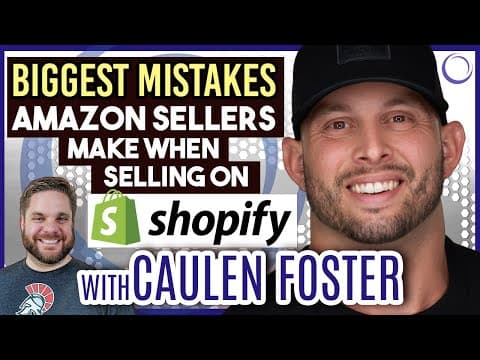
Top 5 Mistakes Amazon Sellers Make Selling on Shopify | Caulen Foster | Oracles of Ecomm
Private Label Legion - Tim Jordan
25m 2s4,377 words~22 min read
YouTube auto captions
Transcript source
YouTube auto captions
This transcript was extracted from YouTube's auto-generated caption track. The transcript below is server-rendered so it can be read, searched, cited, and shared without opening the original YouTube player.
Pull quotes
[0:07]Hey everybody, Timbo Jordan here with another Oracle's video where we bring in really smart people to try to teach you something.
[0:07]One of the biggest conversation pieces, one of the hottest topics that people talk about as Amazon sellers or e-commerce marketplace sellers, is how do we start direct to consumer.
[0:07]How do we create our own sales, have our own customers, have our own sales pipeline.
[0:07]It's fairly intuitive, it's fairly simple and you can actually have your own website, selling your own product pretty quickly.
Use this transcript
Related transcript hubs
Watch on YouTube
Share
MORE TRANSCRIPTS


