[0:00]Hey, welcome to The Explainer. Today we're diving into a really interesting new category in cybersecurity called Adversarial Exposure Validation.
[0:08]This is all based on some fresh research from Gartner and we're going to break down what it is and, you know, why you should actually care about it.
[0:15]So, let's just start with this scenario. Picture yourself as a security leader.
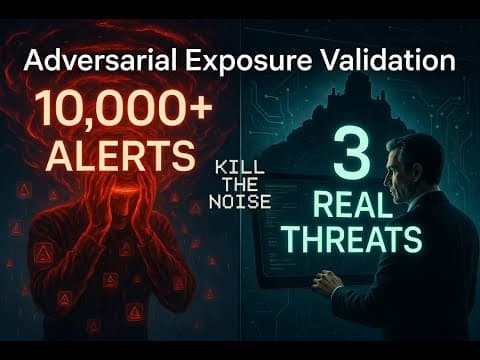
[0:19]It's Monday morning, you grab your coffee, you look at your dashboard, and it's screaming at you with 10,000 different alerts.
[0:26]And honestly, for a lot of security teams, that's not even an exaggeration. The biggest problem they're dealing with day in and day out is this vulnerability overload.
[0:35]So the real question is, in that giant sea of noise, how in the world do you find the one alert that's a real emergency?
[0:41]I want you to think about your company's entire digital setup like it's a giant fortress.
[0:47]Now, your vulnerability scanners, they're like these inspectors running around pointing out every single little crack they can find. So you get this massive report with thousands of them.
[0:56]But here's the catch. You have no way of knowing which cracks are just cosmetic. You know, a little chip in the paint.
[1:01]And which ones are actual structural weaknesses that an attacker could use to bring the whole wall tumbling down.
[1:06]And that really gets at this fundamental shift that's happening. The old way, what we've been doing for years, was basically just drowning in theoretical alerts.
[1:15]It was a numbers game, right? You get these huge, unmanageable lists of potential problems.
[1:20]The new way, though, is about getting a short, focused list of proven threats.
[1:25]We're talking about only the exposures that have been validated as actually exploitable in your unique environment.
[1:31]So, what is the solution to this whole fortress problem? Well, according to Gartner, it has a name: Adversarial Exposure Validation, or AEV for short.
[1:40]Now, the formal definition is right there, but what does that actually mean in plain English?
[1:46]Just think of AEV as having a friendly automated team of hackers working for you 24/7.
[1:50]They are constantly and safely simulating real world attacks. And the whole point is to give you hard evidence, not just theory, about which of those cracks in your fortress are actually dangerous.
[2:00]Now, this idea didn't just pop up out of nowhere. It's really been an evolution. You can see on this timeline, the journey kind of started back in 2017 with something called breach and attack simulation, or BAS.
[2:12]Then, by 2021, we started seeing more automated penetration testing tools. And now, in 2024, Gartner is saying that AEV is where these worlds converge, taking the best of both and creating a whole new unified market category.
[2:26]Okay, so we know what AEV is, but what is it actually do for you?
[2:30]Gartner breaks it down really nicely into three core jobs.
[2:35]And this framework from Gartner, it just lays out the value so clearly.
[2:40]You can see the three key use cases right there. You've got optimizing your defense, improving your exposure awareness, and scaling your offensive testing.
[2:49]So let's just quickly break down what each of those means.
[2:52]All right, first up, job number one, AEV is all about making your defenses stronger.
[2:59]This one is for the blue team. Those are the folks inside your company who are responsible for actually defending the fortress every day.
[3:06]Look, here's the thing. Companies spend millions, sometimes tens of millions on security tools.
[3:10]But how do you really know if they're configured right and actually working? Well, AEV continuously puts them to the test.
[3:16]It's like a constant quality control check for your entire security setup. It can tell you, hey, that expensive firewall is misconfigured.
[3:26]Or your detection software completely missed this simulated attack. It can even give you performance scorecards on your security vendors. It's all about proof.
[3:33]Okay, job number two. This one gets right back to that initial problem we talked about, finding the signal in all that noise.
[3:40]It's all about helping you prioritize which exposures, which cracks in the wall, to fix first.
[3:46]And this is where AEV can completely change the game for a security team.
[3:50]Before, your team might spend all of Monday morning arguing about which of the 50 critical vulnerabilities they should patch first.
[3:57]After AEV, you walk in and the system tells you, here are the three validated attack paths that lead directly to your customer database.
[4:05]Suddenly, the debate is over, the guesswork is gone. You have a proven to-do list and you can get to work on what really matters.
[4:10]And finally, we have job number three. This is all about empowering your own offensive security team, often called the red team.
[4:18]You know, these are the internal good guy hackers that you hire to think just like the enemy.
[4:23]For these highly skilled teams, AAV acts as a massive force multiplier. It automates all the routine, boring, time-consuming parts of their job.
[4:32]This frees them up to focus on what they do best, thinking creatively and designing complex custom attack scenarios.
[4:39]It lets a really small team scale their efforts across the entire company and have a much, much bigger impact than they ever could manually.
[4:47]So AEV is clearly a powerful idea. But is it just some niche technology for a few advanced companies?
[4:54]Well, Gartner's saying no. The market is definitely shifting in a big way. Let's take a look at the numbers.
[4:59]This right here is the key statistic. Gartner is predicting that by 2027, a full 40%, that's nearly half of organizations will have adopted some kind of formal exposure validation.
[5:14]So this isn't some tiny trend for early adopters. This is quickly becoming a mainstream, absolutely essential part of any modern security program.
[5:20]And why is it growing so fast? Well, it's because as this quote from the report points out, AEV provides answers to the really big questions that leaders and executives have.
[5:30]Is all that money we're spending on security tools actually working? Is our team performing effectively? And the big one, what is our real level of risk?
[5:38]AEV gives you the hard data to finally answer those questions with confidence.
[5:43]Okay, this all sounds great in theory, but how does an organization actually get started with this?
[5:49]Well, Gartner has some really clear practical advice on that.
[5:52]They basically recommend a simple crawl, walk, run approach. So, step one, define your goal.
[5:58]Pick one of those three jobs we talked about earlier. Don't try to do everything at once. Step two, if you're not sure where to begin, they say to start with optimizing your defenses.
[6:05]It's usually the easiest way to show a quick win and prove the value. And step three, build your business case with provable data.
[6:13]Show exactly how AEV is going to improve your security vendor performance or make your internal team way more efficient.
[6:19]And that really brings us to the final and I think most important question. In a world that's just filled with overwhelming alerts and nonstop threats,
[6:27]Adversarial exposure validation is pushing this entire industry to ask a very simple question: Is our security strategy based on a long list of theories, or is it based on hard, undeniable proof?