[0:00]So, good morning. I hope you are doing well. We're going to start with 1.2, which that section's on something called place value. We'll review what the place value is. I'm going to kind of explain to you how it relates to addition, subtraction, and that's what we're going in section 1.3. So if you're taking notes, take some notes. Hopefully you're taking notes.
[0:33]So 1.2 and we are talking about place value. Firstly, before we get into that, there's some things that we really should know about place value and and some of the underlying things that you learn in like your math 91 class, or your math 90 class. Those things I'm expecting you to know are things like a a number line. Are we all familiar with the number line? Raise your hand if you're familiar with the number line. Know how to plot numbers on that. So I'm expecting we know how to make one of these things, starting at zero for right now and put numbers on this number line. So if we're listing this out, of course, numbers get bigger as we go to the right, and we can put whole numbers on a number line. You guys feel okay with that? Little head nod, if you do. Okay, good deal. Um also, I'm going to expect you to be able to put numbers in order from smallest to largest or largest to smallest. That's something that we need to be able to do right off the get-go here. And lastly, uhm how to plot numbers between here using fractions, which we'll we'll go into more detail later on in our course. So those are some ideas that I need you to have down before we get started. What we're going to start with is actually our place value. So we'll start with a big number here.
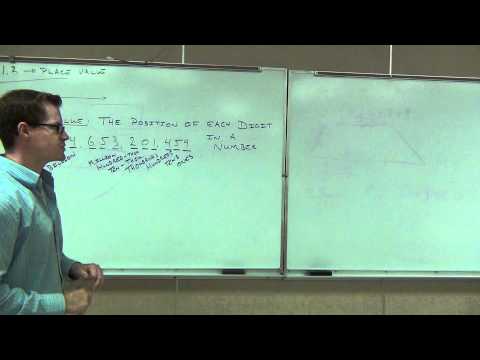
[2:11]Is that a big number? It's big. It's how much money you wish you had? It's how much money I wish I had. I'd probably I think I'd probably be teaching all still. I think I would. That's the honorable thing to do, right? Nobody said it. But that's a tremendous amount of money if we're talking about money. What we know about money or numbers or any other type of number that we're talking about is every single number has what's called a place value associated with it. Every one of these numbers, these digits has what's called a place value. What we mean by a place value, I'm going to write it right here.
[2:48]Is simply the position of each digit in a number. That's the definition. That's like a textbook definition for it. What it really means is the value of this digit or the value of this digit. So I'll say the position of each digit in a number, but we need to know it as, oh, that's a number of tens I have, or the number of thousands. That's what we'll get into in just a second. So the position of each digit in a number.
[3:34]So we got a whole lot of place values going on here. Can you tell me if this is a whole number, what's the very first place value that we deal with? One. Yeah, so we got some ones going on. How many ones do we have in this case? Nine. Yeah, this number says there are nine ones. So here our very first place value is our ones.
[4:06]So we move one over, what's the next place value to the left of the ones? What do we have there? Tens. Yeah, okay. Tens, that's great. Says we have five tens here. How much is five tens? 50. That's why we say 59. That's the way this thing works. What's the next place value? What do you think? Hundreds. Uh huh.
[4:31]By the way, if you're having trouble reading that in the very back, there's a lot of seats up here for you to move to, if you want. So hundreds is the next one. What's the next one to the left? What do we have there? Thousands. Great. So we have our ones. Move over, we got our tens. Then we have our hundreds. We've got our thousands. What's to the left of the thousands? 10 thousands. Great. I'm going to abbreviate 10 thou, but we mean 10 thousands. What happens if we go one more? Someone over on the my right hand side. This is this is my right, right? So somewhere over here, what's the next place value that we have? Hundreds. No. Million. You would think so, right? But we have another word for that. Every every triplet has its own little pattern. We have thousands, ten thousands, hundred thousands. Then we're going to have, this is where we all want to be, right? We all want millions.
[5:49]Millions, ten millions, hundred millions. What's the next one? Billion. It follows that pattern. Do you think it ever ends? No. Do we end at this number? I mean, this is a big this is the biggest number we can think of? Can you add more? Trillion. So we got millions. We know that one. This is going to be ten millions. This one's going to be hundred millions. This one's going to be billions.
[6:48]Which is a tremendous amount of money. If they took our national debt and we had that money somehow and they spread it between all of us, we'd be the wealthiest people in the world. It'd be insane. It's so crazy. Like a billion dollars is a drop in the bucket to a trillion. Insane amount of money. It's huge. Okay, so trillions. It doesn't end there. You could go 10 trillion, 100 trillion, quadrillion, 10 quadrillion, 100 quadrillion, quintillion, then sextillion, septillion, octillion. You keep going and going and going. It never, ever, ever ends. There's a lot of big numbers out there. But my point today in this is that every single digit in here has a specific name. It tells you how many of each place value you have, how many how many of each value you have. Here, how many thousands do we have? We have 1,000. How many 10,000s do we have? Zero. We have zero 10,000s. But we have 200,000. This right here, this is the fundamental of when we use this with expanded form, the fundamental of addition. Because when we add, we use this information. Maybe not explicitly, but I'll show you how we use it implicitly in our addition. Also we kind of need to know how to write these as words and say them appropriately. So if I gave you the number this one, could you write that out in English? Like we'll go back and forth between writing it and writing it as a number. For instance, when I'm talking about we'd say this one is 54, we'd say it 54. Yeah? Okay. How do you say this one? 678. You know, a lot of, well, no, a lot of people say 678. I'm going to kind of get you away from that because that word and that word and actually means a decimal. Oh, no. I was just wondering because I'm a bad speller. If I if I speller, let me know.
[8:58]We're not to decimals yet, but good call. So if we said 600 and 78, it would imply to someone writing that number down that would it'd be like 600 and 78 hundredths, like 600.78. We don't want to say things like that. So the only time we ever use and is if we're dealing with a decimal. Let me show you what I'm talking about. If we do this number. The appropriate way we would say that is 93, we don't say the nine first, right? We say 93. That's a weird how we say that. Well, we consider this to be one number of thousands. We have 93,000, 205. Say that with me. 93,205. Great. We're not 205 because that and would imply a decimal. We just say 205. It's going to be kind of weird to get away from that, but that's really the way people say the numbers. Let's practice, let's practice one more. We're going to do the place values for these things.
[10:20]Now, I'm going to ask you for place values first of all, make sure you really have a handle on this, okay? Don't answer right away. I want to give everyone about five seconds to think about it. So right now in your head, I want you to think about, don't say it. Think about what is this place value right there? Don't say it out loud.
[10:43]Just think about it. Do you have it down? What is that? 10 million. Very good. How about the three? Thousands. Great. Can you tell me how about this uh this six right here? 100 million. So the way we would say this, we consider this to be a triplet. We'd say 679 million because this was millions, right? 430 what? Thousand. 125. Done. Do you think you can go back and forth between saying them, writing them, and the numbers themselves? How many of you will do it? Raise your hand if you feel okay with this so far. If you don't, don't raise your hand, but if you're not raising your hand, I'm going to apply that you're you're not getting it. So let's try it one more time. How many people feel okay about saying these numbers? Good. Okay, that's great. The last thing we're going to do in this section, it's a very short section. We're going to talk about expanded form.
[12:06]Expanded form gives us really the basis for addition and subtraction. But here's what expanded form looks like.
[12:28]Here is a normal number. If I wanted to write expanded form, all you need to do in order to write expanded form is know your place values. Can you tell me what place value the four is in right now? Thousands. Great. Someone else over here, tell me what place value the eight is in. Hundreds. How about the three? 100. And how many ones do we have? Two. Okay. Here's expanded form. It says you take that information and you write this as a sum of of the number followed by the appropriate amount of zeros. Basically, if we have 4,000 you said there's there's four in the thousand spot, right? It means we have 4,000. We could write this as 4,000 plus. Then you look at the next number. You okay? What's the next digit? Well, it's 300. We have 300s, right? Let's add that on. 300. Plus, go to the next one, that's the eight. 8 tens or 80. Very good. And we have to also add on the ones, which is two. Hey, if you add all that up, do you suppose you get 4,382? Exactly right. Otherwise math doesn't make any sense. I'm going to just stop right here. But that's expanded form. It means that we can take a number and separate each individual digit as a sum of its parts. That's what it means. We had 4,000, 4,000. 300s, 300. 8 tens, well that's 80. Two ones, we got that two back there. How many people feel okay with this? That's all we mean by expanded form. You should be able to go from expanded form to our normal standard notation or standard notation to our expanded form. Just back and forth like that. That's really all we're talking about. But why it's important is because when we get into section 1.3, which we're going to do right now, this really is how we add numbers together. We look at place value by place value. We add place value by place value. It's kind of cool. It's all based on stuff that expanded form. We just don't really talk about it. Do you guys have any questions on the whole place value issue, saying the numbers or expanded form at all? Hey, we just did section 1.2. That's pretty painless, right? Only like 50 more sections to go. We're almost there. Almost there.