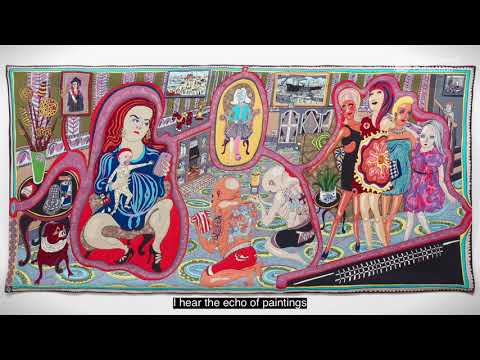
[0:13]I'm delighted to introduce you to Grayson Perry's The Vanity of Small Differences, one of the amazing exhibitions we have here at the Arts Council Collection. This exhibition consists of six large tapestries, which tell the story of Tim Rakewell, as he traverses class boundaries. He starts off in a working-class household and as he moves through middle-class and upper-class, you get to understand his experience, see the people he meets and encounter some of the objects that point to his class status. Some of you may remember the 2012 TV series, All in the Best Possible Taste, where Grayson travelled the length and breadth of the country, talking to people about their tastes and understanding of class in modern Britain. He wanted to meet people, he wanted to talk to them, he wanted to take pictures of the objects, the insides of their houses, and he took all this material and put it together into these tapestry designs. It's an interesting exploration of taste and class. He talks about the tribal nature of class in Britain today. And those tribes have objects, they have things to wear, they have things to own. It's those things that help us to understand where we might sit in relation to other people. But Grayson is also poking fun at us, because these objects are essentially very vain. They are the vanities of small differences. They're not big differences, but we use them to set ourselves apart from somebody else. For somebody who works in art galleries, who has worked with art all of my life, I love seeing people really drink them in and really take their time. And then when you see people in these spaces, you see them identify with it, because he's showing you you. He's showing you lots of elements of British life that you can identify with them because they're part of us. Every year, we continue to support British artists by buying their artwork. As part of the Arts Council Collection, Grayson Perry's tapestries will go on delighting people for generations to come. And these tapestries will stay part of a national collection, we'll care for them, we'll look after them, we'll protect them. And in hundreds of years to come, people will be looking at these tapestries to understand what life was like in Britain in the 2000s. Grayson's going to tell you more about these tapestries in the following short film. The Adoration of the Cage Fighters The scene is Tim's great-grandmother's front room. The infant Tim reaches for his mother's smartphone, his rival for her attention. She is dressed up, ready for a night out with her four friends, who have, perhaps, already been on the pre-lash. Two mixed martial arts enthusiasts present icons of tribal identity to the infant, a Sunderland AFC football shirt and a miner's lamp.
[3:06]In the manner of early Christian painting, Tim appears a second time in the work, on the stairs as a four-year-old, facing another evening alone in front of the screen. Although this series of images developed very organically, with little consistent method, the religious reference was here from the start. I hear the echo of paintings such as Andrea Mantegna's Adoration of the Shepherds of 1450.
[3:40]The Agony in the Car Park. This image is a distant relative of Giovanni Bellini's The Agony in the Garden, c.1465. The scene is a hill outside Sunderland. In the distance, the Stadium of Light. The central figure, Tim's stepfather, a club singer, hints at Matthias Grünewald's Isenheim Altarpiece. A child-like shipyard crane stands in for the crucifix, with Tim's mother as Mary, once again in the throes of an earthly passion. Tim, in grammar school uniform, blocks his ears, squirming in embarrassment. A computer magazine sticks out of his bag, betraying his early enthusiasm for software. To the left, a younger Tim plays happily with his step-grandfather outside his pigeon cree on the allotments. To the right, young men with their customised cars gather in the car park of Heppies Social Club. Mrs T and a call centre manager await a new recruit into the middle class.
[5:01]The Expulsion from No.8 Eden Close Tim is at university, studying computer science and is going steady with a nice girl from Tunbridge Wells. To the left, we see Tim's mother and stepfather, who now live on a private development and own a luxury car. She hoovers the Astroturf lawn. He returns from a game of golf. There has been an argument, and Tim and his girlfriend are leaving. They pass through a rainbow while Jamie Oliver, the god of social mobility, looks down. They are guilty of a sin. Just like Adam and Eve in Masaccio's The Expulsion from the Garden of Eden, c.1425. To the right, a dinner party is just starting. Tim's girlfriend's parents and fellow guests toast the new arrival.
[5:59]The Annunciation of the Virgin Deal Tim is relaxing with his family in the kitchen of his large, rural second home. His business partner just told him that he is now an extremely wealthy man, as they have just sold their software business to Richard Branson. On the table is a still life demonstrating the cultural bounty of his affluent lifestyle. To the left, his parents-in-law read and his elder child plays on the rug. To the right, Tim dangles his baby while his wife tweets. This image includes reference to three different paintings of the Annunciation. By Carlo Crivelli, the vegetables. Matthias Grünewald, his colleague's expression. and Robert Campin, the jug of lilies. The convex mirror and discarded shoes are reminders of that great pictorial display of wealth and status, The Arnolfini Portrait of 1434 by Jan van Eyck.
[7:22]The Upper Class at Bay, or An Endangered Species Brought Down.
[7:29]Tim Rakewell and his wife are now in their late 40s and their children are grown. They stroll, like Mr and Mrs Andrews in Thomas Gainsborough's famous portrait of the landed gentry, in the grounds of their mansion in the Cotswolds. They are new money, they can never become upper class in their lifetime. In the light of a sunset, they watch the old aristocratic stag with its tattered tweed hide being hunted down by the dogs of tax. social change, upkeep and fuel bills. The old land-owning breed is dying out. Tim has his own problems. As a fat cat, he has attracted the ire of an Occupy-style protest movement who camp outside his house.
[8:43]#Lamentation The scene is the aftermath of a car accident at an intersection near a retail park. Tim lies dead in the arms of a stranger. His glamorous second wife stands stunned and blood-stained amid the wreckage of his Ferrari. To the right, paramedics prepare to remove his body. To the left, police and firemen record and clear the crash scene. Onlookers take photos with their camera phones to upload to the internet. His dog lays dead. The contents of his wife's expensive handbag spill out over a copy of Hello! Magazine that features her and Tim on the cover. At the bottom of Roger van der Weyden's Lamentation of 1441, the painting that inspired this image, is a skull. I have substituted it with a smashed smartphone. This scene also echoes the final painting of Hogarth's A Rake's Progress, where Tom Rakewell dies naked in the madhouse.