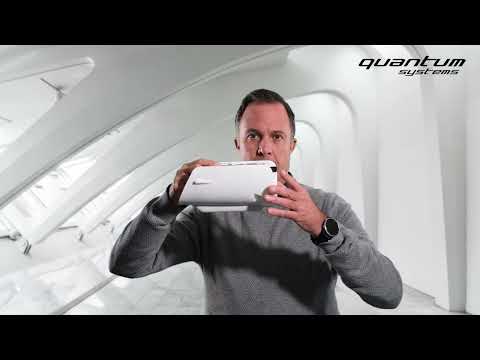
[0:09]How long does it take until the Qube 240 LIDAR is ready to fly? When I have two payloads and want to switch to the Qube 240 LIDAR, which tools are needed? Well, that's easy. All our payloads are swappable without any tools. You just remove the payload with what press of one button and then you slide the new payload in. And actually you are ready to fly after you mission is uploaded. You press the single button and the lidar will start operating and you are done. How does the Qube 240 LIDAR compare to satellite imagery?
[0:47]Well, satellite imagery is a complete different thing. Looking at the earth from space is a complete different resolution and the lidar, our lidar, the Qube 240 is measuring in 3D. That means we are measuring elevation. Most of the satellites are just doing auto images like multispectral images or panchromatic images. And there are only a few methods to measure the elevation of the earth. One is the radar, the so-called radar technology which is an active satellite. And we all know the SRTM data, which is a very old data set which shows the Earth in 3D and we actually use this 3D data for flight planning. The second way measuring the Earth from satellite is stereo images from satellites. But again, this is complete different kind of accuracy. We are looking at meters, while here with the lidar, with the Qube 240, we are looking at a centimeter accuracy. 2 cm, 3 cm accuracy. That's the main difference. Is the Qube 240 LIDAR powered from the Trinity or does it have its own battery? What is the maximum scanning time? Well, the lidar does not use its own battery. It's powered by the Trinity, by the flight battery. And once the payload is plugged in, it's powered by the Trinity and it will operate for one hour. This is approximately 350 hectare. Right after landing, you can swap batteries and you are ready to go and can do the second mission. It's super easy. From the Qube 240 LIDAR user manual, what does it mean by "insert the calibration figure before and after the mission"? Well, the calibration figure is a method to calibrate the IMU of the lidar. So, the lidar is not only using a lidar, it's also using an IMU, a very precise inertial measurement unit. And this is necessary to measure the roll pitch and your angle of the lidar in the air. All IMUs do require a basic calibration before the mission. That means in our Qbase software, we enter a calibration pattern. And this calibration pattern lets the aircraft fly a couple of U-turns and these U-turns are calibrating the lidar so that we can achieve the maximum accuracy of about 2 1/2 cm. How do you ensure that the LIDAR strips are matching to each other for each different day?
[3:27]The single stripes of a lidar mission match together, but also a mission from one day and a mission from a second day will match together. This is because we are using PPK and the PPK, it's a kind of GPS post-processing, makes sure that the data has an absolute accuracy, not only a relative accuracy, an absolute accuracy of 2.5 cm. And therefore it really doesn't matter whether we we match together a couple of stripes or a couple of missions, it's always on the same accuracy. What's the availability of the Qube 240 LIDAR unit or what is the production time once the order is placed? Well, typically all our payloads are in stock or delivered within about two weeks. The lidar is a bit special because each and every single lidar has to be calibrated in Germany. And of course, this is a bit of weather dependent, especially now in winter, it might take a bit longer. So please allow about four up to five weeks for your delivery. Does the Qube also include a RGB sensor to colorize the point cloud? Well, for the moment, we are using the RGB data of a second flight. Uh, we are flying with a second payload like the Sony UMC or the Sony RX1 camera for a second flight. Usually in a higher altitude, a very quick flight, we calculate or we process an auto image, an auto mosaic, and we are using this auto mosaic to colorize the point cloud. Well, but you never know. Our engineers are always working on nice ideas and you never know, maybe something will come up soon. Why should I use the Qube 240 LIDAR instead of the Sony RX1 RGB Camera? Actually, there are three reasons why you might want to use the lidar instead of photometry. One is you can penetrate the vegetation. So, for example, we use the lidar the lidar in Ghana in the tropical rain forest, also in the Amazon region in Peru. And we've been able to capture the complete terrain data through the tropical vegetation. But also you can use it at night and there are a couple of reasons why you might want to survey your data at night. One is you can have more flight hours per day if you are not only operating the lidar during daytime. But even more important, there are areas with high wind speeds during the day or high temperatures during the day and you want to use the night time to have calm air for flying.
[6:12]It's a very important very important reason to use a lidar. And then last not least, the data processing is a complete different story. Data processing of photometry data, one hour flight time, 10 hours of processing, one hour of lidar scanning, 20 minutes of processing.
[6:36]How much area can be surveyed with one Trinity F90+ and one Qube 240 LIDAR per flight and per day? You can actually capture about 350 hectare per hour. That means about 4,000 hectare a day, but remember what I said previously, you can operate the lidar at night. That means you can scan 24 hours if you wish and do about 10,000 hectare a day. What is the difference between the Qube 240 LIDAR and other LIDAR solutions?
[7:11]The main difference is the IMU. This Qube 240 is using a survey grade, expensive IMU and a Plex APX 15. And therefore we can guarantee a very high absolute accuracy. Of course, there are other lidar sensors, um, don't want to name it here, but these sensors with the same specs are much heavier. And you need a different kind of UAV. You need a very large, very heavy aircraft. You need a manned aviation aircraft or helicopter or you need a very heavy multi-rotor drone which is limited in flight time. So, most of the sensors I've seen so far are about 2 kg up to 4 kg and the maximum scanning time is 20 minutes. And therefore, only you can only use them for very small areas, while this Qube 240 can do large scale mapping, survey grade large scale mapping. And that's that's unique. Well, that's it for now. 10 questions, 10 answers, and I'm happy to read more questions. Just write your comments below the video and I'm ready to answer all your question with the next video. Thank you very much.


