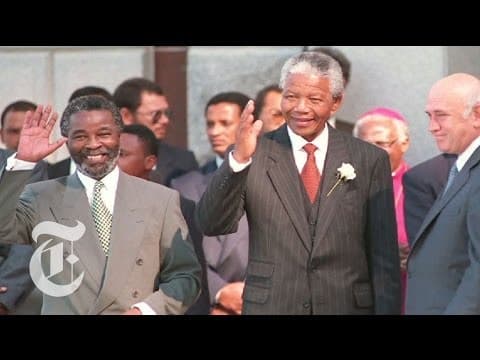
[0:04]When a man has done what he conceives to be his duty to his people and his country, he can rest in peace. I believe I have made that effort. And that is therefore why I will sleep for the eternity.
[0:28]Nelson Mandela, who led the emancipation of South Africa from white minority rule, and served as his country's first black president, became an international symbol of dignity and forbearance. Mr. Mandela's quest for freedom led from the court of tribal royalty, to the liberation underground, to a prison rock quarry, and finally, to the presidential suite of Africa's wealthiest country. The central goal was that South Africa would be ruled by South Africans. It was the cause of his life and he achieved it.
[1:08]Mandela first came to the world's attention while serving a life prison sentence for sabotage and conspiracy to overthrow the state. He would become the personification of opposition to South Africa's brutal apartheid regime. Apartheid was a system that was set up by the National Party government, an extremely formal race-based division of the country. Apartheid literally in the Africans language means aparttness, and it means that the races were not meant to live together. In the early 1960s, Mandela led the ANC, the African National Congress, on a road of armed insurrection against the apartheid regime. It would lead to his eventual arrest on charges of conspiracy to overthrow the state. Mandela's legend grew when he arrived at his trial wearing traditional Kosa leopard skin garb to underscore that he was an African entering a white man's jurisdiction. Mandela's courtroom speech was one of the most eloquent of his life. I have cherished the ideal of a democratic and free society in which all persons will live together in harmony and with equal opportunities. It is an ideal for which I hope to live for, but my Lord, if it need be, it is an ideal for which I am prepared to die. The South African government of Prime Minister Hendrick Verwot was under pressure from liberals at home and abroad to spare the defendants. Nevertheless, the judge sentenced them to life in prison. The sentence in the case of all the accused will be one of life imprisonment. As you learned, the court will be in adjourn. Nelson Mandela was 44 when he was sentenced to hard labor at South Africa's notorious Robben Island Prison. They were placed in small cells. They did manual labor. They walked off every day to this these limestone quarries where they smashed up limestone that would be used to build highways, roads. Under the National Party's rule, ethnic clashes and violence were rampant. In Mandela's view, by the mid-80s, the enemy was already morally and politically defeated. His strategy, he said, was to give the white rulers every chance to retreat in an orderly way. Mr. Mandela's decision to begin direct and secret negotiations with the white government was one of the most momentous of his life. He made it without consulting his comrades in the African National Congress, knowing full well they would resist. He was released from prison in 1990, at the age of 71. Bill Keller was the New York Times South Africa bureau chief, from 1992 to 1995. It was clearly an electrifying moment. You know, again, it was a symbolic moment because a lot of the important stuff had already happened before then. He'd been negotiating for literally for years, um, the terms of a deal that would, um, legalize the opposition parties, uh, and, and begin the process of, of democratizing South Africa. But that was the moment when I think, you know, it's in everybody's minds. They just said, oh my God, it's real. I stand here before you not as a prophet, but as a humble servant.
[4:36]The South Africa that he walked out into was kind of a mess. I mean, it was the campaign against apartheid had set itself a goal of making the country ungovernable, uh, and to some extent they succeeded. The townships were, uh, erupting in violence and everybody sort of knew that the established order was beginning to crumble, but nobody knew quite what was going to succeed it. So people were very, very anxious. Two years after Mandela's release from prison, black and white leaders began negotiations that would lead to the end of white rule. All the while, extremists, black and white, continued to use violence to tilt the outcome their way, as Mr. Mandela and the white president FW de Klerk argued and maneuvered towards a peaceful transfer of power. The key to the deal was the decision on the part of the ANC that they would share power. Uh, for the initial stages of a new democracy. And that the, uh, president would have two deputy presidents from other, other parties who would participate in the, in the governance of the country. Having established this Constitution, they then had to prepare for something that South Africa had never seen, which was a an honest-to-God election campaign in which most Africans got to participate. It was an amazing spectacle. He campaigned in white neighborhoods, too, and went to white events. But, but the just the unforgettable thing was to be in one of these small soccer stadiums in the, in an African Township, people sitting up on the tin roof, and then you sort of see this dusty trail of cars approaching, and they'd arrive in the middle of the soccer field and Mandela would get out and the place would just erupt. And it was, you know, profoundly moving, I have, I have to say, you know, again, elections are just the starting point of democracy, but there is something about watching people get this privilege who've been denied it for a long time, that it, that, you know, you can't help but be moved. The African National Congress won 62% of the vote, earning 252 of the 400 seats in Parliament, and ensuring that Mr. Mandela, as party leader, would be named president when the Parliament convened. He had a cabinet that was consisted of some of the people who had been his arch enemies. He didn't much like either of his deputy presidents, uh, Thabo Mbeki who succeeded him was not Mandela's choice to be his successor. And FW de Klerk, who shared a Nobel Prize with Mandela, um, the two of them had a relationship that kind of seemed to veer between tolerance and loathing. While Mandela disliked and blamed de Klerk for much of the trouble in South Africa, he did praise him for having the foresight to see the reality of the situation and for having the courage to face it. Many whites ended up despising de Klerk as a sellout.
[7:42]His presidency was about inventing South Africa. Mandela realized that in order to, to govern this country, he had to win over some significant percentage of the whites. He had to at least reassure them that there was a place for them, that it was their government too. And the vehicle that he chose for doing that was was rugby. And rugby had been historically the Afrikaner sport, the white sport. Uh, blacks didn't play rugby much and in their eye it had become kind of the, a symbol of the oppressor's, um, culture. So Mandela took it upon himself to embrace the Springbox, the national rugby team. South Africa hosted the 1995 Rugby World Cup, and their national team was the Cinderella story of the tournament. They defeated New Zealand, 15-12 in the finals. Mandela came out to, uh, present the trophy, and you had the stadium full of white, mostly white Afrikaners, uh, the former ruling race, chanting Mandela's name. His being there sent a message to white South Africans, uh, and their reaction to him sent a message to black South Africans. It was a singular moment. The dimensions and the effects of poverty are all too familiar. Hunger. Having delivered the miracle of South Africa's freedom, it was perhaps too much to expect Mr. Mandela to deliver a second miracle of broad prosperity. He came into office promising a lot in terms of economic advancement. Uh, they didn't deliver on those promises. They were probably unrealistic to some degree. You know, the trade-off was that they were not going to confiscate the wealth from whites, and, uh, they weren't going to confiscate the land from white land owners. Today there's some debate in South Africa over whether or not they should have been more aggressive in, in doing that. The other side of that argument is look at Zimbabwe where they did confiscate everything and destroyed their economic infrastructure in the process. You know, he fell short in a number of ways. For one thing, it was becoming clear at that point that the South Africa had a devastating AIDS problem. It didn't get the attention that it really needed under Mandela's regime and so he he has to be faulted for that. Later in life, Mandela spoke out about the need for safe sex and cheaper antiretroviral drugs. In 2005, he would share publicly that his eldest son had died of AIDS. One of the most important things he did as president was step down, which is not a usual thing in new democracies. When Mandela left the presidency in 1999, Thabo Mbeki, who was not his pick for successor, took over. Post-presidency, he kept a very low profile, uh, especially domestically. His successor was resentful whenever Mandela would speak out on any of anything political, and so out of respect for Thabo Mbeki and for the party, he only spoke out on on things that he really cared about, like the AIDS issue. As a former president, Mr. Mandela lent his charisma to a variety of African causes, joining peace talks to end several conflicts and helping his third wife Grasu raise money for Children's Aid organization. You know, people talk about Jimmy Carter being a better ex-president than a president. I, I'm Mandela in a funny way sort of the reverse. He, he did his most important work before he was president. I think Nelson Mandela will be remembered first and foremost for his courage and dignity and persistence. I think he deserves to be remembered as a man who made a free South Africa possible and who did it by behaving not like a revolutionary, but like a politician, by sheer patient, discipline, compromise, and negotiations.


