[0:02]Welcome back mathematicians, Justin here. I've got something very exciting to show you. Come with me. The scientists and engineers over at the Mia Plaza Space Center
[0:29]Uh oh. Uh um It seems that the launch failed due to a miscommunication in calculations among the space exploration team. They must not have used the order of operations. Solving mathematical problems in the wrong order can have some serious consequences. Good thing we're practicing our order of operations today. By the end of this lesson, you'll be able to apply the order of operations to simplify complex expressions. And explain your reasoning behind the steps performed while solving. Have your guided notes ready and let's dive in.
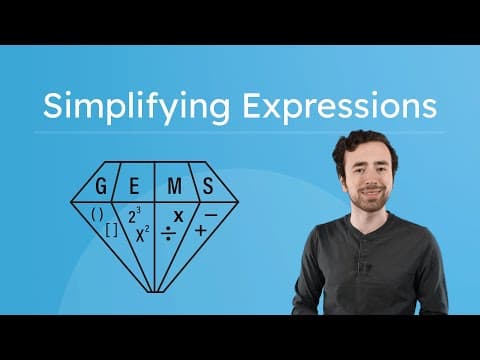
[1:20]Let's begin with a review of what we've learned in our last lesson. In our most recent lesson, you learned that operations are actions that we perform in math, like grouping symbols, exponents, multiplication, division, subtraction, and addition. The order of operations is the sequence in which mathematical operations should be performed. When solving a complex problem, start with the grouping symbols like parentheses or brackets, followed by simplifying the exponents, then tackling the multiplication and division, and finally, handling any remaining subtraction and addition. To help us remember this order, we use GEMS. Ready to put our knowledge to the test? Have those guided notes handy, and let's go.
[2:11]In math, the term simplify means to change a complex expression into a more simple form. So let's simplify the expression 3 squared times the quantity of 2 + 1 - 8. Whenever we read expressions with grouping symbols, we use terms like quantity or the result of to emphasize that the groupings should be performed first. Following GEMS in the order of operations, we should always start by looking for groupings like this one. 2 + 1 = 3, so we'll record 3 right underneath that section of the expression. Be sure to bring down the rest of the unsolved pieces in the order they appear in the expression. Now we're ready to move on to the next operation in GEMS: exponents. Does this expression have any exponents? Yes, right here. 3 squared or 3 to the power of 2 is the same thing as 3 x 3, which equals 9, so we can record that right below the spot where the exponent was in the expression and bring down everything else. According to GEMS, multiplication and division come next. They're inverse operations or opposites, so they are ranked equally in GEMS. Whenever we approach multiplication or division in a problem, we work from left to right solving whatever comes first. There isn't any division in this example, so we just need to take care of this multiplication right here. 9 x 3 = 27. Bring down that last part of the expression and we're ready for the last level of the order of operations, subtraction and addition. Subtract 27 - 8, and that equals 19, simply simplified. Let's try another one. This time we'll simplify the expression, the quantity of 15 + 5 divided by the quantity of 2 + 2 cubed. Following GEMS, we start by looking for groupings. Interesting. This problem has two sets of groupings. Whenever we're faced with more than one case of groupings, we work from left to right solving whichever grouping comes first. This same concept applies to exponents. We ever come across a problem with more than one grouping or more than one exponent, just work from left to right until you're ready to move on to the next step in GEMS. So, we start by adding 15 + 5, which equals 20. Bring down the rest of the expression, and now we're ready to tackle that second grouping, 2 + 2 cubed. Notice how there are two operations within this set of parentheses: addition and an exponent. Exponents come before addition in GEMS, so we'll start by solving 2 cubed or 2 to the power of 3. 2 cubed means 2 x 2 x 2. 2 x 2 = 4, and times 2 again = 8. Next we're going to add 2 + 8, and that gives us 10. Bring down this first part of the expression and we're left with 20 divided by 10, which equals 2. We've reached our final answer. You're getting pretty good at this. Ready to try a little challenge? For our next problem, we need to simplify the expression, 7 + 3 times the quantity of 10 - 1 all + 2 all within parentheses. How fascinating. There's two different kinds of grouping symbols in this problem, and the brackets are inside the parentheses. This is a fun one, mathematicians. Take a moment to make a prediction about how you think we should approach this problem. Feel free to pause the video while you think. Whenever you come across a case of groupings inside another grouping, you should always work on the innermost set first, and then work outward. In this case, we have a set of brackets within the parentheses, so we'll first tackle what's inside the brackets. Inside the brackets, we have 10 - 1, which equals 9, so we'll record 9 right underneath that section of the expression and then bring down the rest of the unsolved pieces. Do you think you could solve the rest of this problem by yourself? Pause the video here and we'll check your work when you're done.
[6:53]Remaining inside the parentheses is 9 + 2, equals 11. Bring down the rest and we're left with 7 + 3 x 11. According to GEMS, multiplication should be performed before addition. 3 x 11 = 33. 7 + 33 = 40. Great job! We've got one more practice problem and I think you're ready to try this one all by yourself. The final problem we have is to simplify the expression, 4 squared minus the quantity of 3 + 3 divided by 2 + 7. I challenge you to think through why you're doing each step as you solve it. Imagine you're explaining the steps of this problem to a friend or a sibling. Pause the video here, and solve.
[7:48]We start with the parentheses. 3 + 3 = 6. Bring down any unsolved parts. Next up, exponents. We have one exponent here, 4 squared. equals 16. Bring down the rest of the problem and we're ready to move on to multiplication and division. 6 divided by 2 equals 3. Now we're left with subtraction and addition. Subtraction and addition are ranked equally in GEMS, so we need to work from left to right solving whatever comes first. 16 - 3 = 13, and 13 + 7 = 20. And there's our final answer.
[8:33]Great work today, mathematicians. You now know how to apply the order of operations to simplify complex expressions. We also practiced explaining our reasoning behind each step performed. Now that you know how to use the order of operations, let's see if we can help out their space engineers. You are not going to believe this, I just bumped into the lead engineer. Turns out they did follow the order of operations and their calculations were correct, they just forgot to fuel the rocket. I'm going to help them fuel up. Meanwhile, be sure to complete the practice questions and the extension activities that go along with this lesson. See you right back here next time.


