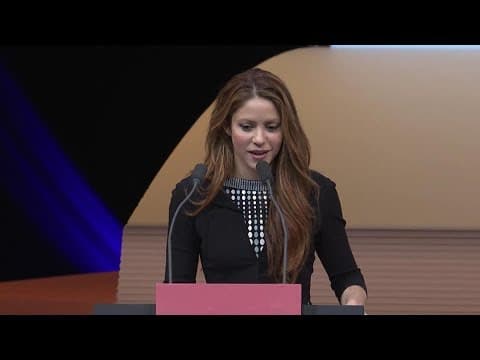
[1:35]As a wise community, we all know that education is not only a matter of political policies and agendas. Sometimes all it takes is just one individual to make a difference. Some of the greatest changes and social movements of our time were in fact initiated by individuals who felt compassion, who felt courage and dedication to bring about change in the lives of those who need it the most. And we have the privilege of having one such individual among us this morning. She has used her incredible global influence and talent to help the cause of education in her native Colombia. She is the founder of Fundacion Pies Descalzos, the Barefoot Foundation. She I got that right. which provides access to quality education for displaced and under privilege children in Colombia. Ladies and gentlemen, please join me in welcoming UNICEF Goodwill Ambassador and Grammy Award-winning artist, Shakira Mubarak.
[2:50]Thank you.
[2:55]Shukran. Good morning. Your Highness, excellencies, friends and colleagues. I would like to thank you for the opportunity to be here today. It's also an honor to join forces with educated child, an organization led by a woman who is an amazing role model, a woman who has shown such relentless dedication to getting every child in school. This is such an exciting day for us because it marks the beginning of a new era in my home country Colombia. Most of you may know me as an artist, as an entertainer, and uh that's indeed my calling and what I've been doing since I was 13 years old. But I never would have imagined when I started out that my work as an artist would end up being the vehicle for me to serve my greater purpose in life, of working towards eradicating poverty through the power of education. As a Colombian citizen, inequality is a concept that sadly one becomes very familiar with at a very young age. It's a country like many others in Latin America, where a few have a lot, a lot have almost nothing, and where if you're born poor, you will almost certainly died poor. And where people don't access equal opportunities, and because of that, generation after generation, after generation, live trapped in the same vicious cycle fed by prejudice and inaction. Growing up in my country, when I was around eight years old, I remember I saw kids my age, who instead of being in school, were already working in the streets, were barefoot in the park, kids like me, whose reality was completely different than mine, only because of the circumstances into which they were born. It was really hard for me to accept that, to accept that something so unjust didn't have a solution. There had to be something that could be done. So I often asked myself, why the adults around me were so resigned to the fact that these kids who were just like me, or even their own children, were living in a parallel reality so different and so cruel? As Koffi Anan put it, poverty is intolerable in a world of plenty. So as soon as I had some success, the first thing I wanted to do, um, was to invest as many resources as I could into what later would become the most meaningful project of my life, working for children. So, I set out to find a team, a team of people who dreamed big, and worked hard, and thought like me to help me write the wrongs that I had witnessed throughout my entire childhood. And that's when our foundation, the Barefoot Foundation, Piestas Descalzos Foundation, was born. I knew, and I was only 18 years old then, but I knew that I wanted to focus on children and improving their lives. But I didn't know where to start.
[6:34]So I, I really, I felt that I needed to learn what the roots of inequality and low social mobility were. So I decided to study the reasons why children were working in the streets, or why some children were being recruited by the violent organizations like the paramilitary or the gorillas, why were so many children suffering from chronic malnutrition? And I realized that most of the issues that children face in my country had and have a common denominator, the lack of access to quality education. To me, it became crystal clear that education was the surest way to give all these kids the best fighting chance of improving their circumstances in life, because education is the great equalizer. When I started building schools in Colombia, we chose the most remote areas, areas where there was literally nothing. No infrastructure, no paved roads, no electricity, no portable water, and we decided to build in those places, but not only built schools, but state-of-the-art schools. Schools with comprehensive models that included ECD programs, school feeding programs, parent and teacher training, and another very important part, we decided to engage the government as a strategic partner, and made it nearly impossible for them to say no to doing their part by showing them results through our holistic model that really proved to work.
[8:19]We noticed that as soon as a school is built in those places, everything is transformed. The improvements to the infrastructure were jaw-dropping. Electricity, portable water, were made available, were made accessible, roads were paved, malnutrition plummeted, but the best part of all is the academic results. The kids really, really responded academically, and now those kids who could have been recruited by the by the guerrillas or paramilitaries, or that could have had a completely different outcomes for their lives, they're now on the way to the university and thriving in their communities. Some of them are athletes, some of them are professionals.
[9:14]That's why I'm so, it really is a thrill to work for education. That's why I'm so passionate about it, because I've really seen results that are as palpable as this podium. And seeing all these success stories that have a name and a last name has been the one of the most rewarding things I've done in my lifetime. Even, even more so than winning Grammys I think.
[9:54]Now, that said, our work is far from being done. Many, many developing countries are still right with inequality and internal conflict, and there are a lot of kids who still need to be reached. History is not only the past. History, it's made every day in the present, and what matters now is how we go forward and how we fix what's wrong. And that is the real challenge. This is the goal of the SDGs and what people like her Highness and myself and so many more of you who are adamant about achieving our here for. Facts don't lie. Numbers show what an incredible return on investment a quality education provides. For instance, if all students in low income countries left primary school with basic reading skills, 171 million people could be lifted out of poverty. Systemic change often begins from the bottom up rather than the top down. The government must take responsibility, and we should all put as much pressure as we possibly can, but the rest of all, the civil society should also do their part. What we have discovered, both at Piascalzas and educated child is that many times only one single barrier to entry, such as no access to transportation, or basic needs like a functioning bathroom, can prevent a kid from attending school or even put them at risk of dropping out. Sometimes all it takes to change a child's life is the security of a hot meal in school, or the ease of being able to hop on a bus that will leave you safely at your classroom's door. It's as simple as that. And these are simple interventions, and they don't cost a lot.
[11:50]The biggest effort really is in mapping the communities, in going door to door searching for the out of school children, talking to the parents, talking to their families, giving a name and putting a story behind these children is the first step to start rewriting their story. Over the next three years, we pledge to get 54,000 kids who are out of school or at risk of dropout into the educational system. Ultimately, more than 295,000 people will benefit from this project, including children, teachers, families, and community members. New schools and classrooms will be built, school kids in uniforms will be distributed, children will be enrolled in school, feeding and transportation programs, teachers will be trained in strategies and in how to identify those students who are at risk so they can receive psychosocial support, and we are extremely confident that this partnership is only the beginning.
[12:59]And we'll be the model to replicate throughout my country until not a single child is out of school. This is our responsibility. Thank you.
[13:13]This is our responsibility to our children, and our debt to fulfill for the generations to come. Thank you very much.
[13:27]Thank you so much, Miss Shakira, for that impassioned speech. Thank you for speaking from the heart.


