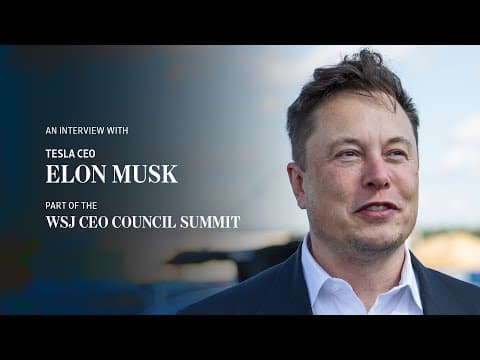
[0:01]Hi. Hi Elon, how are you? Good, how are you? Uh, pretty good, pretty good. Thank you so much for being here. Um, and by here, I mean Sure, electronically. Electronically. And where are you right now? Um, I'm at, um, I'm at the Tesla uh Giga Texas factory, um, that we're about to complete. Um, so, yeah, what you see behind me is um, the, the factory basically. Um, we have the uh office space and the factory kind of uh together. So, um, uh, I think this is kind of important that uh we don't have uh Ivory Tower management or engineering and that the management engineering is uh as close to the factory as possible. So, um, uh, yeah, so you can see what's going on in the factory and um, and stay grounded. All right, well, I'm in the Ivory Tower here in front of a lot of CEOs and a live audience here in Washington DC. And we are also joined by lots of people all over the internet. We are streaming this to www.js.com, Twitter and YouTube. So, we have a very brief amount of time, only 30 minutes, um, but I'm very excited to talk about a wide range of things. I want to start with uh talking about our world, the world we currently live in, we currently live in, then I want to move to the future of the world and then uh talk a little bit about your world. And so we'll start right here in Washington DC. where everyone is talking about the infrastructure plan and the bill and um I wanted to ask you, you say tomorrow you get a phone call from Joe Biden and he says, I think that's unlikely, but sure. You know, he he just gives you a call and he says, you know, I haven't been talking a lot about Tesla lately, but, you know, what do you, what do you need from this bill? What are your needs? What do you answer him? Um, well, I I I I totally Frank, I'm I I I don't know if we, at least no, no one at Tesla is actually brought up whether they they care about this bill or not.
[2:07]I I I think if this bill happened or didn't happen, I, I don't know. We don't think about it at all, really. Okay.
[2:18]It might be better, honestly, it might be better if the if the bill doesn't pass. Um, because we've spent so much money, uh, you know, it's like the federal budget deficit is insane. Um, you know, it's like $3 trillion Federal, uh, expenditures are 7 trillion, uh, federal revenue is 4 trillion, that's a $3 trillion uh, difference in uh, if this was a company, it would be a $3 trillion loss. So, uh, I don't know if we should be adding to that loss. That seems pretty crazy. Um, something's got to give. You can't just spend uh $3 trillion more than you own uh every year and expect uh, you know, we don't expect something bad to happen. I I think, you know, this is not good. Um, Well, we, Mr. In fact, if I may elaborate on that, the the the deficit is more than $3 trillion when you look at uh the future obligations. So it's 7 trillion of current expenditures, but the it's it's much more than that if you look at future obligations for social security, Medicare and and so forth. So we're running this incredible deficit. I I I don't know this this can't keep going. Well, Mitch McConnell said something similar, it wasn't too not as extreme as you. Um, but it just, okay, so let's say this follow-up question is, okay, Elon, you don't think we need to spend anything on the infrastructure. If he says to you, what is the biggest improvement we can make to the US infrastructure? What do you what do you what do you say?
[3:49]Um, I I think we generally could uh have better airports, better highways, um and uh, you know, I think uh that that especially in in cities that are congested, we've got to do something uh to deal with extreme traffic uh which I think is some combination of double-deck freeways um and building tunnels.
[4:18]Um, but if if we don't do something, um, we will be stuck in traffic for forever. Um, and uh as autonomous vehicle autonomous vehicles come to the four um and it's it's easier to drive without going through the pain of of having to drive yourself, which which is absolutely coming and will be one of the biggest transformations uh ever in human civilization. Um, there will be more cars on the road. Um, and the traffic will get much worse. And so we really need to do some combination of tunnels um and uh or like I said double-decking freeways. I'm not a big believer in in flying cars. They're basically helicopters with wheels. Um, and people don't want uh the the sky to be swarming with helicopters. So, um, it's it's tunnels and double-decking freeways. Um, we don't have a traffic problem in suburb, we have a traffic problem on freeways because the they were just too small and did not anticipate the size of the open environments that we're currently experience. So, um, yeah, but I I don't see a strong effort in this direction. Um, Well, I want to come back to autonomous vehicles, but, um, I want to just stay a little bit more on the role of government. You said at this conference actually a year ago that you think government should really just be hands off when it comes to innovation. Though with this bill, there is a lot of support for EVs and it could be the the biggest change that we've seen uh throughout the country in terms of the infrastructure of EVs and and it helps Tesla. What do you think the role of government should be? Um, I I think the the role of government should be that of like a referee. Um, and you know, like uh and and uh but not a player on the field. Um, so, um, I mean, generally, you know, government should I think just try to get out of the way and and not uh impede progress. I think we there's a general problem, not just in the US but in in most countries where the rules and regulations keep um increasing every year. Uh rules and regulations are immortal. They don't die. There's not a natural occasionally you see some law with a sunset provision. But, but really otherwise the vast majority of rules and regulations, uh, live forever. And so if more rules and regulations are applied every year, and it just keeps growing and growing. Eventually, uh, it just takes longer and longer and it's harder to do things. Um, and there's there's not really um an effective garbage collection system for removing rules and regulations. Um, and so the gradually the the this this hardens the arteries of civilization, um, where you're able to do less and less over time. Um, so I think government should be really trying hard to get rid of rules and regulations. Um, that perhaps had some merit at some point but uh don't have merit currently, but there's very little effort in this direction. Um, this this is a big problem. And we I also want to come back to you later. I know that you do have some other stance on sort of AI and what the the rules and regulations we should have on on on that. Um, but you're right now you're sitting in a in a Tesla factory. How are you spending your time these days uh between the split between Space X and Tesla? Um, yeah, it's it's about um even between Space X and Tesla. Um, it depends on, you know, what is the kind of crisis of the moment. Uh, so some weeks will be more Tesla, more Space X. Um, but I I work a lot. I work seven days a week and put in put in I had some pretty crazy hours. So, um, but it really depends on on where the where I'm needed most. I like basically just I I triage the tasks and um try to do the things that are most useful um or or where I'm most needed. Um, you know, and and it varies from from from one week to the next. Um, but you know, just going back to that that infrastructure bill for a second. Um, the, um, because you know, some of the criticism of Tesla is like, hey, Tesla gets all these subsidies. But it's worth noting that for the the vehicle purchase tax credit the $7500, Tesla stopped getting that like two years ago. So we've uh whereas um, uh, everyone else I think except for GM still gets the $7500 tax credit. So all of our, you know, sales this year and I think last year were uh had nothing to do with the the the the tax credit because we were no longer eligible because we'd made so many electric cars. Uh, Tesla's made roughly two-thirds of all the electric cars in the United States. Uh, you know, I'm not sure most people are aware of that. Um, so, yeah, so Tesla's made basically twice as many electric vehicles as the rest of industry combined. Um, and we don't need the $7500 tax credit. Um, I would say honestly, I would just can this whole boat. Don't pass it. That's my recommendation. What it what about what about the the support though for the charging network? I mean, there are there are parts of this bill and No. I mean, you know, do we need support for gas stations? Uh we don't. So, uh there's no there's no need for this uh for for support for charging network. I would delete it. Delete. Okay. All right. I'm literally I'm literally saying get rid of all subsidies. And if you think about also how this affects your competitors. Is that is that impact how some of your view on this?
[10:07]Um, I mean, maybe maybe they need it. I I don't know. Uh but I I think just generally, uh I'm in favor of deleting subsidies. I mean, when we start at Tesla, there were there were no EV subsidies at all and gasoline was super cheap. Uh we did not anticipate any subsidies. Uh that that came later and and that came the $7500 tax credit came as a result not of Tesla activity but of General motors lobbying for it. Um, so, you know, um, I would just say, just just delete them all. All right, but I there's some other good things in this bill that some would argue. I mean, the a lot of money ear marked for R&D. Would would you want to put that towards something? No. Okay. All right. All right, we're going to move on from the bill because I think we get what you're saying on it. Seriously, we should pass on it. In general, we we should just we if we don't cut government spending, I I something really bad's going to happen. This is crazy. Our spending is so far an excessive revenue, it's insane. Um, like you could zero out all billionaires in the country. There's almost like anti-billionaire BS. Well, uh if if you zeroed out all the billionaires, you still wouldn't solve the deficit. All right, I'll ask you another question around the billionaire BS. Say tomorrow we we've talked, you get the phone call from uh for President Biden. Next day actually, we decide we we elect you to Congress. Somehow this happens. You're now working on tax bills, you're working on tax policy. What is what is how do you tax someone like you? How do you tax billionaires? Um, I mean, first of all, I pay a lot of tax. I mean my margin tax rate is like 53%. So, that's not trivial. Um, and uh you know, and then obviously there's like, you know, uh uh asset-based taxes, the sales tax and and everything else. Um, there's also the estate tax. I I in generally I I think I think the the estate tax is is a good tax. Um, like if you think of, uh, assets beyond a certain level, um, that that are far beyond, uh, let's say somebody's ability to consume. Um, then, you know, at some point, really what you're doing is capital allocation. So, you're not, it's not money for personal expenditures. It's what you're doing is is capital allocation. And it does not make sense to take, uh, the the job of capital allocation from people who have demonstrated great skill in capital allocation and give it to, uh, you know, an entity that has demonstrated very poor skill in in capital allocation, which is the government. Uh, I mean, you can think of the government essentially, uh, as a corporation in the limit. It is it is the the government is simply the biggest corporation with a monopoly on violence. And with and where you have no recourse. So how much money do you want to give that entity? Could you explain the last part quickly and then we're I want to move on to some product stuff. Sure. I mean, I can talk for for a bit longer if you'd like then the half hour. Um, if you if you're worried about getting through other questions. Um, but I hear we have nobody else joining us at this conference. Um, yeah, I mean, government is a cooperation in the limit. So, um, if you it is the most corporate thing. It's it is maximum cooperation. Um, and it but it's also Monopoly and and also is the only one that's allowed legally to do violence. So, Um, why why would you want to give a cooperation with no competition that that can't even really go bankrupt? Um, more money. Um, I it's not as though I think the government shouldn't exist or that they're not good things that the government can do or or things that are necessary for the government to do. Um, you know, for example, a, um, you know, science programs where, uh, we we send a probe to to Mars. Um, and the value of that is it's it's sort of a it's a small amount of value for for all citizens. But it would be inefficient to sort of go and collect, you know, $10 from from every citizen for a Mars probe. Um, and so that, therefore, it's better to have the government do something like that. Um, you know, like a heavy science program, uh, rather than than try to collect small amount of money from from everyone. Um, so so I'm not somebody who who's sort of an extreme libertarian, uh, and thinks the government should not do anything. I just think we should, um, minimize what the government does because the government's efficiency at spending is is just going to be lower than, um, a, a competitive commercial company but by a lot. Um, if you look at, say, um, East Germany versus West Germany or North Korea versus South Korea and you look at the GDP per capital of East and West Germany or North and South Korea, the difference is gigantic. Um, and that's just the difference between East and West Germany or, um, you know, it's it's like a random line was drawn, uh, basically depending on where the the the red army was and and where the ally troops were. Um, and, uh, East Germany's productivity was like, uh, at least five times worse than West Germany. Um, and it's not like West Germany was like some bastion of capitalism. They were quite socialist, really. So there's there may be as much as an order of magnitude difference between a, the efficiency of of a competitive private company versus the government. I'm going to shift away from government, come back to your world. Um, just just thinking about sort of how you juggle Tesla and SpaceX. And you've said along the way that, you know, the workload at Tesla is is quite a lot. Have you, um, and and I know now you can, you could regain the the chairman position. Have you thought about that? Have you thought about that? Have you thought about, uh, your, sort of, your, your title and your and your position there right now?
[16:03]I mean, it's interesting that these these titles. Um, you know that there's there's actually only, uh, uh, three legal three titles that that actually mean anything for cooperation. Uh, it's president, secretary and treasurer. Um, and technically they could be the same person. And all these other titles are just basically made up. So CEO is a made up title, CFO is a made up title, General Council made up title, uh, don't mean anything. That's a nice I think a room of CEOs are how how do we feel about that? Yeah. Yeah, it was like, if you obviously just somebody's mocking experiment. Um, so, uh I I So I guess I'll be more direct. I mean, are you considering stepping down a CEO? Would you would you transfer be chairman and think about being Chief Product Officer? I mean since CEO title is like, I I changed my title to to Tekno King. Um, and and by the way this is a formal SC filing. It's I'm legally from whatever, Tekno King. Um, and I just did that as kind of like a joke because just just a show that that that these titles don't don't mean a lot. Um, you can see what what is actually legally necessary. If if you fell out the form for creating a C-corp. And then you'll see as president, treasure and secretary. You need a director too. Um, but that's that's basically it. Um, and then all these other, you know, chief, whatever officer are, uh, basically just, uh, made up. Is the Tesla bot in the running for any of these titles? Not yet, maybe in the future.
[17:36]But but speaking of the Tesla bot, I I I know you've talked about the importance of creating this bot for the future of AI. Tell me a little bit about where you're at with this project and, uh, what we can expect, uh, in the next coming months. Um, well, with the Tesla autopilot or self-driving, we're effectively, I think, creating the most, uh, advanced practical AI for navigating the real world.
[18:11]Um, and, you can almost think of Tesla as like the world's biggest robot company. Um, or semi-sentient robot company. So, then, so, you know, so the car is kind of a robot on four wheels and and so then, well, you know, we could probably take that same technology and and put it in a humanoid robot and have that be useful. Um, and, uh, you know, so, so essentially for to to have the humanoid part, we we need to develop some custom, uh, actuators and sensors. Um, and then, essentially use the Tesla full-self-driving or autopilot or just, generally speaking, real-world navigation, uh, AI in in the humanoid robot and, um, I think this could be quite profound.
[19:05]Um, I don't know exactly when we will get we will get this right, but we will get it right. Um, and you've said also that it will solve some labor issues. I mean, what are some things that you envision this bot doing?
[19:18]Well, it has the potential to be a generalized substitute for human labor over time and, um, the economy, the foundation of the economy is labor. Um, I mean, capital equipment is essentially distilled labor. So, um, I was speaking to a friend of mine, actually, to say, you know, just like what, what, what should we optimize for? Um, and he what he said was, um, gross profit per employee. Uh, fully considered. So you got to include the supply chain in that. Um, the fundamental constraint is labor. There are not enough people. I can't emphasize this enough. There are not enough people. Um, and I think one of the biggest risks to civilization is the low birth rate, uh, and the rapidly declining birth rate. It is it is and yet so many people, including smart people, think that there are too many people in the world and think that the population is growing out of control. It's completely the opposite. Please look at the numbers. Uh if people don't have more children, civilization is going to crumble. Mark my words. Is this why you have so many children? I'm trying to set a good example. Yeah. You know, got to practice what I preach. Um, I won't ask you to predict how many more children you're going to have tonight, but, um, we're I I want to move on to some future talk. That's part of where I'm going with this Tesla. But, I I'm not as good at Twitter as you are, but people on Twitter are asking me what's going to happen on 12-9. Can you tell me what's going to happen on 12-9? I nothing as far as I know. I I don't know where this came from. Um, I think this is just one of those memes that, uh, I don't know, it came out of nowhere, but as far as I know, nothing. Um, but maybe something will happen that I'm not aware of. All right, so I want to ask now a little bit farther out in the future and to into 2022. Um, and we can't get to all your future projects, but I thought a fun way to do this might be I'm going to name some of the projects. I'm going to give you 60 seconds and you tell me what your plan is in 2022 to move that project along and what we can expect from it. But 60 seconds. You only get 60 seconds. Okay. You going to do it? All right, here we go. So the first one is, hold on, I think I know how to work this Apple Watch. All right. 60 seconds and Cybertruck. Sure. Cybertruck. Uh Cybertruck is going to be an incredible product. I think it's it may it may it may be our our best product ever and I think it probably will be. Um, uh it it has a lot of new technology, so it's it's a hard car to make. Um, but it will be awesome. Uh, and um, I think I've said before that, you know, we're aiming for volume production in in 2023. Um, and I I will provide a more detailed product update at the Tesla owning call, the, you know, early next year. So, um, I I I wish it could be sooner, but but that's that's most likely, uh, when it happens. Um, it'll be something really special, you know, like just one of those kind of rare products that happens once in a while that's that's really special. Um, Okay. That was about 60 seconds. I don't know what's going on with my watch, but we're we're we're on Cybertruck. We're now we're on to Neurolink. Okay. Okay, so no the big question is in 2022, how are you pushing that project along? What happens? So Neuralink we, um, we we have, uh, Neuralink's working well in, um, in monkeys, um, and we're also doing, um, just a lot of testing, um, and and just confirming that it's it's very safe and reliable and, uh, and that the the Neurolink device can be removed safely.
[23:10]Um, people may have seen the, uh, demo that we we we published, uh, earlier this year, the video of a monkey playing, uh, the video game pong, uh, telepathically using the neural link in its in its, uh, in its, uh, in its brain.
[23:25]Um, and, uh, it's completely wireless, uh, charges inductively. But basically, the monkey looks completely normal and yet is playing a video game telepathically. Um, which is I think quite quite profound. Um, we will have, uh, we we hope to have this in our first humans, which will be, um, people that have, um, severe spinal cord injuries, like, uh, next year, uh, pending, uh, FDA approval. And, um, and I should say our standards for implanting the device are substantially higher than than what the FDA requires. Um, just as our standards for safety with Tesla are much higher than what, uh, the US government requires. Um, I I'll take a little bit more than 60 seconds. Yes, I'm about to cut you off. Because I I think there's there's something that's that's I think pretty cool and and I I do want to say that I'm I'm very, you know, emphasis on cautiously optimistic about this. I think I think we have a chance with Neuralink of being able to restore, uh, full body functionality to someone who has a spinal cord injury. Um, meaning I think I think we have a chance. I am sure there's a chance of being able to allow someone who, um, cannot walk or use their arms, uh, to be able to to walk again. Okay. I'm not going to cut that off. I can't really cut you off when you're talking about that. So that It's it's a super big deal and I I don't want to raise hopes unreasonably, but, but I'm increasingly convinced that that this can be done. All right, so the the last one is Starship. Sure. Because there's a lot happening in 2022 on Starship, right? Yes. Um, man, Starship is a hard, hard, hard, hard project.
[25:24]Um, this is the the biggest rocket ever made. Um, it will have a thrust and and mass, uh, double that of a Saturn 5, uh, which is the largest rocket to reach orbit. Um, and is intended to be fully and rapidly reusable. This is a profound, um, if we are successful with this, which I I think we will be, but I don't know if we'll be there in 2022, I hope so. Um, this is a profound revolution in access to orbit. Um, there has never been a fully reusable orbital launch vehicle. Um, this this is the this is the holy grail of of space technology. Um, it is the fundamental breakthrough that is necessary for humanity to become a space-faring civilization. Um, yeah, um, it's generally difficult. It's not like, like many super smart people have tried to do this before and and no one has succeeded. And most of the time they've just given up part way through. Um, but but if full and rapid reusability can be achieved, it reduces the cost of access to orbit.
[26:51]by, um, a factor of 100 or more. Um, so so it's it's like a factor of 100 or more.
[27:06]Um, that means you you have to have the basically A+s across the board. Um, incredibly efficient engines, incredibly efficient structure. Um, and and there's there's so many things that need to be done to have both the booster and the upstage should be reusable. Um, it's it's extremely difficult. It's not like like many super smart people have tried to do this before and no one has succeeded. And most of the time they've just given up part way through. Um, but but if full and rapid reusability can be achieved, it reduces the cost of access to orbit by a factor of 100 or more. Um, so, Starship is extremely difficult. It's not like a small team could do it. Uh it's it's incredibly difficult. It's it's the holy grail of of space technology. Um, it is the fundamental breakthrough that is necessary for humanity to become a space-faring civilization. Um, this is extremely difficult. This is what smart people trying hard. Okay. Thank you very much, Ian. Thank you. Thank you. Back to the wall.