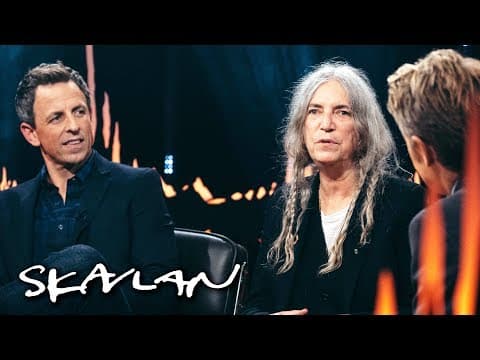
[0:00]Please welcome to the show, Parismith.
[0:33]Uh, well, I got a lot of uh, go back to the kitchen where you belong. I got sometimes I got a great reception and sometimes I got a lot of booze and I just I I just did my thing. I just plowed through it, you know, whether people like me or not, I just did I just went ahead and did what I was doing. How how did you How did you find the strength for that? I just it's what you do, you know, I mean, I never uh, you know, I've always been a I guess a scrappy kid. I was the oldest of three children. Um, I always had a lot of responsibility. Um, and I just it was if I'm on stage, it's my responsibility to reign them in. And I'll do it, you know, I'll fight till the very end. I don't think I've ever failed. I had a lot of rocky moments. You have the strength because that's what you're that's what you'd like to do. By doing something you like and you believe in, it gives you internal strength. Do you would you call yourself a perfectionist? No. How come? No, I'm because uh, I never well, when I'm writing, when I'm doing a drawing, when I'm uh writing a poem, I have a expectation of perfection. But when I'm performing, singing or, you know, with people, I don't care about any of that. For me, the most important thing is communication and uh, I'll I'll communicate at the expense of, you know, to get a laugh. I don't mind if I look foolish. I don't mind if I fail a little or make a mistake, as long as I feel that uh, the people and I are in, you know, staying in tune with each other. That this is so interesting to talk about because we were in you were in Stockholm. Oh, yeah. And you were there, you were there to honor Bob Dylan, uh, uh, I mean, the Nobel Laureate. Yes. And how was that experience for you? That experience was one of the most difficult experiences of my performing life. And for anyone who didn't see, uh, I was, um, in Stockholm at the Nobel ceremony to sing, a hard rain's going to fall, which is seven minutes long, uh to honor Bob Dylan, the uh poet laureate or the the literary laureate. And I knew the song backwards and forwards. I've been singing it since I was a teenager. Um, and I was singing with the orchestra, I was ready, I felt confident and I don't know what happened. The second verse, I froze. Not forgot the words, I mean, I froze. I I I and it was when I think of it now, I still can do what I did. I covered my face, I was so humiliated and ashamed, uh to fail. What what went through your head? What did you
[3:50]Because it was a big decision to ask to ask to begin again. Well, there's cameras, I knew it was being filmed globally. I just had to tell the truth. That's one thing I've learned as a performer, if you tell the people the truth, um, they'll they're very forgiving. And I just told them I I got nervous, which I never get nervous. But I was so nervous and I just asked the if we could start over. And um, I could feel everyone with me, the king, the queen, the Lord, they're like, come on, you can do it. And then, you know, I got through it and um, I learned a great lesson though from that. Which was The next day, I mean, for myself, I felt, of course, unfulfilled. I felt, you know, terrible that I didn't just do my best for Bob Dylan, for the people. And the next day, all the Nobel laureates, all of the people, they were so happy and so happy to see me and so happy that I was so flawed and had such a rough moment because they told me, they all do. And they felt a kinship and they felt well, well, if she goes through that, you know, we all go through it and we all they took selfies. I had selfies with all the Nobel laureates. Did you ever, did you ever speak to Bob Dylan? No, no, I I I didn't. Bob is a very private man. Um, I spoke to his son, his oldest son, who said the family was very happy with me. And he said that his father said that uh no one uh messes up his lyrics any worse than he does. So that's confident.
[5:47]What what do you what do you think is the biggest misconception about you? I I I Well, I um, sometimes I think, I have a very uh, I suppose because of my youth or the idea, people's idea of what punk rock is or something. Um, they imagine that I'm devoid of humor or that I'm going to be really mean or I'm going to come like come on a show like this and start, you know, kicking things over and and yelling at everybody and cursing and everything. And uh, you know, I they, you know, people have preconceptions of what I might be like. But I'm just like, you know, I mean, I have, you know, if I'm on stage and I feel a certain energy, I'll I'll put my foot through my amplifier. I'll rip off my guitar strings, but when I'm in a family situation, I'm respectful to the family situation. I'm kid friendly.
[6:54]When when you became a part of the rock scene, uh, you came from poetry, becoming a part of the rock scene and you had uh a great success. Did did did the business try to change you? Well, they wanted me to comb my hair for one thing. That's I was happy being rough. You had a great radio hit with Bruce Springsteen, crossed the night. How was that for you suddenly having that? Well, I was happy about that. Um, when I listened to the music that I wrote words on, when I listened to Bruce's production, I knew that it was going to be a very popular song. And in a way, I didn't want to do it because I I was hoping if I ever had a popular song that I would write it myself. But it was a perfect song for me. The key was perfect, the rhythm was perfect. It was very anthemic, and um, and I was really in love with my boyfriend and I was able easily to write words to it. I knew that some people would say, oh, you sold out or, um, you know, say things like that, or you've become mainstream. But I didn't care. I mean, I'm always the same person. I'm always the same person. I evolve, but I don't change, uh for any material reason. And I was very happy to have a song that communicated with people on such a large scale. If I could, I'd write the hit of the world. I would love to write a song that everybody sang.
[8:38]You you mentioned your boyfriend. Uh, he was later to become your husband. Yes. How did the two of you meet? That was it was like love at first sight, was it? We uh, we met in Detroit. It was my first time playing in Detroit on my horses tour in 1976 and I really don't like parties and they wanted to throw a party for me at night and I don't really like them. So they said, okay, what if we have a bunch of people at a hot dog place and you can just get hot dogs and uh in Detroit and meet some local musicians. So I said, oh, okay. So I go to the hot dog place, the Lafayette Coney Island, got a hot dog, and I was very happy. I liked it, you know, I got my hot dog. Then I said, okay, time for me to go. And I was just about to go. I almost made it out of there when I saw this guy standing against right next to a white radiator in a blue coat. And he looked at me and I looked at him and I thought that's the guy I'm going to marry. And I did.
[9:49]It's I can't explain it. It's actually one of those alchemical things, but and he was. I mean, it took a few years, but. So it was like you you that was the first thing you said to him. No, I said it to my No, I didn't tell him that. No, I said it to myself. I just saw him and that was it. And did you start talking in them? Um, well, I was on my way out and I was introduced to him and I think it was Lenny K who said, um, Fred Smith, Patty Smith. Patty Smith, Fred Smith. And that's how we met.
[10:32]You've said that, you've said that motherhood, um, actually strengthened your work, uh, gave you discipline. What do you mean by that? Well, I, I mean, I always worked, um, uh, when I was younger, but I, I was fairly undisciplined and I was also interested in so many things and drawing and painting and writing and and, uh, performing.
[11:24]Because you disappeared, you disappeared from the rock scene. Oh, yes. Fred and I decided to leave public life and just, um, and just get to know each other and and raise a family. And so I I chose the hours of 5:00 in the morning till 8:00 in the morning when when my child and my husband were sleeping and I would wake up and I taught myself to use those three hours to write and study. And in 16 years I I did that religiously. And in that period, even though I didn't publish or do anything in the public eye, I grew as a writer. Um, I uh became more disciplined as a, as a human being. And, um, and I learned a lot about myself and I learned a lot about my mother. I realized, you know, I was always disinterested in domestic things. I was never, I always wanted to be an artist, and then I realized how hard she had worked. She had four children and she was a waitress, and I had been first one child, then two, and, um, and no 9 to 5 job, and I still saw how much, um, sacrifice and labor goes into taking care of one's family. So it was really, uh, I learned a lot about the people, which I didn't count myself as one. You know, artists, um, you know, and at least when I, when I grew up, it was sort of like, uh, a different kind of sacrifice, an elite sacrifice. We sacrificed ourselves for our work and that's what we did. But, um, I had to shift, you know, that point of view. But now that your children are grown-ups, do you still do you still wake up at five and you still start to work and? Well, maybe more close to 6:30 or 7:00, but I still, I still write in the morning. Early morning? Yes. Well, almost every morning. Yes. Uh it's the first thing I think about. I wake up and sometimes a dream I have or thoughts, waking thoughts, I want to write them down. And I think of two things when I wake up, well, three, I have to feed the cat, but um, coffee and writing. And so that's there are the two things that come to mind. I would the other thing I wanted to say in having children is, yes, um, it is possible to be uh empathetic whether you have children or not. But then when you have children, there's another level of it. It's not just it's there is human empathy and then there's parental empathy. So if you if uh you imagine if someone loses their child, if you project that onto your own situation, your own child, it becomes even more unbearable. I asked you if you could bring a guitar. Yes. And you brought your guitar. Yes. I don't know what you're going to play. You haven't told anyone here, so we don't know.
[14:38]But I'm I'm thinking of one song, I'm certainly it's not that one because that's not for one guitar, but but the song Gloria. It's it's a song that opens with the lines, Jesus died for somebody's sins, but not mine. Yes. Have you often had to explain that? Yes, in fact, when I first, when that record first came out, I had legions of people actually praying for me or telling me, you know, um, uh, I was going to be, you know, struck by lightning or that I didn't believe in Jesus. And I said, of course, I believe in Jesus, he's the first, the first thing I evoke on my first record is his name. And really, it was not so much about Jesus himself as the the the way organized religion, uh presents him to us. And also, I was a young girl. I wanted to be take responsibility for my own actions. I don't want didn't want Jesus to have responsibility for every mistake I made. I wanted to make my own mistakes, but, um, uh, in terms of his teaching, he's given us one of the greatest teachings, love one another. There can't be any teaching more clear and beautiful than that. So tell me, what are you going to what are you going to sing for us? Well, I'm not a very good guitar. I'm really not, and, uh, I often make lots of mistakes, so I thought the simplest thing. We're going to have some help with the sound here. Can we have that? The simplest thing is just to do a song that only has one chord, so then I can't really. I know Tom Duley that has two. Tom Duley, Stu ball has three. Um, I have to stand up actually. Actually, if you don't mind, I'm going to do a little song of that Lenny K and I wrote called, uh, Beneath the Southern Cross. And, um, so I'm curious, why did you choose that one? Uh, recently, uh, I lost a very good friend of mine, Sam Shepard, and of course, everyone lost Sam Shepard, a beautiful writer. And I thought it would be nice, um, uh to sing a little song for him.


