[0:10]Stink bugs, squash bugs, cucumber beetles. Hey, if you're growing vegetables, sooner or later, you're going to have problems with pests in your garden. Hi, I'm the bug guy here for the University of Maryland extension, and today, I'm going to talk about an approach for managing the pests on our plants, which we call integrated pest management. The integrated part comes from the fact that we're going to combine many different tactics and approaches to manage these pests. Hey, we're going to use cultural controls, mechanical controls, we're going to use Mother Nature's hit squad. We call that biological control, and when we have to use pesticides, we're going to try to use the ones that are most environmentally responsible. And in this way, we can produce really healthy, safe vegetables to eat.
[1:09]Step number one in putting together an IPM program is to build your knowledge base. Learn about your plants, learn about the proper culture, rates of fertilization. How are you going to make your vegetables most productive? In the case of these beans, this beautiful trellis allowed these guys to grow up and just produce bountiful fruit. The other thing to learn, of course, is the pests that are going to attack these vegetables. In the case of beans, one of the major nemesis are the Mexican bean beetles. So, learn about the history of these, learn their damage characteristics, how they're going to affect the plant, and then actually learn what the various life stages of these insects look like. Here's the adult Mexican bean beetle. Once you build your knowledge base, then you're ready for step two in your IPM program.
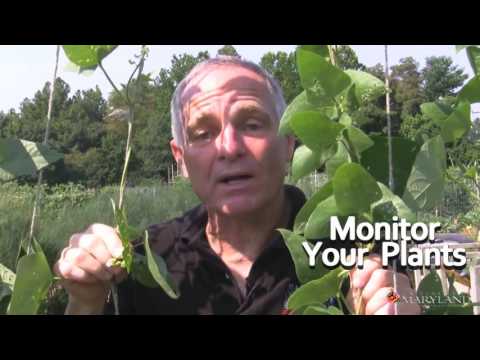
[2:08]Monitoring is the second step in building an IPM program. Monitoring means the regular inspection of your vegetables, and what we're looking for are symptoms and signs of insect activity. Symptoms are things like the defoliation that Mexican bean beetles are causing. Signs are the insect itself. So right here, we can see the eggs of the Mexican bean beetle. Sometimes using a hand lens can really help us see very small insects and their eggs or even mites that are on leaves. If you monitor often and thoroughly, you can really stay on top of these pests.
[2:53]The third step in building an IPM program is decision-making. You've gone out, you've monitored your plants, you've detected your pests. Now you have to decide if and when it's time to treat. In the case of this tomato, hey, there are a few aphids on the leaf, but guess what? There are some ladybug beetles eating this thing. I'm not doing anything at all. But in the case of this squash vine, I think I see some squash vine borer in here. A single larva could kill that vine, so I'm going to have to do something right now. Decision-making, that's the third cornerstone in building an IPM program. The fourth step in building your IPM program is intervention. In this case, we're going to use a floating row cover as a preventive tactic to exclude pests. Another preventive technique we can use is the use of kaolin clay. This is applied to the leaves of plants, it makes the plants unfavorable, the bugs simply don't go there to feed. A third intervention tactic is the use of biological control. This is simply using Mother Nature's hit squad, the predators, parasites, and pathogens that naturally occur and can reduce pest populations. When we've exhausted all other tactics, we may choose to use a pesticide to help reduce these populations. What we like to use are compounds that are on EPA's reduced risk list, those that are safe to use in organic gardening. Always read your insecticide label and always be careful when you apply pesticide.
[4:49]The fifth and final component of an IPM program is record keeping. Record keeping is used to simply keep track of what you saw in your garden and when you saw it. This will help you be prepared next year to figure out when you need to intervene. Also keep track of how well your interventions worked. In this way, you'll know if a biological control or a certain pesticide that you used actually did the job. Record keeping is the fifth and final component of a sound IPM program. So that's it, gang, remember your five steps of your IPM program, build your knowledge base, monitor your plants, make decisions. When you see those bad boys smack them down, intervene, and finally, keep records of what you found. In this way, you're going to be able to produce a beautiful, bountiful, healthy crop of vegetables that are really delicious.


