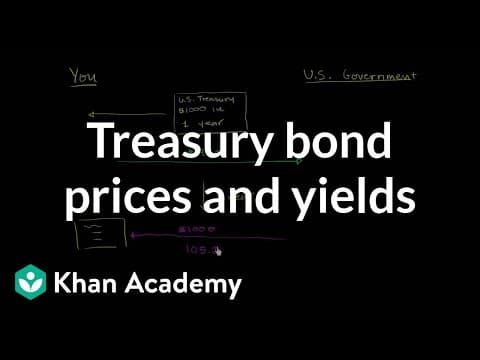
[0:00]When you buy a US Treasury security, you're essentially giving a loan to the US federal government. And just as an example here, I have a US Treasury security, in which it says that the owner of this, this piece of paper will be paid $1,000 in one year.
[0:17]So if you buy this from the Treasury, maybe you're buying it from someone else, but let's just say that the government is issuing them right now. Let's say you buy it for, let's say you buy it for $950, and the government will give you, will give you this security right over here.
[0:35]Now, fast forward, fast forward one year, fast forward one year, you're holding this security, and what happens? So, you know, all that stuff is written there. What happens a year later?
[0:46]Well, written on this security, and I've simplified it just for this example, it says the old the the holder of the security will get $1,000. So at this point, the US government has to give you, has to give you $1,000, has to give you $1,000.
[1:03]So when you look at just the money flows, it's pretty clear that you just lent them money. You gave them $950 now, and then a year later, they give you $1,000. And if you wanted to put this in terms that you normally associate with borrowing money in terms of how much interest did you get, well, you you lent $950, and you got back a thousand.
[1:23]So let's think about it this way. Let's get a calculator out. So $1,000 divided by $950, $1,000 divided by $950 is equal to 1.05. Just to round it, 1.053.
[1:40]So you got 1.053 or 105.3% of your money back. So let me put it this way. So this is, this is 105.3% of money lent, of money given, of money given to the government.
[1:57]Or another way to think about it is, you got a 5.3% interest, or if you you you lent your money out at an annual interest of 5.3%. You got your money back, plus you got 5.3% after one year.
[2:13]So you could imagine, if all of a sudden many people want to buy this this government security, and now the price goes up, instead of being $950, let's imagine that it is now $980. What is the implicit yield that the person would now get on it?
[2:30]Well, we get the calculator back out here. So if you pay, so you're going to get $1,000, and if you paid in $980 instead of $950, then a year later when you get the $1,000 back, that'll only be 102% of your money.
[2:44]So in that situation, it would be 102% of your money. So in the $950 price, you're essentially lending the money the government money at 5.3%, and at $980, you're lending the government money at 2%.
[3:02]And I'm doing this to show you a point. When the price of the Treasury security goes up, as happened in this case, the yield, the interest that you're getting on your loan goes down. So if there's more demand for Treasuries, the interest rate on Treasuries will go down.
[3:40]In the next video, we'll talk about how this might change for Treasuries of different maturity dates.

![Thumbnail for 2016 서울패션위크에서 YG모델 이호정을 만나다! [oh Hot] - KoonTV by 최군TV funny](/_next/image?url=https%3A%2F%2Fimg.youtube.com%2Fvi%2FSqHgAly3Ajc%2Fhqdefault.jpg&w=3840&q=75)