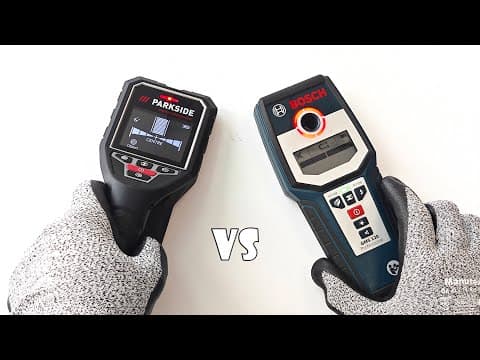
[0:00]Hey guys, I am really starting to hate Parkside. Releasing so many new products simultaneously is really ruining my free time. Here is another one, the all new Parkside performance wall scanner or stud finder or you can call it whatever you want. It's used for detecting objects inside your walls.
[0:18]According to Parkside, the new product has 140% greater localization depth compared to the Green Parkside multifunction detector and that thing was ridiculously bad. Let's hope the numbers here are correct.
[0:31]Parkside claims a maximum localization depth for metal objects 120 mm, for wooden objects 38 mm and for live electrical wires 60 mm. The measuring accuracy should be within plus minus 10 mm.
[0:46]The product features large LCD display, LED indicator and a convenient handle.
[0:52]On its back, we can find soft sliding pads for protecting your walls from scratching.
[0:58]The buttons below the screen are rubberized. Same goes for the edges of the door closing the battery compartment, you can see the rubber strip here.
[1:06]And according to Parkside, the product should meet IP5X standard.
[1:11]As it goes to the operating modes, well, Parkside could do better. There's an operating mode called object, suitable for plasterboards and dry walls where you can detect metal, non-metal, thinner cables and live wires.
[1:25]The second operating mode is called metal, suitable for brick walls, concrete walls, cement walls, where you can also detect metal, thicker cables and live wires. So, let me get this straight. In both operating modes, we can detect metal but one of them is called metal and the other is called object. Really smart Parkside, really smart.
[1:48]But let's continue. In front of you is the Bosch Professional GMS 120, which I might say is quite reputable wall scanner. I will use it as a benchmark.
[2:00]By the way, Bosch also features different detecting modes. Live wire detecting mode, metal detecting mode and metal and wood detecting mode. The names are quite normal and there's nothing misleading in them, like in the object detecting mode of Parkside.
[2:16]Another thing that I like more on Bosch is that it doesn't matter for what object are you scanning for, metal, wood or live wires, the device always tries to pinpoint its exact location by displaying you arrows and the center mark. On Parkside, you'll get arrows and center mark only when you're scanning for metal and wood. When you're scanning for live wires, you get just a warning triangle.
[2:40]Let's start with some laboratory tests. As I don't have dry wall piece available, I will use this 1 cm thick plywood instead.
[2:48]Starting with this, I think it's 18 mm rebar.
[4:56]5 cm. According to Parkside. Which is more or less correct.
[5:28]Placing the rebar behind the second tile, the distance is 11 cm.
[7:48]Quite well from Bosch. Well, unfortunately, Parkside is unable to pinpoint the location. Bosch was also struggling, but Parkside is totally unable. Moving the rebar in front of the second tile, distance 10 cm.
[9:13]Well, Parkside is doing slightly better. It's reading the depth. 12 cm, 11, which is about correct. Is detecting that is non-ferrous metal, but it's unable to pinpoint the exact location.
[9:43]Changing to copper, again the distance is about 11 cm.
[11:33]Absolutely no detection from Bosch. Still no detection from Bosch. Nope, nothing from Bosch.
[11:47]Nothing from Parkside either. Some really misleading readings from Parkside. Aluminum behind the second tile, 11 cm.
[12:08]No detection from Bosch. This time, Bosch is doing really well.
[12:30]Parkside is performing better and it's able to calculate the depth, but it's unable to pinpoint the location. Now, Parkside can even pinpoint the location. Wooden beam, the distance, the depth is about 3 cm, 2 and a half.
[18:11]Real-life test on this light switch. This here is a drywall. Scanning for live electric wires with Bosch. And now scanning for rebars. Same exercise with Parkside. When detecting live wires, Parkside is not displaying arrows for pinpointing the location. If you ask me, this is a really stupid decision. You get only this triangle. Moving the cable position behind the second tile. As you can see, when detecting live wires, Parkside is not displaying arrows for pinpointing the location. If you ask me, this is a really stupid decision. You get only this triangle. Moving the cable position behind the second tile.
[19:17]Parkside is displaying information not only about the live wires, but also for the metal structure inside the drywall. Same exercise with Parkside.
[23:23]Well, so much with this video. I think I've managed to cover a lot of stuff. The product ain't bad, but as usual for Parkside, it could have been better. Of course, the price tag is a killer and as always, it's up to you whether you buy it or not. Bye guys and see you soon.