[0:14]The DNA is shown as a circular double strand within the bacterial cell. Like the DNA of all living organisms, it contains the unique genetic code for all of the proteins required for bacterial survival. These include the proteins required for reproduction, growth, repair, and regulation of metabolism. It also codes for the three kinds of RNA that are essential for carrying out protein synthesis. These are known as ribosomal RNA, RRNA, messenger RNA, MRNA, and transfer RNA, TRNA. In order for the bacteria to begin protein synthesis, the double stranded DNA molecule must first unwind and separate in the region which codes for the specific protein that is to be made. Only one strand of the DNA serves as a template for this process known as transcription. Transcription results in the formation of messenger RNA, MRNA, which is a mirror copy of the DNA segment. Once the strand of MRNA is complete, it will detach from the DNA template and in turn, become attached to ribosomes. Bacterial ribosomes are made of a small 30S and a large 50S subunit. After the two subunits join together around the strand of MRNA, synthesis of the polypeptide chain begins. This step involves the aligning of transfer RNA, TRNA molecules in sequence along the MRNA. Each TRNA carries a unique amino acid, determined by the sequence of the TRNA, which, when aligned along the MRNA and ribosome, joined together to form the polypeptide chain. This step is known as translation. The ribosome will continue to add amino acids to the growing polypeptide chain until it reaches a point along the MRNA that signals it to stop. At this point, it releases the finished protein molecule.
[2:26]Macrolide antibiotics such as erythromycin act as inhibitors of protein synthesis by attaching to the 50S ribosomal subunit. As a result, they block the ability of the ribosome to synthesize the polypeptide chain. By inhibiting protein synthesis, macrolides are considered bacteriostatic antibiotics. However, at higher concentrations and with lower bacterial density or during rapid bacterial growth, macrolides may be bacteriocidal.
[3:03]Changes or modifications to the 50S ribosomal subunit, I.E. the target binding site for macrolide antibiotics, will confer resistance to macrolides and sometimes other classes of antibiotics. This type of resistance may be of a high level. This mechanism of resistance is mediated by the erm, erythromycin ribosome methylation gene, which is found on plasmids or transposons, I.E. small genetic elements, which are capable of moving from one bacterium to another and integrating into the host chromosomal DNA. Copies of the erm gene are transported to other bacteria via plasmids or transposons through like channels. The erm gene is incorporated into the new bacterial genome. During the process of protein synthesis, this bacterium will transcribe and translate the genetic code of the erm gene, resulting in the production of a protein enzyme, capable of methylating the 50S ribosomal subunit at a specific position. This altered 50S subunit results in decreased binding affinity for macrolides and other antibiotics such as lincosamides and streptogramin type B. This pattern of resistance is referred to as the MLS phenotype. Because the macrolide antibiotic is unable to bind to the 50S ribosomal subunit, it is unable to inhibit protein synthesis and thus, the bacteria itself is not harmed, continuing to produce polypeptide chains of amino acids.
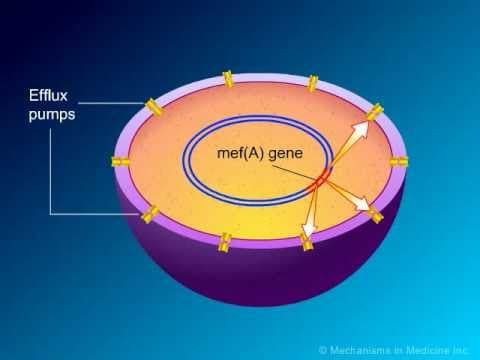
[4:43]A second mechanism of bacterial resistance to macrolide antibiotics is mediated by efflux pumps. These efflux pumps are encoded by the MEFA gene, which is a transposable element. Because they confirm resistance to only macrolides and not lincosamides or streptogramin B, they are referred to as the M phenotype. The efflux pumps are energy dependent and for S pneumoniae, result in moderate levels of resistance. These pumps traverse the cell membrane of the bacteria and function to pump out the macrolide antibiotic after it has entered the bacterium. It should be noted that for other bacteria such as staphylococcus aureus, for example, a different efflux system, which is plasmid mediated and encoded by the MSRA gene, result in macrolide resistance, as well as lincosamide and streptogramin resistance in some cases. Despite the presence of these efflux pumps, macrolide antibiotics continue to enter the bacteria. However, once inside the cytoplasm of the bacteria, these efflux pumps actively remove the macrolide antibiotics before they have a chance to reach their target, the 50S ribosomal subunit, and bacterial protein synthesis is unaffected.