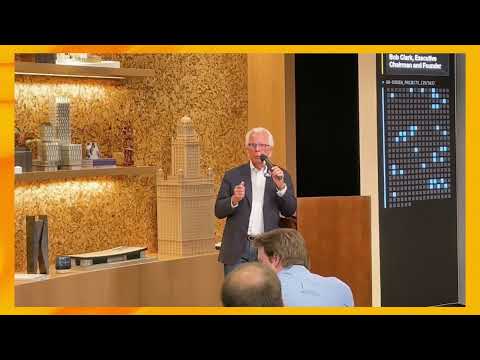
[0:00]we've lost over 50 corporate headquarters since I started Clayco 40 years ago. What what was once a thriving community where I felt like I could build a business that could could be a local business became a kind of a negative scene that caused Clayco to go far and wide to seeker work. So we travel quite a bit and it's been frustrating to me to watch this happen to our community. I have over 2,000 employees in the St. Louis, Missouri region. In the last few years we made a big commitment to try to bring more of our jobs back to St. Louis to the St. Louis region. Uh we do have a large facility in Chicago, but we also have offices in the East and in California, Phoenix, we have a large presence there. I think it's been frustrating to watch what's happened to the St. Louis region and I call it the um the City of Lost Opportunities. I think people have heard me say that before all the way back at the turn of the century we lost the railroads went to Illinois to Chicago. And pretty much ever since then, we've missed some of the big opportunities to really bring economic development to the community. So it was with good intentions a couple years ago that I went to the governor to various political people around the state. And more importantly, I went to Amaron uh who's our our major utility on the Eastern side of the state. to ask them why St. Louis couldn't attract more of this economic engine that is blowing up across the country. So we went to Amaron, we started working really closely with them. We've been meeting them monthly for the last two years. We've really studied the business, the industry, the transmission lines, the potential for major economic engine development, uh data centers in the community. And we found a handful of what I think are really great, great locations. When we started the process, the data center backlash, I would say, uh had not really started. So this has been a phenomenal thing to watch come together over the last probably 18 months. And it seems like each month it intensifies. With the uh fear of AI, some of the technology people coming out themselves and saying that it's going to have tremendous negative impact on white collar jobs. Something whether you believe it or not, I'm more optimistic about them than than some of the naysayers are. I found our process of engaging with artificial intelligence and these new agents and engines have made us more productive. I haven't seen an opportunity yet to envision our company without a full parking lot. I think our parking lot will get more full over the next few years, so I'm really optimistic our company will grow and maybe we won't grow employment at the same level. We our productivity is going to increase tremendously, so I'm more than optimist about the um the technology itself. But I'm very aware of the negative backlash, the concern, legitimate concern about how data centers are going to impact communities, but also I'm highly aware of the economic engine that they create, which is really kind of mind shifting, particularly as suburban areas around the country have been really challenged economically. Even prosperous communities have been struggling with how they're going to meet their budgets and how they're going to keep their schools uh expanding and their fire departments and have a right level of security in their communities. And interestingly in the places that we are working in building lots of data centers, there are lots of economic advantage coming to some of those communities. I think some of the backlash has been because of the general lack of transparency. Which was the way that um a lot of industry has has built most of the carp plants, most of the chemical factories, most of the manufacturing jobs works under kind of an umbrella of confidentiality. Particularly up until you get into the community approval process. So I think the transparency has to change and I do understand communities really need to know what they're getting themselves into. I'm personally committed to a very transparent process. I think in the project I'm about to talk about we were extremely transparent and I'll get to that in a second. I think um one really interesting thing as I've engaged with the data center coalition across America and I'm a working closely with the community engagement and communication departments of the large technology companies, I was on record, having worked with Microsoft and AWS in the last six months on some of their communication efforts. That these companies have really stepped up to the plate to address some of the key issues. And um, it's going to be really important to remain competitive globally in the AI race. I don't think there's going to be any pullback and I think data centers are going to have to be built in the United States, it's going to have to remain competitive and there are constraints. Power is a giant constraint, available land is a constraint and now we're going to deal with this public outcry and these questions are going to have to be answered and we're going to have to be answered appropriately and through appropriate processes. So I really believe that the Eastern region of Missouri with the right setup can benefit tremendously from the expansion of these data centers in our community. And I hope that we can answer the questions that the press has and the public has and I think we're committed at Clayco and CRG to having a very open transparent process and trying to answer every question. So I think the key issues with these data centers have been utility costs, water, noise, location,
[7:05]tax breaks, and jobs. I think one of the really important things that I believe is that there's an incredible amount of misinformation. And that there hasn't been good, successful responses to this misinformation.
[7:29]But these misinformation campaigns have been extremely well organized and well funded and quite frankly I think there is some truth. Kernels of truth in the process, but I think in general, that these data centers are here to stay, expansion is good for for communities, it's good for jobs and that every one of these questions can be answered. On the utility front, there's tremendous legislation occurring across the United States right now and our team. Ashley was at a meeting with the White House with President Trump, who did an executive order saying that the utility companies, um should uh make the data center and technology companies pay their fair share. But there's already been legislation in place particularly in Missouri, which is addressed that the ratepayers, the residents should not pay for the expansion of utilities by the data center companies. In terms of the water use which I think is uh very legitimate question. Particularly in some of the desert states that we work in in Arizona, the technology companies were building data centers that were mostly evaporative cooling. Almost all of the technology companies have converted their projects to closed loop systems now and address the water uh concerns. At least for the most part, work work has to be done and I think the technology is changing every day. We have our own engineers working on uh these systems. I think there's been accusations that the waste water might have antifreeze in it and that sort of thing and that is not true. There's no waste going out of any facility that we're building that's not as clean as the water that comes into the facilities. That's all being treated, so I think that that question is answered. I think most of the backlash, this is really interesting because I've been in the room with probably a hundred different people who started out as opponents in these projects. Most of these people haven't seen a data center. So one of the biggest things we've been able to do to turn the tide is get people to go look at data centers. We know some of the council people, we're going to get to Festus in a minute, from Festus went to see projects that they located on their own and came back uh a lot less alarmed than they than they were before they saw them. My own experience from building data centers all over the country is that these facilities look like industrial warehouse buildings that are full of servers and full of air conditioners and that they're relatively harmless other than they use a lot of energy and that we have to address those questions. You're not noisy, I think they're in a lot of cases, they're less noisy than the highways or the roads near them. They're a lot less noisy than industrial warehouse buildings and all the truck traffic and uh they do have generators that have to be tested usually in conjunction with the plans and the neighborhoods that are around them or the cities or the communities. So it's not like they just turn them on and turn them off without a plan. And I think that um everybody's using their iPhones and everybody's using their iPad and everybody's using Facebook and technology and it has to come from somewhere. I think um in terms of the tax breaks, I think that's just simple math. I think each of these projects has to be weighed on its own economic weight to the community in the case of Festus. Uh the project will generate enormous additional new revenue regardless of how you structure it, but we have uh committed to no tax abatement on that project. But I think all of the technology companies and their most recent published commitments have said that they're going to address all of these issues. And Microsoft in particular has said no new subsidies for their projects. And I think we're seeing a wave of uh balance of less tax abatement, but the general economic benefit to communities like Festus, is in the range of $40 million a year of new revenue. After all of the uh paperwork is said and done, that's an incredible boon to their economic likely good for generations to come.
[12:04]So I I just want to address two other things. Last week we were served by um lawsuit by a citizen group that claimed various things in the the lawsuit that are related to transparency and the sunshine law. I can tell you from my perspective that Clayco under no circumstance violated any laws, any rules, that we acted appropriately through the entire process. We were completely forthright and that all of the meetings that we had were public meetings that where votes occurred. There was an eight to zero vote on the annexation, which was a public hearing. There was an eight to zero vote for the zoning, which was a public hearing. And there was a six to two vote to agree to our development agreement that that was on March 30th, which was at at a subsequent meeting where it was supposed to be approved on March 23rd, but they wanted to the city council gave the public an additional meeting to to give voice and there was a lot of pros and cons to the project before that decision was made. It's my opinion that in that boat, we were granted vested rights to develop the data center and that we have all the appropriate zoning now to proceed with the project. I also want to address that four opponents to data centers were elected last week and I completely respect democracy, elections and I congratulate all the council people who were elected last week. And I look forward to getting the opportunity to sit down with them. Some of whom have already been willing to to sit down to listen to explain the project in more detail. We're we're still at the beginning of the project just because we have vested rights to develop the project. We still have a lot of work to do and it will be probably at least six or nine months before we're ready to actually break ground on the project. So the public and the new council are going to get lots of time and uh opportunity to to ask questions and uh we're going to listen to every single question and we're going to try to answer every question. And we're going to try to prove the case that it's good for Festus to have this kind of economic development in their community. So with that I think I'll just stop and maybe answer some questions. Mr. Mark referencing the lawsuit lastly, sorry, reference the lawsuit lastly, and attorney for that group said the city could cancel this project at any time. Do you agree or is there some kind of contact in place where this goes forward no matter who's on the cow for? I don't think that they can cancel the project. I think our rights are vested, so I I think that'll be determined in the legal process. That's my opinion is that we will aggressively defend our rights to develop the project for the uh vested rights that we have and what to develop agreement. But the the vote also seemed to be a pretty clear expression of what the is what. You're you're addressing the election in the results of this, but I think a lot of people watching like drums will understand not the legal argument or the financial argument for the humans argument here. Uh why should people of Festus have to accept something that their community is now publicly rejected about this? Well, we we've been in over 50 meetings with the public. And I've spent a tremendous amount of time in Festus and I wouldn't say that this one election, while it absolutely, is a demonstration by some people to elect officials who are who are opposed to the data center. I don't still think that they speak for the entire constituent and I don't think the full public understands the entire public benefit to their community. And so I think and hope that the newly elected council people will represent all of their constituents, not just the people who elected them recently and that they'll listen to us and they'll understand the project better. I don't think most of them have seen what we haven't seen, which are plans for the project because we haven't completed in plans for the project yet. So I think that's going to be a a give and take process and I I hope they'll listen to us and I believe they will. Follow on transparency that you raised. I wonder if uh do you sense that that was a problem of CRG's own making, or maybe some of the EL suggests that as early as November 2025, the city administrator of Festus has emailed uh executives at CRG uh about these briefings they were having in counselors and saying that the Festus data center uh big cap was out of the bag. Seems to suggest that uh these reviews were being kept from the public in early stages. Did CRG ever instruct city officials to avoid triggering the open meetings requires my only city council briefings and he briefed us in a brief. I can't comment on that because I I personally didn't have any communication like that. I don't think any communication like that happened, so that'll be determined by the by the outcome of the the lawyers and litigation. I think we acted appropriately 100% of the time. I think it's not unusual for real estate developers or businesses when they're working and interacting with the community to to have multiple meetings with council people. We invited council people to come to this facility to understand and learn more about data centers and we conducted over 50 public meetings. Or some public and some small gatherings of meetings, so I think we acted transparently the entire process personally. So I don't think it was a a anything out of the ordinary to process that we went through. And uh I think it's really notable also that the opposition held two meetings, two large gatherings, both of which we invited ourselves to, attended and stayed for over an hour and answered questions. So to the question that we weren't present and we weren't answering questions, that's just not true. Now that the project is approved since Alice, which company is behind it and it's not what you expect that would be called real. So we're still negotiating. We we do not have a letter of intent or any kind of agreement with any of the specific hyperscalers. CRG is uh is the entity that has the development rights and we're negotiating in good faith with various hyperscale companies and at the appropriate time we'll work with the city to make sure that they're the right fits for the community and that it'll be the right economic outcome for everybody involved. But though there is no specific hyperscale company that we're signed up with at this point. And for the Festus project specifically. Exactly. Yeah, speaking directly to the Justice project. Okay, so there's we don't have a hyperscale data center company signed up. Mr. Clark, what would you say to all these residents that come out and spoken against the project, whether they're concerned about their home values, or they're swept the the issue you address up there from water use to uh electricity issues. What's your message to these folks who are still passionately opposed to this community that you're in here? Yeah, well, there's a lot of people that are for it too. So, I mean I think we have to listen to both sides of the story. We certainly have people who are opponent, I don't know if you saw any of the meetings, I thought there was, there were some rational opponents to the project and quite frankly there was some irrational opponents.
[20:30]People were yelling and screaming and um I think behavioral norms have really changed uh in America over the last few years and it's gotten worse and worse and I think every American citizen should be nervous and concerned about the way people are conducting themselves uh in these public meetings. And I think um all I can say to every single one of them is that we're going to listen to every one of their concerns. Uh no matter how loudly they yell at us, and we're going to try to answer their questions rationally. And um, listen, I think when you look at some of the development of data centers across the United States, some of them have been built in inappropriate locations. I don't think a data center should be built 100 people at somebody's homes. When you look at some of the projects in Virginia, they're extremely close to people's homes. I don't I don't think that's appropriate. Um and this uh project that we're proposing and the site is up here on your left. We're going to be over 1,200 feet away from people's homes when all is said and done. And 1,200 feet is a long way from somebody's house. I think the other notable thing about the site in Festus and the reason that we became so interested in the site, and I'll just take a second and point to the site over here. It's obviously on a highway. It's on a loud highway that's being expanded, um as we speak. There's a tremendous construction project. There are industrial uses all along Highway 67 right now. I think what's really interesting about Festus, Arnold, Herculanium, the whole area around there is it's a nice mix. It's not just a bedroom community where people are driving to St. Louis every day for for jobs and economic engine of their own. And I think the data center adds value to that economic engine to make your community a thriving suburban center as opposed to just a bedroom community where people are driving back and forth. If you look on the left, you see a large transmission line. That's where that that light green section is. That's why the site is attractive to us. It's on a highway and if you notice on the right, there's a subdivision. Those are homes. I was in that subdivision yesterday. We've met with a lot of the people that live in that subdivision. That subdivision is on a giant hillside here. There's a large ridge that rises way above the rooftops of those homes. This entire ridge is to be protected. Every tree is to be protected. And essentially, the area of the development is this area from Highway 70 up into about level with this subdivision road right here coming across. And so when you look at the site in context, it's really hard to imagine how any of these people are going to be negatively impacted by the the data center development. Most won't be able to see the project at all and they won't be able to hear the project by by uh ordinance.


