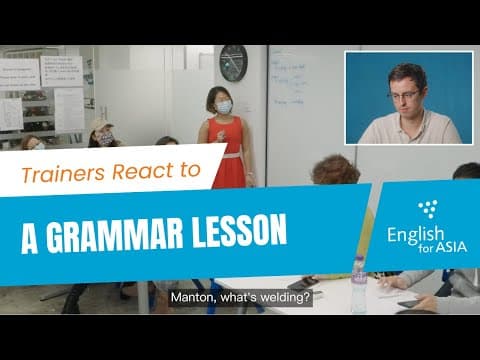
[0:00]the challenge is not knowing what the tense is, the challenge is making the right choice. What new things have you been doing? Here the student example is that he's been studying welding. You'd never teach them the word 'welding'. Manton, what's welding? It's obviously relevant to their lives, right? We're going to watch a grammar class on the present perfect continuous, which is have been + ing. So ‘I’ve been reading a book for the past few days’, and we’re going to see a really nice example of working with student language and how to present grammar communicatively. Alright. Good morning, everyone. Good morning. Lovely. Okay, so today we are talking about recent events. What does 'recent' mean?
[0:51]Is it now or in the past? In the past, yeah. Very far away many, many years ago or quite close to now? Quite close. Good. Close to now, right? Lovely. So it's really important to do that, right? Otherwise maybe students don't know what 'recent' means and the whole lesson is going to collapse as a result. Have a look here. Can you talk to your partner? What new things have you been doing? And you can follow this one. For the past few months, for the past few weeks. For example, for me, 'Reading a new book'. Okay? For the past few days, days for me. And it's a really, really interesting book, okay? Cannot stop reading, okay? Can you talk to your partner? Egg tart. I've been doing yoga. Jennie has set up a situation where you pretty much have to use the present perfect continuous to answer that question. And so this does two things, right? One is we're setting up the topic, the context of the lesson. Um, but also it's a test for the students. It's a nice way of the teacher assessing what they can actually do.
[2:01]My daughter make. Ah, you've been cooking? Oh, very nice. Nice. This bun. So that's a nice exchange there. Here, here the student, I think is, uh, perhaps doesn't have the vocabulary to say what she wants, and she's trying to find it on her phone, and Jennie's just there to help her. And also, if you notice, the student didn't use the target tense, the present perfect continuous. She said ‘My daughter make’, something like that. And then Jennie reformulated that and gave it, said it um, ‘Oh, you have been cooking’. This, this bun. Sausage. Sausage inside?
[2:41]Okay, so here for a few days for me, I've been reading a new book, okay? Uh, what about you guys? What have you been doing? Gina? I... recently I do make to, how to make the egg tart. Egg tart. Yes. So egg tarts. So here, after being asked to discuss what they've, what have you been doing recently? The student is unable to do that. So she didn't use that that tense and also she didn't really use an appropriate alternative either, which is good because it tells you the teacher that now what you're going to teach them is, is useful and new for them. Here we're working with what's called 'Emergent language'. We know it's not just relevant to their lives, but it is, these are things they are trying to say now. This is language that they need help with now. It's something that they're very likely to use and be motivated to use. uh, making cakes. What is this called? Baking. Yes. Baking! Lovely. Thank you very much. Okay. So we call that 'baking'. When you make... The student used 'make' with cakes. I think she said 'make cakes' or 'make egg tarts', which is okay. Um, but here Jennie elicited and then basically upgraded that to 'baking'. Maybe the student knows that. Maybe they've forgotten it, but it's a nice sort of extra freebie. what about Manton and Sunny? Studying. err.. welding. Welding? Oh very cool. What is that? So this can happen when you use the student examples. Here the student example is that he's been studying welding. Um, and that's, that's interesting. I think it's very unlikely that we would teach them the word 'welding' directly. It's quite niche, right? Um, but it's... that's what the students have been doing. That's what they need to know to be able to say. So Carmen asked, 'What is welding?' Manton, what's welding?
[4:40]About construction. Fixing the.. the.. Is it to do with paper? Not paper, right? It's metal. Yeah? Metal like.. Yeah, yeah. Kind of, when you're connecting metal with other metal together, this is called welding, right? Really cool. So I thought that was really nice as well. We have to concept check what welding is for the other students. Um, and the other students are interested, what, what is that? What does it mean? I like how quickly she thought on her feet and then asking about the, the material. Is it paper or metal? I think that's a very precise question to ask. So I think that's the challenge here is responding to the students' language. Asami and Kim, what have you been doing? Oh, Asami says two months ago she came to Hong Kong to find a job and met different people. Nice. And then. So that's a really nice example of the student sort of doing everything they can to avoid the present perfect continuous, which would suggest to the teacher that it's new to them, or if they have studied it before, it's something that they, they've forgotten about or just don't use. I think she said a lot of past simple, like 'Two months ago she came to Hong Kong', something like that, right? So again, that's the really nice benefit of of having that task at the beginning, which tests what they know. Um, Jennie here can be quite confident that what she's going to teach the students next is useful to them and something that they need. So my experience five days ago, I went to hike. You've ended up with this nice board full of different student examples. Um, so yeah, the examples have been generated from the students, and now I suspect Jennie is going to turn these into sentences with the right grammatical tense in them. Okay, so remember I said we're talking about recent events, yeah? Can you tell me again what does 'recent' mean? Tell me again.
[7:03]Before. Okay, good. So, before. So that means it started in the past, yes? Yes. Good. Okay. So, before.
[7:37]I have been reading a new book. Also means that you still, you know, you haven't finished the book. You still have some pages to read. It's very important to check first of all, the meaning, not the form, but the meaning comes first. And how long for? Nice. Great. Do you see it's the same? I have been studying welding for two months, yeah? Again, started in the past and again I haven't finished, right? Yes. Good. Let's try another one. Uh, Welding, we've done this one. Can you choose another one? Choose a different idea. Any one. Shall we go here? 'Meeting lots of new people'? Yeah? So tell me, what what should it say? I.. Yep. I've been. Meeting. Lovely. Excellent. Thank you, Gina. Meeting a lot of new people. Good. And that's a nice touch. After giving the students two model sentences herself, she then elicits the third one, asking them to convert the previous example into this new form. So again, that just helps check that the students are following right and gets them a bit more involved. Started in the past, yeah? Am I still meeting new people? Yeah. So it's not finished, yeah? Good, well done. Okay. Let's have a look here. Tell me again which words are always in all the sentences. I have been, have been, have been. We've got I, I and I. So I really like this approach. Um, where actually the students are being asked questions to notice things. Note what Jennie isn't doing is, she's not writing, 'Today we're going to study the present perfect continuous. The present perfect continuous is 'have' plus 'been' plus 'ing'.' That conclusion is reached through exploring the examples together rather than being given to the students directly. This is the subject, yeah? Now with 'I' we will use 'have'. What if we change it to 'she'? Is it 'she have'? Ah, really good. Okay. She has. So, next, when I put these two together, I put them together. Is it still 'I have'? I've, really good. Okay. So here, can we try together? I've, I've been. Good, so this 'ee', it's a long sound, but here, now it's a short sound.
[10:36]So /i/, been. I've been. Good. It sounds like this one, /bin/. I've been. I've been reading. I've been studying.
[10:54]Good. And then, 'she has'. We put it together. She's, really good. Okay. And the same down here. It's nice to see the learners all sort of, their attention. Their gaze is directly on the board here, which is obviously always a good sign that they're paying attention. And he has? He's, really good. Well done. Okay, now let's try the next one. If you look here, I'll show you again. So again, we have some sentences. So I, I and she. So again the question is, 'Did the action start in the past, present or future?' Tell me. One aspect of presenting grammar is this, there's a lot of things to cover. And we talked about being concise, so often it's quite nice at the end of the presentation, just to recap. We can ask the concept checking questions again and we can check the students understand the general rules of thumb for this grammar point. Past. Good, so it started in the past, okay? The result of the action, can you see it now? Yes. Reading a new book, I haven't finished, but I can see the book here, yeah? A new face cream. What is the result of the face cream? Your skin should be.. Smooth. Yes, really good. Beautiful, right? Your skin should be beautiful. Good. Going to the gym for many months. You should be quite strong, fit, yes, really good. Okay? So, I know the book now. My face is more moisturized now and she looks fitter now. So you can see the result now. Okay? So, for 'I' we say 'have', for 'she' or 'he', we say 'has'. Really good. Have or has, okay? And then we have, been, good and then after, ing. Really good, okay? So this, um, is what I would call a summary of the grammar point that she's been teaching, in this case, present perfect continuous. Um, there's an alternative approach here, which would be to start with this. a slide like this and we say, 'Okay, here's the present perfect continuous, here's some examples, here's the form, here's the timeline.' Um, and just present it to them directly at the beginning. I think the way Jennie did it, where she got the student examples first, she got them to discuss things that are happening in their own lives, and then converted their examples into sentences with the present perfect continuous. I think you can see that that's more engaging. It's more useful to the students. So now I will give you this one. You need to do some sentences, okay? Have a look. So number one. Person A: 'Wow, your skin looks amazing.' 'Thank you, I've been ____.' What? What do you think?
[13:59]After the presentation, we're going to do some controlled practice. And here we have some exercises, right? The students need to write the right, correct forms of the verbs in the, in the gaps and complete the sentences. I like the examples because they're all very meaning focused. This idea of the result still existing in the present, or you can see the result. Some things I really liked about that class. One, I love the really simple question at the beginning, which is a very open question, 'What have you been doing recently?' and it involves the target language, right? So that acts as a test, what can the students do, or not do? That was really nice. I really liked them working with their examples, what have they actually been doing, and then transforming what they said in a slightly inaccurate way into a model sentence containing the present perfect continuous. That was really smoothly done. I like how the presentation was nice and concise, and it covered the meaning first with comprehension, checking questions, little bit of the form, and then a bit of pronunciation bonus at the end. All of the students from what I heard are able to answer the question, 'What have you been doing recently?' Right? They can have that conversation, they're not total beginners, but they use tenses that are not wholly appropriate. Um, and in learning a language with grammar, the challenge is not knowing what the tense is. The challenge is making the right choice. What tense should I use at this point? What grammar structure should I use? What's the best choice to express what I want to say? And that's really hard. If you work with what the students are saying, the sentences they come up with, the vocabulary they're trying to use and upgrade it for them, make it a little bit more accurate, maybe more precise. Baking, lovely. You're really helping them in that journey. So I think this lesson is a really good example of that. It's also this idea of learning at the point of need. You've asked them to try and use the structure, they fail to do it, and therefore they need to get better in order to complete that. A great example, I think, is that word 'welding' that the student uses. Student says 'I've been studying welding'. Um, and in their life, if they are communicating to their friend or to someone they just met, that's probably a sentence they have to say. 'Welding' is something they have to say, right? Because if I'm talking to a welder, what else are they going to tell me, right? But if we, if we control everything as the teacher, you'd never teach them the word 'welding'. That's not going to come up in in a sort of list of most common words that people should know. Um, but it's important to them in order to achieve their goal of communicating. Just to recap, we started off with uh, a context setting or a lead in, but also that can be called an initial test, where the learners discuss what they've been doing recently and the teacher can see, do they use present perfect continuous at all or naturally or, um, is it difficult for them? Then we use the student examples to form model sentences for a grammar presentation. Presentation is nice and concise. We train, we check meaning first, then we look at form, then a little bit of pronunciation as a bonus at the end. And then right at the end of the presentation, Jennie really nicely just summarized it again, and you end up with that slide with all the rules on it, basically, that the students can use as a reference. After that, we're going to practice. We'll start off with a controlled practice like this. And I'm sure if we kept watching the lesson there would be more freer practice. My guess is Jennie would then ask them to have the same conversation at the end, right? So, okay, 'Tell your partner again what you've been doing recently and remember to use the Present Perfect Continuous'. And you should see a nice upgrade in terms of what the students are saying there and how they're saying it. Gina, what have you been up to recently? I've been baking. I've been learning English. I have been sewing and I've also been teaching my.