[0:00]The cancer type that we chose to present is neuroblastoma. Uh the targeted intervention that we picked was Unituxin. First some basic biology of neuroblastoma. It's a solid tumor characterized by different risk stratifications based on age, tumor stage, histology and genetic markers. The subtypes are low, intermediate and high risk groups. Neuroblast originate Neuroblastoma originates from neuroblasts. Neuroblasts are immature nerve cells that normally turn into working nerve cells. They are part of the developing sympathetic nervous system which controls your body's fight or flight response. Um the tumors commonly develop in the adrenal glands, which are located above your kidneys, but can also occur in the neck, chest or spinal cord. Some molecular consequences of a frequently mutated tumor suppressor gene. So first um, the tumor suppressor genes regulate cell growth. They repair DNA damage and prevent uncontrolled cell division. Um some consequences of these mutations are, it can disable the gene's ability to suppress tumor formation, allowing neuroblasts to proliferate unchecked and form tumors. An example of a hallmark of cancer that a mutation can cause is the loss of growth suppressors. Um mutations in the tumor suppressor genes can lead to abnormal growth and differentiation of neuroblasts, contributing to tumorigensis. And that is the process of which normal cells in the body transform into malignant tumor cells. Unituxin targets the GD2 neuroblastoma cells. So what GD2 is, is it's a glycolipid found in the surface of neuroblastoma cells that promote tumor survival and proliferation by contributing to signaling pathways that enhance cancer cells, adhesion, migration and immuno evasion. Unituxin is a GD2-binding monoclonal antibody, which that means that it's a type of antibody that is produced by identical immune cells from one singular parent cell. Uh it facilitates the immune system's ability to recognize, destroy neuroblastoma cells. A hallmark that is targeted by Unituxin is the avoidance of immune destruction. Um GD2 is overexpressed in neuroblastoma cells, which is not typically expressed in high levels allowing for antibody-based immunotherapy. Unituxin flags neuroblastoma cells upon the binding to GD2 for destruction through immune-mediated mechanisms. These are such as antibody-dependent cellular toxicity, which enables natural killing cells to destroy GD2 expressing neuroblastoma cells. Another one is complement dependent cytotoxicity, which forms membrane attack complexes that kill the neuroblastoma cells, as well as macrophage mediated cytotoxicity.
[3:27]It results in macrophages to kill the tumor cells. And then GD2 plays a role in cancer related processes such as cell adhesion and migration and it's not directly encoded by a proto-oncogene.
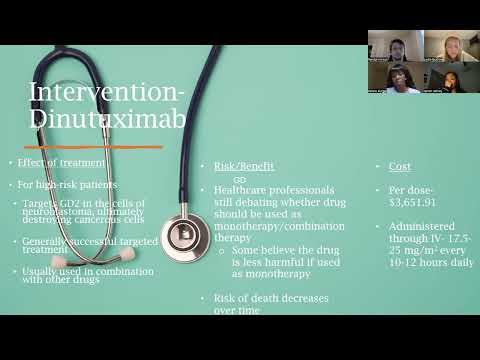
[3:44]Okay, so I talked about the epidemiology um of neuroblastoma. So it's described as um the most common tumor of the synthetic nervous system with the average age of diagnosis being one to two years old. Um the annual incidence rate is about 650 to 1,000 cases per year. Um and it makes up about 15% of pediatric cancer-related deaths. Uh but the mortality rates have improved. Um infants and toddlers have a higher survival rate than older children due to their cancer being caught early and them being in the low risk population. Um but when you get to the older patients like patients aged 30 to 39, the incidence rate goes down to under 0.3 cases per million years. Globally, most cases are reported in higher income regions like North America and Europe. And then lower income regions like Africa, Asia and Latin America report fewer cases. And this is due to quality of care, economic status, etc. prevent medical professionals from diagnosing in a timely manner. So if you look at um these two maps, you can see that the predicted cases and the reported cases vary for their drastically different. Um and that's because from the last slide, higher income regions are able to diagnose this disease more than the lower income regions. So, um the patient's age is a big um factor in determining their chance of survival. So infants and toddlers have the greatest advantage, um and this this research study analyzed patients in three age groups, five years, five to ten and ten years. And the result showed that the event-free and overall survival of patients younger than 18 months was greater than the older patient. Um and that's because the tumors of younger patients are more likely to regress spontaneously. So scientists concluded that intensive therapy and high doses of medication should be used when treating older patients. So our intervention was Dinutuximab, which is a um monoclonal antibody drug. Um and it's for high risk patients and it targets the GD2 in cells of neuroblastoma, um which ultimately destroys cancerous cells and GD2 is responsible for um metastasis. So it's a generally successful targeted treatment and it's usually used in combination with other drugs um or other types of treatments. So healthcare professionals are still debating whether the drug should be used as monotherapy or combination therapy. Um and some believe that the drug is less harmful if used as monotherapy. Um and that's because combination therapy is suspected to cause capillary leak syndrome, which is a really bad side effect. Um so the risk of death decreases over time. The study showed that it decreased so two years, 46%, after three years it went down to 33 and then five years, 38%. Um it's a really expensive drug. So per dose, it's about $3,600 and it's administered through an IV. So 17.5 to 25 milligrams every 10 to 12 hours daily. Um and the total cost could go up to like 18 to 20,000 for the treatment.
[7:32]All right, as far as the specificity goes, for Dinutuximab, it is a very specific uh therapy as it only targets that GD2 glycolipid on the surface of those neuroblastoma cells and some other normal cells that contain the glycolipid on them normally. And as far as I could find the literature, it doesn't really bind to any other surface protein or lipid or anything else in the body. Since those other cells do have it, it's not only going to target neuroblastoma cancer cells, it's going to go after those that normally express it. For the most part, the only normal cells that express GD2 are neurons, skin melanocytes and some peripheral pain fibers.
[8:24]And then since it targets those, it makes some expected off-target effects like neuropathic pain, which is just because that glycol is present on those peripheral pain fibers and neurons. And since when Dinutuximab binds to that GD2 it's going to cause the ADCC and the cytotoxic response and stuff to activate and it's going to if it binds can cause the immune system to attack and kill those normal pain fibers and neurons in the body, causing that neuropathic pain. There's also hypersensitivity reactions and capillary leak syndrome, which aren't really linked to the binding of GD2 by the monoclonal antibody. Those are more linked to other stuff put in with Dinutuximab in the majority of times which is the cytokine IL2 and then granulocyte colony stimulating factor. Those are just stuff to help stimulate their immune response because you need the immune response since that's what the monoclonal antibody is using to kill off the neuroblastoma cancer cells. So since they stimulate those, they can cause some immune hypersensitivity or autoimmunity in some of the people that are getting it and honestly just case by case basis just depends on if that certain level is going to cause that immune hypersensitivity or not. And then as far as capillary leak syndrome would be concerned, it's again linked to that immune response and since part of the immune response is inflammation and inflammation, part of that is making your blood vessels more permeable for your immune cells to get through. It can cause if there's just an over reactive inflammatory response and too much of that being produced, it can make them too permeable or too leaky and now your plasma starting to leak from your capillaries out into your normal tissues. As far as the therapeutic index goes, as far as the stuff I had access to, I could not find a lower end dosage that was effective for neuroblastoma treatment. I was able to find a maximum tolerated dose. This is the maximum tolerated dose of 50 mg/m2 a day. That was for Dinutuximab that's given with IL2 and with the granulocyte colony stimulating factor. The maximum tolerated dose will go up by a large margin if it's just the monoclonal antibody introduced. Um as far as like an idea of what the therapeutic index could be, since the maximum tolerated dose is 50 and the recommended dose given by the manufacturer is around 17 and a half mg/m2 a day, it shows that there's probably a very wide therapeutic index for this targeted therapy.
[11:18]Um for low risk neuroblastoma, um it is characterized by being localized, um because the cancer hasn't spread and it's mostly affected in children that are younger than 18 months. The prognosis for these children um are favorable because they have a greater survival rate of 95%. And the treatment for this is very straightforward, being observation and surgery because it is localized. Um and intermediate risk is characterized by being local as well and it could spread to nearby areas of the body such as the bone and bone marrow. And it's common in older children. But the survival rate is still very high with being 90% and the treatment for this is normally chemotherapy and surgery. High risk neuroblastoma um involves more widespread metastasis. Um and it affects children that are older than 18 months, less than 18 months, sorry. Um and it's more, it's less favorable um with a five year survival rate of less than 60%. And the treatment for this is more extensive, being chemotherapy, surgery, high dose chemo, radiation therapy, immunotherapy and cell stem cell transplants. Um the prognosis for these patients um are influenced by several things such as the stage of the cancer, the age that the patient was diagnosed, the pathologic classification and if the tumor contains the MYCN gene. Um and additionally, however, um much of the cancer is removed can also play a role in the outcome. For low risk neuroblastoma, the prognosis is more favorable, especially when it's detected before 18 months. Um and with the treatment being localized, it makes it more easier to detect. However, for high risk, it's poor because the ability to spread of distant areas which makes it more complicated.
[13:50]Um for high risk neuroblastoma, it has a higher propensity for spreading um because it can metastasize to distant areas of the body such as the bone, bone marrow and sometimes the liver. And the disability makes it um hard for high risk neuroblastoma um to be treated and it impacts the prognosis. And the metastasis often complicates treatment strategies which requires more of an extensive approach such as chemotherapy, radiation and stem cells.
[14:32]Um, the treatment protocol, patients normally get infusions um through the vein. Um and it typically happens several hours a day for a period of four days in a row, once a month with five different cycles. The side effects for um patients with high risk neuroblastoma with this treatment can be nerve pain, fluid leakage, infusion, reactions, vision problems, GI issues such as vomiting, diarrhea and fever and a low blood cell low blood cell count which can increase infection.
[15:15]And when it comes to resistance, high risk neuroblastoma can become resistant over time, which makes the survival rate more difficult. However, with new therapies such as Unituxin and isotrentinion, um it shows more promising results. Um in a recent study, 70% of children receiving this treatment were alive and 61% showed no evidence of the cancer coming back. And here is just the drug combination, the Unituxin, um the immune immune boosting compounds and Isotretinin.
[16:03]Um so there are some benefits um well not really. Um it's more prominent in patients with high risk blastoma and it's less likely to be effective in those with late stage, refractory, or relapse neuroblastoma.


