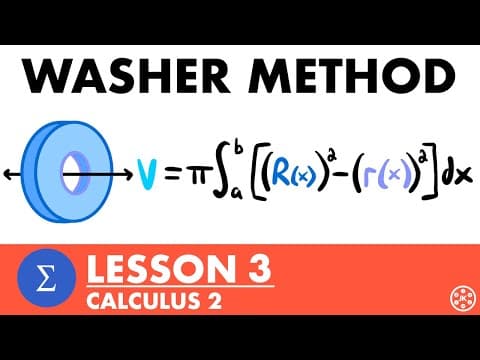
[0:00]Welcome back. In this video, you will learn how to use the washer method to calculate the volume of solid of revolution. Let's get to it.
[0:10]All right, so previously we learned the disk method which allows us to find the volume of solids of revolution that are formed by thin discs. But now we want to extend this method to solids of revolution that have holes that would be formed by thin washers or some people like to think of it as thin donuts. And so before we get started, if you're not familiar with the disc method, I would recommend that you watch my lesson on that topic first. As understanding the disc method is going to be crucial to understanding the washer method. All right, and so if we take a look at this graph here, we have two functions, f(x) and g(x) and a shaded region between them from A to B, which are two values of x along the x axis. And so if we were to take that shaded region and revolve it around the x axis, we would form a solid of revolution that would have a hole. That solid would still have circular cross sections, except the circular cross sections would not be complete circles, they would be circles that have a hole in the middle. And so if we're to look at one small part of this region, let's look at this small rectangular part of this region and we were just to revolve that region around the X-axis, note that we would form a thin washer that looks a bit like this. Now, this isn't going to be a perfect drawing, but I hope it gets the point across of what type of shape is going to be formed. Here. Note that we have this three-dimensional figure that we can call a washer or maybe a donut if you will, that looks very similar to the discs that we used in the disc method except it has a hole in the middle. Right? So this is not a complete disc because it's missing some volume in the middle there. It has a hole. And so we could pick another rectangular region over here and if you were to revolve that region around the X-axis, we would have a similar shape, although it might be a little bit smaller since the region itself is also smaller. And so as you can see, we could continue to pick more and more thin rectangular regions between these two bounds, A and B and form these thin washers that added up together would represent the volume of the entire solid of revolution that would be formed by revolving that region around the X-axis. And so the question is, how can we calculate the volume of this solid of revolution that is formed by these thin washers. Well, if we break it down into two parts, We can use the disc method to help us answer this question. If we just took the shaded region beneath f(x) from this graph and revolved that around the x-axis, we would form a solid of revolution that would not have any holes. And then similarly, if we took g of x, which is that lower function and revolved that around the x-axis, we would also form a solid of revolution that doesn't have any holes. However, that solid of revolution formed by the region beneath g of X would actually be the volume of the whole of our solid of revolution when we revolve that region between both functions around the X axis. Right, this region right here is the same as this region here that would be revolved around the X axis. That makes up this whole inside of those washers. And so what we can do is use the disk method to calculate the solid revolution formed by revolving this region beneath f of X around the X axis and some attracting the volume of the solid of revolution formed by revolving the region beneath g of X around the X axis. And so recall that the disk method when we're working in terms of X says that the volume is equal to pi times the definite integral from a to b of the radius in terms of X squared times dx. And remember that that radius was just the distance between the X axis or the axis of revolution and the outside of our or of our solid of revolution. And so for this solid of revolution, we actually have an outer radius and an inner radius. Right, F of X is going to be our outer radius that forms the outside of our solid of revolution and G of X is going to be our inner radius and that will form the inside of our solid of revolution. Okay? And so I'm actually going to relocate these lines. This top function will be our outer radius, which we're going to label with capital R of X and this lower function will be our inner radius that we will represent with small R of X. And so we'll reflect that over here with these graphs. We have capital R of X and then small R of X. And so using the disc method, we can represent the volume of the solid formed by revolving the region beneath the outer radius around the X axis and the solid formed by the region beneath the inner radius around the X axis. And so those volumes would look like this. For the outer radius we'll have that the volume is equal to pi times the integral from a to b of the outer radius R of x squared times dx. And then the volume of the solid formed by the inner radius will be equal to pi times the definite integral from a to b of the inner radius squared times dx. And now if we want to find the volume of the solid of revolution formed by the region between those two radius we just have to subtract the volume of the solid formed by the inner radius from the solid formed by the outer radius, right? We have the complete solid formed by the outer radius and then the hole that is formed by the inner radius. And so all we're doing is subtracting out this volume, the volume of the whole from the complete solid to get the volume of this solid revolution that has a hole. And so if we're going to subtract this volume from this volume we can actually combine them to be one definite integral. And so we will have that the volume is equal to pi times the definite integral from a to b of capital R of X squared which is our outer radius minus small R of X squared which is the inner radius times dx. And this right here is what we call the washer method. If you have a region between two curves and you want to rotate that around the X-axis to form a solid of revolution, you can use this definite integral to calculate the volume. However, we can also calculate the volume of a solid of revolution where we have a region that is revolved around the Y-axis or a vertical axis of revolution. And so this is very similar to the X-direction if we have two functions, f of y and g of y that are defined with y and we revolve the region between those two functions from C to D which are two values of Y around the Y axis that will form a solid revolution with a whole in the middle. Right, we can pick a particular rectangular region here and revolve that around the Y axis to form a thin washer that we could calculate the volume of and we could do that an infinite number of times for this region from C to D between these two curves. Okay? And so remember that the disc method in terms of Y says that the volume is equal to pi times a definite integral from C to D of the radius in terms of Y squared times dy. And so if we want to find the volume of the solid of revolution that has a hole in it, then we want to take the volume of the solid formed by the outer function or the outer radius and subtract the volume of the solid formed by the inner function or the inner radius. And so let's actually relabel these two functions as the inner and outer radius. So we'll have capital R of Y as the outer and small R of Y as the inner radius. Okay? And so the washer method in terms of Y to calculate the solid of revolution formed by revolving this region around the Y axis will look like the following. We'll have that the volume is equal to pi times a definite integral from C to D of the outer radius R of Y squared minus the inner radius small R of Y squared and then times dy. All right? And so that is the washer method when you are revolving around the Y-axis or a vertical axis of revolution. All right, and so in summary, here's the washer method. We have our definite integral for when our solid is formed by revolving a region around the X-axis or a horizontal axis of revolution, and then we have our definite integral for when we want to calculate the volume of a solid that is formed by revolving a region around the Y-axis or a vertical access of revolution. Okay? And so then just a quick note, the disk method formulas that we learned in the previous lesson are actually the same as the washer method, except the inner radius was equal to zero. Right? So because those solids of revolution that we were calculating the volume of using disks didn't have a hole, the inner radius was just zero. So that means when we were revolving around the X axis, small R of X was just the X axis or the line y = 0 and so we have 0 squared and so this whole thing was just 0 and so we just have the outer radius squared and then multiplied by dx. And then if we're revolving around the y axis, small r of y would just have been equal to the y axis or x = 0 and so we'd also have 0 squared and so we'd be subtracting 0 and so we just have the outer radius r of y squared times dy. And so here are those disk method formulas as a comparison. And so in the end what I'm trying to get you to realize here is that the disc method and the washer method are actually the same method. It's just that the disc method is when your inner radius is zero. Okay? So that's important to realize going forward as you calculate the volume of more solids of revolution. But with that, let's look at an example problem where we calculate the volume of a solid of revolution using the washer method. Okay, so here's our first example. We want to find the volume of the solid that from revolving the region enclosed by y = x and y = x squared around the x-axis. All right, and so the first thing that you want to do when you have a problem like this is to draw a graph of your region. And so, I'm going to draw the y-axis here and then we will draw our x-axis and I will label them. So here is the x-axis and here is the y-axis. Okay? And so let's graph both of these equations. We know that y = x is just a diagonal line or line crossing through the origin with a slope of one. And so that will look something like this. That will be y = x. And then for y = x squared, we know that x squared is just a parabola that points upwards where the vertex is at the origin.
[11:17]And so that will look something like this. All right? So that will be y = x squared. All right? And so the volume of the solid that we want to calculate is going to result from revolving the region enclosed by these two functions around the X-axis. So this region right in here that is between these two functions is the region that we're going to revolve around the X-axis. And so I'm going to draw this little arrow here so that we know that we're revolving around the X-axis. And then I'm also going to shade in this region that we are working with. Okay, but before we can use the washer method to calculate the volume of that solid revolution, we need to figure out between what values of X this region lies between. Now might be familiar with the X and X squared functions and you might just be able to tell that well they intersected X equals 1, but if you didn't know that, you could set these two equations equal to each other and then solve for X which will give you the X values of the intersection points. So if we do that here, we'll have X is equal to X squared and if we subtract X from both sides of the equation, we'll have 0 is equal to X squared - X. And then we can pull out a common factor of X and we'll have that 0 is equal to x * x - 1 and then we can set each of these factors equal to 0 and solve for X. So x = 0 and x - 1 = 0 which gives us that x is equal to 1. All right, and so from that, we now know that these two functions intersect at x = 0 and x = 1. And so this would be x = 0 and this would be x = 1 and so I'll label that as 1 along our x axis. Okay? And so now we are ready to use the washer method and the washer method with respect to X looks like this. We have that the volume is equal to pi times a definite integral from a to b of the outer radius, capital R of X squared minus the inner radius small R of X squared times dx. Okay? And so now we need to determine which of our functions is the outer radius and which of them is the inner radius. And so in order to determine which is which, you first need to identify what you are revolving around, right? We are revolving around the X-axis. And so whichever of these lines is closer to that axis, that is going to be your inner radius and whichever is farther away is going to be your outer radius.
[13:48]And so if we look at this enclosed region, this line, y = X is on the outside of that region, and so that's further away from the axis than this parabola which makes up the inside of that region. Okay? And so since this parabola or this part of the region is closer to the X axis, which is our axis of revolution in this case, that is going to be our inner radius and that will make this line y = X, our outer radius because it will form the outside of our solid of revolution. Okay? So y = X is capital R of X and y = X squared is going to be small R of X. And so now we will have that the volume is equal to (pi) times a definite integral from a to b which are two values of x that our region lies between in this case from x = 0 to x = 1. So we will have from 0 to 1 of our outer radius squared and remember our outer radius is y = x, so we will have x and then we'll square it minus the inner radius squared and our inner radius is x squared and so we will have x squared squared times dx. Okay? And so now all we have to do to find the volume of our solid revolution is to solve this definite integral. And so if we simplify this a little bit, we will have that this is equal to pi times a definite integral from 0 to 1 of x2 - x2 - x2^4 * dx. Right? x2^2 will be x^4 power. Okay? And so if we clean up our work here, we can now integrate both of our terms using the power rule of integration. All we have to do is add one to the exponent and then divide by that new exponent. So we will have that the volume is equal to pi times x cubed divided by 3 - x to the fifth power divided by 5 and that will be evaluated from 0 to 1. All right? And so now all we have to do is plug one into this expression and then subtract plugging zero into this expression. But note that zero plugged into both of these terms is just going to produce zero. So we're just going to be subtracting So all we have to do is just plug in one into this expression. And so we'll have that this is equal to pi times 1/3 by 3 - 1/5 by 5. And if you wanted to, just so you don't forget what you're doing, you can write -0 to represent plugging 0 into that expression. Okay? And so this will be equal to pi times 1/3 - 1/5, which you can either plug that into your calculator. or if you're familiar with working with fractions, you can get a common denominator. In this case, you're going to want to get a common denominator of 15, and so if we clean up our work here, we can rewrite 1/3 to be 5/15 and then 1/5 will be 3/15 and that will be equal to pi * 2/15 which is equal to 2 pi / 15. And so pi / 2 is the volume of the solid that results from revolving this region between X and X squared around the X axis. Let's look at another example. All right, so for our next example, we want to find the volume of this solid that results from revolving the region enclosed by y = x squared, x = 1 and y = 0 around the y axis. Okay? So because we're revolving around the y axis and we're going to be using the washer method, we're going to be working in terms of y for this problem. And so the first thing that I recommend that you do is draw a pic of your region, right? graph everything that you have been given. And so I'll start by drawing the Y-axis and then we'll draw the X-axis and I will label them as such. So here's the Y-axis and here is the X-axis. All right, and so let's graph everything we've been given. We know that Y = X squared is just a parabola pointing upwards where the vertex is at the origin. And so I'll draw that here. Here's our parabola that will be Y = X squared. And then for X = 1, that's just going to be a line at the value of x = 1. And so let's label x = 1 right here and then we will draw a line that will be x = 1. And so this is x = 1. Okay? And so then we have y = 0, but that's just the x axis, right? the x axis is where y is equal to 0. And so the region that we are working with here, enclosed by y = x2, x = 1 and y = 0 will be this region right here. And so I'll shape that region in, so we remember what region we are working with. Now, one more thing that we want to label is what axes we are revolving around. In this case, we are revolving around the Y-axis. And so, I'm going to draw an arrow to represent that. That way I don't get confused and think that we're revolving around the X-axis and choose the wrong outer and inner radius. All right, so now that we have graph everything that we've been given, we are ready to set up our definite integral using the washer method that will represent the volume of the solid of revolution formed by revolving this region around the Y axis. And so the washer method in terms of Y, right? because we're revolving around the Y axis, we need to work in terms of Y says that the volume is equal to pi times a definite integral from C to D, which are values of Y of the outer radius, capital R of Y squared minus the inner radius small R of Y squared times dy. Okay? So it's important to remember that both of your radio need to be in terms of Y and your balance of integration also need to be values of Y. And so if we start with our bounds of integration between what two values of Y does this region lie between? Well, we know it starts at Y = 0, but then where does it meet with the line x = 1? Well, all we have to do to figure that out is plug 1 into Y = x2 and 1 squared is just one and so the intersection point right here is the 1,1. This region is contained between y = 0 and y = 1. Okay? And so our volume will be equal to pi times the integral from 0 to 1 and now we need to determine what our outer radius is and what our inner radius is. And the way we determine this is look at our axis of revolution, which is the y-axis and determine which radius is the farthest away from that axis of revolution and then which radius is closest to that axis of revolution. And so if we look at the Y axis here, what we're going to be revolving around, this parabola that encloses this region is the closest to the Y axis. This line is further away, right? If we were to revolve this region around the Y axis, this line would be the outside of that solid and this part of the parabola would be on the inside of that solid. Okay? And so X equals 1 is going to be our outer radius, capital R of Y and y = x squared is going to be our inner radius small R of y. But now remember, y = x squared is in terms of x and so we need to solve this for x and have it in terms of y. And so if we do that real quick, we just have to take the square root of both sides of this equation, we will have that x = to plus or minus the square root of y. And now in this case, this is the positive side of that function and so we just need to work with the positive square root of y and so that that will be our inner radius. Okay? So now back to our definite integral, we will have capital R of Y which is x = 1, so we just have 1 squared - small R of Y squared our inner radius which will be the positive square root of Y. So we'll have the square root of Y squared times dy. Okay? And so this definite integral represents the volume of the solid of revolution formed by revolving this region. around the Y-axis. All right, and so now all we have to do to find the volume is solve this definite integral. And so if we simplify a little bit, this will be equal to pi times a definite integral from 0 to 1 of 1 because 1 squared is 1 minus y. And that is because when you square a square root, they cancel each other out and you're left with what is inside that square root function and so we have 1 minus y and that is multiplied by dy. And now we have a pretty simple definite integral that we know how to solve. And so if we clean up our work here, we will have that this is equal to pi times the integral of one and the integral of a constant is just that constant multiplied by the variable of integration, which in this case is y because we're integrating with respect to y, that's what dy tells us. And so 1 x y is just y and then we will subtract the integral of y, which if we use the power rule of integration, we add one to the exponent and then divided by that new exponent and so we'll have y squared divided by 2. And that is evaluated from 0 to 1. Okay? And so now we want to plug one into this expression and then subtract plugging 0 into this expression. And so this will be equal to pi times 1 - 12 / 2 - 0 plugged into y - y2 / 2 which will just be 0 because we have 0 - 02 / 2. That's just all going to be 0, so we're subtracting 0. Okay? And then this will be equal to pi * 1 - 1/2 and 1 - 1/2 is just 1/2. So this is equal to pi * 1/2 which is equal to pi / 2. And so pi / 2 is the volume of the solid that results from revolving this region bounded by these graphs around the Y axis. So now you've seen an example for using the washer method when we're around the X axis and when we're revolving around the Y axis. Okay? So when you revolve around the X axis, you're working in terms of X and when you revolve around the Y axis, you work in terms of Y. All right, now sometimes it might be of interest to calculate the volume of a solid formed by revolving a region around a line other than the X or Y axis. And so in this example, we are going to be revolving a region around the lines Y = 1, Y = -1, X = 1 and x = -1. And so when we calculate the volume of the solid formed by revolving a region around these other lines that aren't the x or y axis, we need to make an adjustment to the measurement for our outer and our inner radius. Now determining how to adjust each radius can be a little tricky, but I'm going to show you an easy guide to follow that will allow you to make those adjustments fairly quickly. And so here's what you need to know. If we're working with respect to x, meaning that the line that we are revolving around is a horizontal line or it's parallel to the X axis, then we have two different possibilities. If the region that we're revolving around that line, this region right here is below the axis of revolution, then we need to subtract the boundaries of our region, meaning whichever one is the outer radius and whichever one is the inner radius from the axis value. Right, so if this line right here was y = 5, that's the line that we are revolving around. We would adjust our outer and inner radius by subtracting each of the functions that make up the boundaries of that region from that value of five. All right, but if the region is above the axis of revolution, right? If we're evolving around this line right here and the region is above it, then when we adjust our outer and inner radius, we need to subtract the axis value from the boundaries. And so what that means is that if this line right here is y = -1, we would subtract -1 from the functions that make up the boundaries of our region. which everyone happened to be the outer and inner radius. Okay, so those are the two rules you need to know with respect to X, but if you're working with respect to Y, then we have two different rules. If you're revolving around a line that is vertical or parallel to the Y axis, then of course, we are working with respect to Y, but if your region that you're revolving around that axis is to the left of the axis of revolution, then you're going to subtract the boundaries of your region from the value of that axis. Okay, so if this is the line x = 3, we would subtract each of these functions that make up the boundaries of this region from that value of 3.
[26:40]All right, but if our region is to the right of the axis of revolution, then we subtract the axis value from the boundaries. Right, so if this axis right here was x = -1 and our region is to the right of that, then we would subtract -1 from each of the functions that make up the boundaries of our region when we are coming up with our outer and inner radius. All right, so those are all the tricks you need to know to easily adjust your inner and outer radius when using the washer method and you're revolving around a line other than the X or Y axis. All right, so let's go back to our example now. Let's see those rules in action. So let's read our problem and then we will get started. So we want to set up a definite integral that represents the volume of the solid that results from revolving the region bounded by Y equals X and Y equals a square root of X around the following lines. And we have y = 1, y = 1, x = 1 and x = 1 and x = 1. All right, so let's start by drawing a graph of the region that we're going to be working with. And so I'll draw the y-axis and then I'll draw the x-axis and so then we'll label it. So there's the y and there's the x. And then let's graph each of our equations. We have y = x. That's just going to be a line that passes through the origin with a slope of one. So that will look something like this. That will be our line y equals x. And then let's graph our other equation. We have y equals a square root of x and the graph of the square root of x will look something like this. All right, so that's y equals the square root of x. Okay, and so then before we start working on part A, where we're going to be revolving around y equals 1. Let's first figure out where these two functions intersect. We want to figure out what point this is right here. Now, if you're familiar with both x and the square root of x, maybe you know that this is the point 11, but if you didn't, you could set these two functions equal to each other and solve for x. And so if we did that real quick, we'd have x is equal to the square root of x, and if we squared both sides of the equation, we would have x squared is equal to x, and if we subtract x from both sides, we will have x squared - x is equal to 0, and then we could pull out a common factor of x from both terms, and so we'd have x * x - 1 is equal to 0, and now we can set each of these factors equal to 0 and solve for x.
[28:59]So x = 0 and x - 1 = 0 which gives us that x = 1. All right, and so now that tells us that these two functions intersect at x = 0 and x = 1.
[29:17]All right, and then if you plugged x = 1 into this equation right here, well then y would equal 1 and so then we know that our point is 1,1. All right, so this point right here is 1,1 which makes this x = 1 and this y = 1. And just to be consistent, I'm also going to label x = -1 and y = -1 because we're going to need that when we draw our lines later on in this example. Okay, so if we clean up our work here, I also just want to shade in the region that we're going to be working with. This region right here between our two functions is the region that we're going to be revolving around these four different lines. And so now let's start with part A. Let's revolve this region around the line y = 1 and set up a definite integral that will represent the volume of the solid formed by that revolution. Now the line y = 1 would be this line right here. Okay, so that is going to be y = 1. And so since that line is parallel to the x-axis, that means that we are going to be working in terms of x. And so if we're going to use the washer method to set up a definite integral to represent the volume of the solid of revolution we're going to need an outer radius, capital R of X and an inner radius small R of X. Okay? And so now this is where our rules come into play that we looked at earlier. If we look at where our region is located in relation to the line that we are revolving around, note that the region is below that line. And so for each of our radius, the outer radius and the inner radius, we're going to be subtracting the boundaries from the value of that axis. All right, so that is directly from our rules from earlier. But first we need to determine which of the boundaries or which of our functions would be part of the outer and inner radius. And so let's start with the outer radius that is going to use the function or the boundary that is the furthest away from our axis of revolution. And so for looking in terms of X, meaning we're looking in the up and down direction, the boundary that is the furthest away from the line that we're revolving around will be this line right here, Y equals X. So our outer radius will be equal to the value of the axis 1 minus that function X. Okay? Since the region is below the line we're revolving around, we need to subtract each of our boundaries from the value of that axis to get the actual measurement for each radius. Okay? And so 1 minus X is the distance between this boundary or this line and our axis of revolution. Okay? Then for the inner radius the boundary that is the closest to our axis of revolution will be this curve right here, where Y equals the square root of X, but we need to subtract that from the value of our line, and so we will have that the inner radius is equal to 1 - the square root of x. Okay? And that will be the measurement of the distance from the line to this curve. And so now that we have our outer and inner radius, we can now set up a definite integral to represent the volume of the solid that results from revolving this region around that line. So we will have that the volume is equal to pi times the integral from a lower bound of x to an upper bound of x which if we look at our region, it lies between x = 0 and x = 1, so we will have from 0 to 1 of our outer radius 1 - x squared - the inner radius 1 - the square root of x squared times dx. All right? And so this represents the volume of the solid of revolution formed by revolving this region around the line Y equals 1. All right, so let's clean up our work and then we will look at the next line. Okay, so next we're going to be looking at Y equals -1 and Y equals -1 will be located right here on our graph. All right, so that is Y equals -1 and now our region that we're going to be revolving around that line is above that axis of revolution. And so what that means is we're going to be subtracting the value of our line, which is -1 from each of our boundaries when we set up each of our radio. All right, so for part B, once again, our line is parallel to the X-axis and so we're going to be working in terms of X, which means we want an outer radius capital R of X and an inner radius small R of X. Now, the outer radius is going to involve the boundary of our region that is the furthest away from our axis of revolution. And so with regards to y = -1, it looks like this curve is the furthest away. Right? If we're measuring the distance from this line to our region, this curve is the furthest away. And that curve is the square root of X. And so we will have that our outer radius is equal to the square root of X minus the value of our axis of revolution, which is -1. So we will subtract -1, which is actually the same as adding one because these two negatives will cancel out. So this is actually equal to the square root of X + 1. Now, for our inner radius, we want to look for the boundary that is the closest to our axis of revolution and so with regards to y = -1, y = x is the closest boundary of our region to that line. And so our inner radius will be equal to x - the value of that axis of revolution, which is -1. Right? Our region is above the axis of revolution, so we need to subtract its value. And so that will be equal to x + 1 because subtracting -1 is the same as adding one. All right? So now that we have our outer and inner radius, we can set up our definite integral to represent the volume of the solid formed by revolving this region around that axis. And so we will have that the volume is equal to pi times the integral from 0 to 1, right? We're still working in terms of x. So the bounds are still the values of x of which our region lies between, which is x = 0 and x = 1. And then we will have the outer radius, which is the square root of x + 1 squared minus the inner radius x + 1 squared times dx. And that will represent the volume of that solid of revolution. Okay, so let's clean up our work once again, and then we will work on our next line for part C. All right, so now let's look at the line x = 1 and x = 1 will be located right here on our graph. All right, so that is the line x = 1. And now this line is parallel to the Y axis. And so we are going to be working in terms of Y. So for part C, we're going to be looking for a radius capital R of Y and an inner radius small R of Y. Now, before we work on finding our radius, let's switch each of our functions to be in terms of Y. Now Y = X is pretty simple to get in terms of Y. Y = X, so X = Y. So that's just going to be equal to Y. But then for Y = a square root of X, we're going to need to square both sides of the equation to solve for X. And so if we do that, we will have that x is equal to y squared. And so y squared will be this curve in terms of y. Okay? So now, let's look at our region here. Our region is on the left side of our axis of revolution. right? We're going to be revolving around this line x = 1. And so because it's on the left side, we need to subtract the boundaries from the value of that line. Okay? So for our outer radius, the boundary of our region that is the furthest away from that of revolution, if we move from the right to the left here, this is the furthest away from that line and so this curve Y squared will be part of our outer radius. But since our region is to the left of that line, we will subtract Y squared from one. The value of our axis. So, our outer radius will be equal to 1 - Y squared. All right? And then for our inner radius, the line Y equals X is the closest to our axis of revolution and so we will subtract Y from the value of our axis, and our inner radius will be equal to 1 - Y. Okay, so now let's set up our definite integral to represent the volume of the solid formed by revolving this region around the line x = 1. We will have that the volume is equal to pi times the integral. Now be careful, our bounds of integration here need to be in terms of Y since we are working in terms of Y. And so if we look at our region, it lies between the Y values of Y = 0 and y = 1. It happens to be the same as the values of x that lies between, but you still need to check to make sure you have the correct bounds of integration. So we're still going to be integrating from 0 to 1, except this time those are values of y and not values of x. And then inside the integral, we will have the outer radius 1 - y squared squared and then subtract the inner radius 1 - y squared times dy. And so this represents the volume of the solid of revolution formed by revolving this region around the line x = 1. Okay? And so let's clean up our work and then we will look at the last line x = -1. All right, so now we're going to look at x = -1. x = -1 will be located right here on our graph. Okay? So this is the line x = -1. And this line just like x = 1 is parallel to the Y axis. And so once again, we're going to be working in terms of Y. And so for part D, we're going to be looking for an outer radius, capital R of Y and an inner radius small R of Y. But now this time, our region is to the right of the axis of revolution. And so we will be subtracting the value of that axis from the boundaries of our region when determining our radio. Okay? So for the outer radius with respect to this axis of revolution and we move towards our region, the line y = x is the furthest away from that line. Okay? So y = x or x = y is the boundary of our region that is the furthest away from the line, and so that will be part of our outer radius, but we need to remember to subtract the value of our axis of revolution. So we will have that the outer radius is equal to y - 1. And of course, that is the same as adding one and so this is equal to y + 1. Now, for the inner radius, the boundary of our region that is the closest to the axis of revolution will be this curve y equals the square root of x or x equals y squared. And so just like we did for the outer radius, we need to remember to subtract the value of our axis of revolution since our region is to the right of that axis. So we will have that the inner radius is equal to y squared - 1. Okay, and that will be equal to y squared + 1. And now we can set up a definite integral to represent the volume of the solid revolution formed by revolving this region around the line x = -1. And so we will have the volume is equal to pi times the integral from 0 to 1, those are the values of Y for which our region lies between and then we will have the outer radius Y + 1 squared minus the inner radius Y squared + 1 squared times dy. And that will be the volume of the solid revolution formed by revolving this region around the line x = -1. Okay, so I hope this example is helpful and showing you how to adjust the outer and inner radius for the washer method when you are revolving around a line that is not the X or Y axis. It can be a little bit tricky, but as long as you follow those rules that I introduced you to before we started this example, you will be just fine and you will be able to set up your definite integrals correctly. All right, and then one more thing to note is is that those rules also apply to the disc method. Remember that the disc method is just the washer method except the inner radius is equal to zero. So you need to remember to either subtract the value of your axis of revolution from zero or subtract zero from the axis of revolution depending on where your region lies. So remember to do that if you're working with a solid of revolution that only has an outer radius because that inner radius is zero. All right, and so with that, that is all I had for this lesson. If you want to see some more example problems, feel free to check out my examples video that I'll have linked at the end of this video as well as in the description below. If you have any questions, feel free to leave those in the comments, but if you don't have any questions, this is all I had for now, so I will see you next time.


