[0:00]Welcome to The War Archive, where wars become stories. In the tense darkness along the rocky shores of the Straight of Hormuz, the sea looked deceptively calm. Tankers drifted slowly through the narrow shipping lane, their navigation lights glowing faintly against the black water. But inland, along a winding coastal highway carved between jagged cliffs and the Persian Gulf, a very different movement was underway. One that could threaten the lifeline of global energy. Iranian Revolutionary Guard commanders believed they had found a narrow window of opportunity. Under the cover of a moonless night, a heavily guarded convoy began moving south along the coastal road. Engines rumbled quietly, headlights dimmed to avoid detection, as armored escort vehicles surrounded several large transporter trucks carrying something far more dangerous than cargo. These were not ordinary weapons. Mounted on the backs of the transporters were advanced anti-ship missile systems, mobile launchers designed to strike commercial tankers and US naval vessels from concealed firing positions along the coastline. Once deployed, they could transform the Straight of Hormuz from a shipping corridor into a battlefield. The mission was simple in theory, deliver the missiles, establish launch sites, and tighten pressure on one of the world's most critical waterways. But far above the convoy, unseen eyes were already watching. US surveillance aircraft, satellites and drones had tracked the movement from the moment the trucks left their staging area. Analysts monitored speed, route and escort patterns in real time, quietly feeding updates to commanders waiting across the water. The convoy believed it was moving through darkness, yet every kilometer was being measured. Before the trucks could reach their destination, a decision had already been made. America's most elite special operations units were preparing to intercept. Within hours, the quiet coastline would erupt into one of the most daring raids of the crisis. A strike designed not just to stop a convoy, but to send a message that the straight would remain open, defended, and contested. The convoy moving along that coastal highway represented far more than a routine resupply mission. Each transporter carried a mobile launcher capable of firing anti-ship missiles from hidden positions along the shoreline. Unlike fixed batteries, these systems could relocate quickly, disappear into rugged terrain, and reappear hours later at a new firing point, making them extremely difficult to detect and destroy once deployed. Military planners understood exactly what that meant for the Straight of Hormuz. Nearly a fifth of the world's oil supply passes through those narrow waters every day, threading between the coasts of Iran and Oman. A handful of well-positioned missile launchers could force tankers to reroute, drive insurance costs sky high, and rattle energy markets across the globe. In modern conflict, sometimes the threat of disruption is as powerful as the disruption itself. Intelligence reports indicated the convoy consisted of six heavy transporter trucks escorted by four armed security vehicles. The formation was disciplined, deliberate, and heavily guarded. These were trained crews transporting strategic weapons, not smugglers improvising under pressure. Their objective was to reach a series of concealed launch points scattered along the coast, locations carefully chosen to maximize firing range while minimizing exposure to counterattack. Once those launchers were in position, removing them would become far more difficult. Air strikes risked collateral damage along busy coastal routes. Naval forces would have limited visibility against mobile targets hidden among cliffs and infrastructure. The window to act, the brief moment when the missiles were still on the move, was rapidly closing. That urgency drove the decision to strike immediately. Commanders concluded that allowing the convoy to reach its destination would fundamentally alter the security balance in the straight. Stopping it now, on the road, offered the clearest chance to neutralize the threat before it could reshape the battlefield. And so, the mission shifted from surveillance to action. The decision to intercept the convoy set in motion a carefully choreographed operation involving two of America's most elite special operations units. Delta Force operators from First Special Forces Operational Detachment Delta, and Navy SEALs from Team 6 were selected for the mission. Not because the target was large, but because the margin for error was almost nonexistent. The strike would need to be fast, precise, and silent. At a forward operating base on the Omani side of the straight, preparations began hours before the convoy entered the final stretch of highway. Inside a dimly lit hanger, operators moved methodically through their checklists. Suppressed MK-18 carbines were inspected and reinspected. Magazines were loaded carefully. Night vision goggles were adjusted to ensure clarity in total darkness. Every detail mattered because once the helicopters lifted off, there would be no time to fix mistakes. Gear was packed with ruthless efficiency. Lightweight assault rucksacks carried spare ammunition, medical kits, tourniquets, breaching tools, and encrypted communication devices. Navy SEAL teams also prepared specialized equipment for maritime operations, compact diving gear and floatation systems, in case the mission required extraction by sea. Nothing was left to chance. Nearby, intelligence officers projected live drone feeds onto large screens, tracing the convoy's progress along the coastal road. Satellite imagery revealed the terrain, narrow bends in the highway, elevated ridgelines perfect for sniper positions, and choke points where vehicles would be forced to slow. Operators studied the maps quietly, committing distances and landmarks to memory. The plan was simple in theory, trap the convoy in a confined stretch of road and overwhelm it before the crews could react. Despite the tension, the atmosphere remained calm. There were no speeches, no dramatic gestures, only quiet focus. Each operator understood the stakes. If the missiles reached their launch sites, the Straight of Hormuz could become a far more dangerous place overnight. And stopping that outcome would depend on what happened in the next few hours. As the final preparations concluded, the hanger lights dimmed further, leaving the aircraft illuminated only by the faint red glow of cockpit instruments. Outside, the night air over the Gulf hung heavy and humid, carrying the distant scent of salt and fuel. Mechanics conducted last minute inspections on the MH-60 Black Hawk helicopters, checking rotor assemblies, fuel lines and navigation systems designed for low altitude flight in hostile territory. Inside the aircraft, crews secured fast rope systems, medical evacuation kits, and extra ammunition. Loadmasters double checked every strap and latch to ensure nothing would shift once the helicopters maneuvered aggressively over uneven terrain. Red safety pins remained firmly inserted in grenades and breaching charges, a silent reminder that the mission had not yet crossed the point of no return. When the pilots finally received clearance, the engines spooledup slowly, their deep mechanical hum building into a steady roar. The massive rotators began to spin, pushing waves of warm air across the tarmac. One by one, the helicopters lifted off, climbing just high enough to clear the shoreline before dropping back down to skim the surface of the dark water. They flew nap of the earth, hugging the terrain to stay below Iranian radar coverage. From the cockpit, the coastline appeared as a jagged ribbon of black rock and shadow. Navigation lights were kept to a minimum, and radio communication was restricted to essential signals. Every movement followed a pre-planned rhythm, rehearsed countless times in training. At the same time, a small Navy SEAL boat team launched rigid inflatable boats from a nearby staging point. Their role was simple but critical, seal off any escape route toward the sea and provide backup extraction if conditions on land changed suddenly. The operation was now fully in motion, and the distance between preparation and confrontation was shrinking rapidly. Somewhere ahead, the convoy continued along the coastal highway, unaware that multiple strike elements were converging on its path. Within minutes, the quiet night would be broken, not by warning shots or negotiations, but by the sudden overwhelming force of a coordinated ambush. The helicopters reached the target zone just as the convoy entered a narrow stretch of coastal road bordered by steep rock on one side and dark water on the other. From above, the formation appeared exactly as intelligence had predicted, six heavy transporter trucks moving in disciplined spacing, escorted by four armed vehicles scanning the surrounding terrain. Their engines echoed faintly against the cliffs, the only sound breaking the stillness of the night. The Black Hawks descended to extremely low altitude, their rotators slicing through the humid air as they approached the designated landing point. Delta Force operators fast roped first, dropping onto elevated ground overlooking the highway. Their boots touched the rocky surface almost silently. Within seconds, they spread out into pre-assigned positions, rifles raised, scopes trained on the approaching vehicles. Moments later, Navy SEAL teams fast roped down behind them, moving swiftly toward the road from multiple directions. The assault teams advanced in tight formations, using shadows and terrain for concealment. There was no shouting, no hesitation, only the quiet rhythm of coordinated movement practiced countless times in training environments far from public view. When the convoy reached the center of the designated kill zone, the signal was given. Delta snipers fired the opening shots with suppressed precision, targeting the drivers of the lead and rear escort vehicles. The vehicles lurched violently as control was lost, tires screeching against the pavement. In an instant, the convoy's escape routes were sealed. Confusion rippled through the formation. Guards scrambled for weapons, headlights flickered, and engines revved unpredictably. But before the crews could organize a response, SEAL assaulters surged forward from the flanks, using flashbang grenades to disorient the escorts. The carefully planned ambush had begun, fast, controlled and devastatingly effective. What followed unfolded with startling speed. In combat, minutes can feel like hours. But in this operation, every second had been measured in advance. Navy SEAL teams moved vehicle to vehicle with disciplined precision, stacking on doors, clearing cabins, and securing drivers and guards before resistance could fully organize. The flashes from stun grenades briefly illuminated the dark coastal road, turning confusion into compliance. At the center of the convoy, one Delta Force element advanced toward the command truck, the nerve center of the operation. A shaped breaching charge was carefully placed along the reinforced door. The muffled blast cut through the night, sending a sharp wave of pressure across the pavement. Within seconds, operators pushed inside, pulling stunned officers from their seats and securing them with rapid efficiency. Meanwhile, other teams focused on the missile transporters themselves. Under night vision, the launchers loomed like dark silhouettes against the coastline, massive steel frames carrying weapons capable of threatening ships far out at sea. Operators quickly disabled the vehicles by firing controlled bursts into engines and tires, ensuring none could be moved once the fight ended. Demolition specialists then stepped forward, working calmly despite the urgency. They attached explosive charges directly onto the missile tubes and guidance systems. Each connection was checked twice, timers synchronized, and safe distances calculated. Around them, security elements maintained perimeter control, engaging a handful of armed guards who attempted to resist from roadside positions. In less than six intense minutes, the decisive phase was over. The convoy that had entered the ambush zone as a strategic threat now sat immobilized under American control. Vehicles disabled, personnel secured, and the missile systems prepared for destruction. The operation had achieved its objective with surgical precision, but the night was not finished yet. With the convoy fully secured, the tempo of the operation shifted from combat to demolition. Operators moved quickly, but deliberately, aware that time remained their most dangerous enemy. Iranian quick reaction forces could be mobilized from nearby bases, and every passing minute increased the risk of reinforcements arriving on the scene. Demolition teams completed their final checks along the line of disabled launchers. Larger explosive charges were carefully positioned to ensure total destruction, not just damage, but irreversible loss. The goal was to eliminate any chance that the missiles could be salvaged, repaired, or repurposed once the strike force withdrew. Above the convoy, the distant thrum of approaching aircraft signaled the arrival of additional support. AH-64 Apache helicopters moved into Overwatch positions, their advanced sensors sweeping the surrounding hills and coastal roads for incoming vehicles. Under the green glow of night vision, the battlefield appeared eerily calm, a quiet pause before the storm. Once the last prisoner and intelligence package had been loaded onto the waiting helicopters, the order was given. Operators pulled back to predetermined safe distances, eyes fixed on the dark silhouettes of the transporters lined along the highway. For a brief moment, the entire coastline fell silent again. Then the night erupted. Controlled detonations ripped through the convoy one after another, sending towering fireballs into the sky. Shock waves rolled across the rocky terrain, and thick columns of smoke rose above the shoreline, visible for miles across the straight. In a matter of seconds, the missile convoy that had threatened to reshape the balance of power was reduced to twisted metal and burning debris. Within minutes of the detonations, the extraction phase began. Black Hawks swept back into the area, hovering low over the darkened road as operators secured prisoners, sensitive equipment, and intelligence materials. Fast ropes dropped once more, and teams moved with practiced speed, boarding the aircraft in disciplined silence. There were no celebrations, only the steady rhythm of departure. The helicopters lifted off just as distant headlights began appearing along secondary roads. Iranian response units were already mobilizing, racing toward the source of the explosions. But by the time they reached the burning convoy, the strike force had vanished into the night, leaving behind nothing but wreckage and the unmistakable message that the supply line had been severed. Back at the forward operating base, the work continued. Intelligence analysts immediately began examining captured laptops, communication devices, and missile components recovered during the raid. Each document, each circuit board, each fragment of hardware offered clues about future plans, supply routes, and command structures. In modern warfare, information can be as valuable as weapons. The impact was felt quickly across the waters of the Straight of Hormuz. Commercial shipping resumed with greater confidence as the immediate missile threat disappeared. Tanker captains who had been bracing for disruption continued their voyages, reassured that the narrow passage remained open, at least for now. Yet beneath the tactical success, tension across the region remained high. Iranian forces intensified coastal patrols. Aircraft flew more frequent reconnaissance missions, and commanders prepared for possible retaliation. The raid had removed a dangerous weapon system, but it had not ended the conflict. Under the vast Gulf sky, the lesson was unmistakable. A single operation can change the course of a night, but rarely the course of a war. The Straight of Hormuz was safer after the flames died down, yet everyone involved understood that the struggle for control of those waters was far from over.
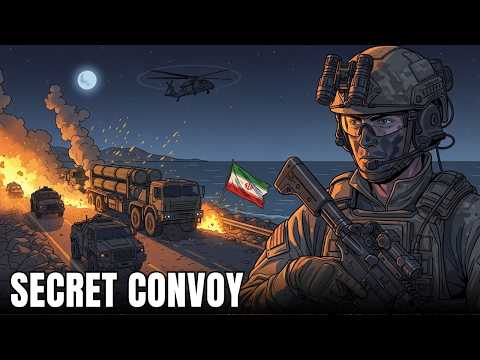
How Delta Force & Navy SEALs Tracked and Captured Iran’s Secret Missile Convoy
The War Archive
20m 24s2,476 words~13 min read
Auto-Generated
Watch on YouTube
Share
MORE TRANSCRIPTS