[0:03]Hi, I'm Pam McAusland, a psychology professor here at the University of Michigan, Dearborn. In this video, I'm going to be talking about media psychology. This is a relatively new area of psychology that focuses on all aspects of the media. Pamela Rutledge, who's a leading scholar in this area, has provided a general definition of media psychology. She defines media psychology as using psychological theory to understand how people use, produce or consume media. It's a very broad interdisciplinary area that has overlaps with fields including media studies and sociology. Other disciplines however, tend to be more focused on the media itself or the process of creating the media. Whereas media psychologist tend to be more focused on the individual who's either consuming or creating the media. Although psychologists have been interested in media for years, the rise of media psychology has come about as a result of a few different things that are going on. One is the rapid proliferation of media technologies. The other is the availability of content, in the past we had very little information that was available to us and it's just exploded over the years. And then another factor is how much on a daily basis people are using media and other various types of technologies. So, some of the research in media psychology has focused on the negative consequences or the negative aspects of media for both individuals and society. But increasingly, researchers are looking at some of the positive consequences of media use as well. As I've alluded to, this is a really broad field and I thought I'd give you a background on a few topics. A large body of this research has considered media effects, so when we talk about media effects, we're thinking about the effect of media on an individual's thoughts, feelings and behaviors. This can be either in the short term or in the longer term. For example, the APA Division 46 recently put out a task force report that looked at the sexualization of music and the effect of having increasingly sexual content in music. And what they find is that for young people in particular, exposure to increasingly sexual content seems to have an effect on individuals' attitudes about themselves. People tend to feel more self-objectifying when they're listening to this music. A recent experimental study that was done by Dylan and Bushman in 2017 looked at the effect of guns on young children. They had young children watch a 20 minute clip of a PG movie that contained guns.
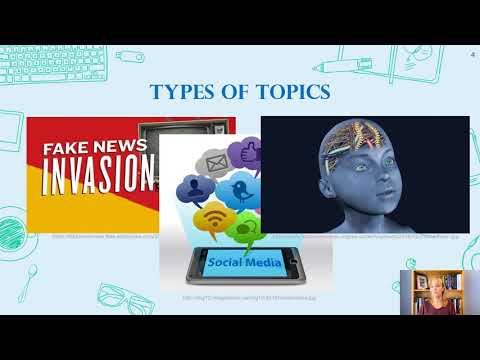
[2:35]And then saw that those kids were more likely to show interest and play with an actual, but disabled gun compared to a control group of kids who watched a 20-minute clip of the same PG movie that had been edited to remove all of the guns. So there was an immediate effect of seeing guns in this movie, so that the kids who saw it were more interested and more likely to actually play with what was an actual real gun, although it had been disabled. For each of these areas, it's really important to understand that the results are quite complicated and the the factors that are going into this are really complex. So there's lots of factors that influence if and how these media effects are actually expressed. Fake news has recently received a ton of attention and this area focuses on whether and how viewing fake news influences people's attitudes and behaviors. Another body of research has focused on how social media influences us both as consumers and as creators of content. And then finally, another research area that is part of media psychology looks at artificial intelligence. Researchers are working to create virtual humans, those that can simulate parts of the human experience, including things like human communication, reasoning and behavior. Although a lot of these AI creations are seen in games, increasingly we're seeing AI used in a variety of training and educational interventions as well. There's numerous career paths that are available to somebody who has a background in media psychology. Remember, this is an intersection of psychological research and theory with an understanding of media and technology. So educating others is an important area that media psychologists work in. Some people might work in developing and implementing media literacy programs for young people. Others might work by helping educators to integrate technology into the educational curriculum. And yet others go on with a PhD to be teaching media psychology in post secondary institutions. Research focused on various ways that humans interact with media and technology is booming. And another area where a background in media psychology is going to be increasingly useful is in advertising and marketing. And finally, last but not least, knowing how humans interact with technology will be critical in the healthcare field in the future. For example, using technology to support healthcare monitoring and lifestyle change is going to be really important as we move into the coming decades. If you're interested in learning more about media psychology, consider taking psych 427. This is the media psychology class and it's going to be offered most winter semesters. I've also provided a couple of websites here if you're interested in learning more about this field. The first is the American Psychological Association Division 46 website. This is the society for the study of media psychology and technology. The second is for the media psychology Research Center. This is a really useful resource, it talks about all different types of recent research that's coming out across varied areas in media psychology. And finally, if you have any questions, feel free to get in touch. My email is there and I look forward to hearing from you. Thanks.


