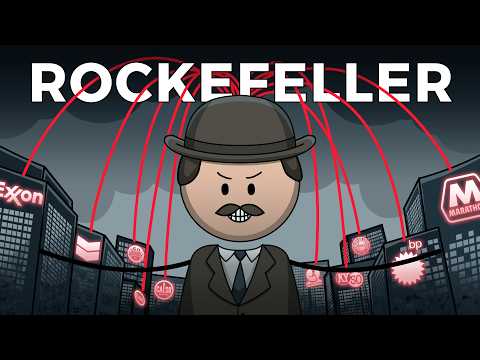
[0:00]This man controlled 90% of America's oil. And when the government shattered his empire to stop him, he actually became richer. This is the story of John D. Rockefeller, the most hated businessman who became the world's first billionaire. July 8, 1839, Richford, New York. A baby was born into poverty. His name was John Davison Rockefeller. His mother, Eliza, was pious, devoted, a devout Baptist, who believed in honesty, hard work, and God. His father, William, he believed in none of those things. William Avery Rockefeller, known to locals as Devil Bill, was a phantom, a con artist. He masqueraded as a traveling salesman to mask a darker reality. Papa, where do you go when you leave? Business, son. Important business. That "business" was cruelty itself. Bill sold colored water as cancer cures to the dying. He posed as a deaf-mute beggar to eavesdrop on farmers, only to use their secrets to swindle them later. He didn't just want their money. He wanted to watch them lose everything. And he treated his own family the same way. I cheat my boys every chance I get. I want to make 'em sharp. One day Devil Bill placed young John on a high chair. Jump, son! I'll catch you! The boy jumped. The father stepped back. John crashed into the floorboards. Remember. Never trust anyone completely. Not even me. That was John's entire education. Trust is weakness. The world is a battlefield. And if you're not the predator, you're the prey. By 1849, Devil Bill took his philosophy to its logical extreme. After being accused of sexual assault and facing mounting scrutiny, he fled to Canada and vanished completely. He took a new name, Dr. William Livingston, married a second woman while still married to Eliza, and lived a double life for 50 years. He abandoned his family, left them penniless, and John never forgot. At 16 year old, he became the man of the house. Quiet, intense, obsessed with the one thing that never lied. Numbers. He enrolled in a three-month bookkeeping course. Then, he landed a job as an assistant bookkeeper, earning 50 cents a day. He was meticulous to the point of neurosis, recording every single penny he made or spent in a small red book he called Ledger A. By age 20, he'd saved $800 through pure austerity. But to enter the world of real business, he needed more. So he did something that probably killed him inside. He asked his father for money. Devil Bill agreed to lend him $1,000, but true to form, he charged his own son 10% interest and warned him he might demand it back at any moment. “just to keep you sharp.” John didn't argue. He took the money and formed a partnership with an older, more established man, named Maurice Clark. They started as produce merchants, selling beans, pork, and oats. It was safe and steady. Then 1859 happened, the Pennsylvania oil strike. The world was suddenly drowning in black gold, and Cleveland became refinery central. John, this oil business is chaos. It's a gamble. People will always need to eat, so let's stick with what we got. No, you don't understand. People will always need to see in the dark. Oil is the light. Against Clark's judgment, they took on a brilliant chemist named Samuel Andrews and built a refinery. But the tension between the partners grew like a cancer. Rockefeller wanted to borrow aggressively to expand. Clark, terrified of debt, tried to reign him in. By 1865, the partnership reached a breaking point. They couldn't agree on the future, so they decided to dissolve the company. The refinery would go to whichever partner could bid the highest at a private auction. It was a showdown. The bidding started at $2,000. 3,000. 5,000. 10,000. Clark's face grew pale, but he couldn't imagine a 25-year-old having the stomach or the capital to go higher. He decided to end it. Fifty thousand, John. Walk away. The room went dead silent. Clark was already reaching for his coat, certain he'd just won.
[4:37]Until, 72,500. The smirk vanished. Clark realized then that John would bid until he was bankrupt or dead. He threw up his hands. I'm done. The business is yours. John D. Rockefeller had won. He shook Clark's hand, walked out of the room, and later said, That was the day that determined my career. Now, John was the master. He renamed the company Rockefeller and Andrews, and he began to apply the Ledger A mindset to the dirty world of oil. At the time, refining was incredibly wasteful. Most refiners only wanted kerosene for lamps. They would dump the waste, gasoline, naphtha, and tar, straight into the river. Rockefeller looked at that river and saw money disappearing. If we can't burn it, we sell it. Together with his partner, Rockefeller stopped the waste. Andrews found ways to turn that refinery sludge into lubricating oil and paraffin wax. He didn't stop there. He bought his own forests to make his own barrels and even built his own kilns to dry the wood. By cutting out every middleman, he could sell his oil cheaper than anyone else and still make a profit. By age 30, the "bookkeeper" had done it. He owned the largest refinery in Cleveland, the oil capital of the world. Most men would have stopped there and enjoyed their fortune. But John didn't look at his success, he looked at his surroundings. As he stood over the smoky skyline, he saw hundreds of small, inefficient refineries competing for scraps. To Rockefeller, these weren't rivals to be respected. They were a mess that was ruining the industry. I will take these broken pieces and forge them into one, and I will be the one.
[6:28]January 10th, 1870. John D. Rockefeller, along with a handful of associates, officially incorporated the Standard Oil Company. He was building a machine designed to swallow every competitor in its path. To do it, he didn't look at the oil wells. He looked at the veins of the nation, the railroads. Railroads were in a death spiral, slashing rates to steal business from one another. Rockefeller smelled blood. He walked into the offices of the Railroad Kings and said, Gentlemen, I can guarantee you sixty carloads of oil. Every. Single. Day. Rain or shine. Sixty? That's more than the rest of the valley combined. Exactly. And in exchange, I want a secret partnership. This was the South Improvement Company, S.I.C. It was a shell company designed to act as a cartel between the biggest refiners and the railroads. It had three ruthless pillars. First, the rebate. Rockefeller got a massive discount on every barrel he shipped. Second, the spy network. The railroads gave John detailed reports on his rivals, where they were shipping, who they were selling to, and at what price. And, the kill shot, the drawback. Every time a competitor shipped a barrel of oil, the railroad took a portion of their money and handed it directly to Rockefeller. It was brilliant. It was legal. He would invite a competitor to his office at 26 Broadway, sixth floor, calm as a deacon, and lay out a simple proposal. You see the rates, friend. I am being paid for every barrel you ship. If you stay in the game, you will go bankrupt. Sell to me now for Standard Oil stock or cash, or you will be crushed. Your choice. In one particular negotiation, a refinery owner made the mistake of refusing the offer. Rockefeller stood up, walked to the window, and opened it wide. Bill, come look at this view.
[8:29]Six stories up. Beautiful, isn't it? The wind was howling. He approached nervously. You know, if a man were to slip here, fall out this window, all it would take is six seconds, and he would quickly become a name in the Cleveland obituaries. To remove your name from public obituaries, use Incogni. Right now, thousands of data brokers are collecting your information, your full name, email, home address, phone number, even your relatives' names, and trading it without your knowledge. This isn't about spam. It's about real threats. Scammers crafting phishing attacks with your details, criminals opening credit accounts in your name, or strangers showing up at your door. I created my Incogni account. They've reached out to dozens of data brokers demanding removal and handle all the legal pushback automatically. Their custom removal feature on Unlimited and family unlimited plans lets you point to any people search site where your info appears, and a privacy agent manually removes it. After using this for a while, I've watched my exposure shrink in real time. Victims of identity theft may spend months or years repairing the financial and reputational damage, damage that could have been prevented. Go to Incogni.com/crayoncapital and use code CRAYON CAPITAL for 60% off. They can't harm you if they can't find you. That's Incogni.com/crayoncapital, code Crayon Capital for 60% off. Between February and March 1872, the massacre peaked. In one legendary 48-hour window, he swallowed six refineries. One by one. Door by door. In less than three months, 22 of the 26 refineries in Cleveland had surrendered. But then someone leaked the secret, and the public exploded. In late March, the oil regions went ballistic. They burned Rockefeller in effigy. They marched with torches against the Anaconda. The pressure was so intense that the Pennsylvania Legislature revoked the S.I.C. charter within months. The public cheered. They thought they had won. They were wrong. Rockefeller didn't care about the South Improvement Company anymore. Why? Because by the time they killed the deal, he already owned Cleveland. I will dominate. Yet Cleveland was just the beginning. He began to look at the map of America like a general planning total war. What he invented next would become the blueprint for every monopoly in history. This was vertical integration. If a rival in another state refused to sell, he cut off their oxygen. He bought the companies that manufactured the white oak barrels. He bought the warehouses. He even bought the chemical plants that produced the acid needed for refining. Suddenly, his competitors found that even if they could refine oil, they couldn't find a barrel to put it in or a chemical to treat it with. But there was one final obstacle: the Independent Pipe Line. In a last-ditch effort to survive, Pennsylvania oilmen began building a massive 110-mile pipeline to pump oil directly to the coast, bypassing Rockefeller's railroads. It was a feat of engineering meant to break Standard Oil's back. Rockefeller's response? Scorched earth. He bought strips of land across the pipeline's path to halt construction with trespassing lawsuits. When that didn't work, his teams engaged in pipe wars, sabotaging lines and bribing local officials to pull permits. By the time the pipeline was finished, the independent companies were exhausted and bankrupt. Rockefeller simply walked in and bought the pipeline for pennies on the dollar. One by one, the dominoes fell. From Cleveland to the Atlantic Coast, the independent oil man was becoming an extinct species. Children watched their fathers break. By 1879, the "bookkeeper" had finally finished the map. He sat a top 90% of the entire industry. He had consolidated the chaos. He had won the great game. But there was a new problem. When you own 90% of the world, you have a massive target on your back, and that target was about to be painted red.
[12:47]By 1882, Rockefeller had won the war, but now he had to figure out how to rule an empire that wasn't supposed to exist. Standard Oil was now a sprawling web of dozens of companies across multiple states. Back then, American law was simple. A company in Ohio wasn't allowed to own stock in a company in Pennsylvania. His empire was a giant, held together by secret handshakes and verbal gentlemen's agreements. It was fragile. So Rockefeller's lawyers invented something the world had never seen before. A ghost that could own everything and answer to no one. On January 2nd, 1882, Rockefeller and eight associates signed a secret document. They pooled the stock of 40 different companies into one single massive entity controlled by nine trustees. It was called The Trust. It was a legal shell game. If a government regulator asked who owned a refinery in New York, the answer was a maze of paperwork that led nowhere. As a journalist would later write, you could argue its existence from its effects, but you could not prove it. From his office at 26 Broadway in New York, a building known as the Temple, Rockefeller wasn't just refining oil anymore. He was optimizing the world. He applied his Ledger A obsession to a global scale. He was famously obsessed with the last drop, once ordering a factory to use exactly 39 drops of solder to seal a kerosene tin because 40 was a waste and 38 leaked. That one drop saved a fortune if we multiply that across millions of tins. This was the 'Standard' way: perfection through obsession. But Rockefeller's vision went far beyond American shores. He realized that while America had the oil, the world had the darkness. He flooded the markets of Asia with iconic blue five-gallon tins. In China, he gave away millions of small kerosene lamps for free. If you give a man a lamp, you own his nights. To keep the light burning, that man had to buy Rockefeller's oil for the rest of his life. The results were staggering. He drove the price of kerosene down from 30 cents a gallon to just 8 cents. For the first time in human history, the poor could afford to stay awake after sunset. By the 1890s, the bookkeeper was worth over 900 million dollars, roughly 1.5% of the entire American economy. But the numbers were the only thing still growing. As the empire reached its peak, the man began to wither. Success was eating him from the inside out. Rockefeller developed alopecia. His hair fell out in clumps. His head, his eyebrows, even his eyelashes. He became a ghostly, hairless figure, eventually forced to wear a rotating set of wigs of different lengths to mimic natural hair growth. He lived on a diet of crackers and milk because his nerves had destroyed his digestion. And while Rockefeller was hiding in his temple, a new kind of enemy was sharpening their pen, ready to reveal the one secret the ledger couldn't hide. 1902. A storm was brewing in the offices of McClure's Magazine. It was led by a woman named Ida Tarbell. She was a journalist and a survivor. Decades earlier, her father had been an independent oil man in Pennsylvania. She had watched firsthand as the Standard Oil Anaconda squeezed the life out of her father's business and spirit. This was her golden opportunity for revenge. For two years, she became a detective hunting one thing, proof that the ghost existed. She hunted down former employees discarded by the machine. She unearthed secret contracts buried in railroad basements. She painstakingly mapped the rebates, the drawbacks, and the spy networks. But then, the investigation took a scandalous turn. A bombshell hit the headlines that no amount of corporate secrecy could hide. Devil Bill. The public learned that John was the son of a wanted criminal, a bigamist who was currently living a double life under a fake name. The mask of the deacon was ripped away. Rockefeller was paralyzed. For the first time in his life, he couldn't control the game. He refused to comment, retreating further into his estates as the public's awe turned into pure unadulterated hatred. Tarbell's History of the Standard Oil Company became the most dangerous book in America. It gave the public a face to hate. And it gave a young, bold president the ammunition he needed. Theodore Roosevelt launched a scorched-earth antitrust investigation that wound through the courts for years. May 15, 1911. The day of reckoning arrived. The U.S. Supreme Court delivered the final blow. They declared Standard Oil an unreasonable monopoly. Their order, the empire must be destroyed. The Trust was shattered into 34 separate pieces. Those fragments would eventually grow into global powers like Exxon, Mobil, and Chevron. At 72 years old, the world believed Rockefeller had finally lost. Actually, when the monopoly was broken up, Rockefeller didn't lose his ownership. He simply saw it decentralized. He still held his massive share of stock in all 34 new companies. Free from the "Standard" name and the legal shackles of the Trust, the value of those individual stocks skyrocketed. By 1916, as the world transitioned from kerosene lamps to the gasoline age, Rockefeller's wealth exploded. Front-page news across the country confirmed a staggering milestone. John D. Rockefeller had become the world's first confirmed billionaire. At a time when the average American earned just $800 a year, his personal fortune hit a literal 1 billion dollars. He had outlasted his father, his competitors, and even the United States government. But as the gold piled up, the old man realized he had one final enemy left. One he couldn't buy, and one he couldn't crush. Time. His time was running out. He hired the world's first PR experts to scrub the Standard blood from his name, appearing in public as a kindly grandfather, handing out shiny new dimes to children. He founded the University of Chicago and the Rockefeller Foundation, funding research that eradicated hookworm and yellow fever. Was it guilt? A genuine awakening? Or the final, brilliant con of a man who knew that history is written by the winners? We'll never know. What we do know is that on May 23rd, 1937, the machine finally stopped. John D. Rockefeller died at the age of 97. He missed his goal to live to 100, but he hit his other goal, to make $100,000, by a margin so large it defies human comprehension. As Rockefeller himself once put it: "I believe the power to make money is a gift from God...and since I have been given it, I believe it is my duty to make money and still more money, and to use the money I make for the good of my fellow man according to the dictates of my conscience."