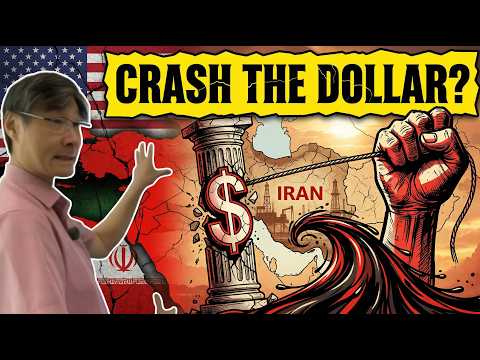
[0:00]Where do you think this war in Iran is going? How will it be resolved and what are the consequences likely to be? Well, thanks so much for inviting me to talk. I'm a huge fan. I've been admiring your work for a number of years now. Thank you so. So I think that this war in Iran will be very similar to the war in Ukraine, meaning that this will be drawn out. It'll be a war of attrition. Neither side will concede defeat, even though it is in the best interest to reach a ceasefire. And this will have dramatic consequences on the global economy. And this war could drag on for years and years. Already, we're seeing major repercussions on the global economy and that flights are being cancelled. So obviously Asia, they're running out of fuel. So they're asking people to stay at home. And in a few more months, experts are predicting a food shortage, meaning that nations will be forced into food rationing. And today, there's a major escalation in that the Israelis struck the largest gas field in Iran and Iran retaliated by attacking energy infrastructure of the GCC. And Iran has stated that its purpose, its goal, its strategy is to move oil to $200 a barrel, which will have a really significant impact on the global economy because the entire global economy is based on access to cheap energy. So unfortunately, I think that we can expect this war to drag on for years and years. Eventually, America will send in ground troops. Eventually, the full homos will be contested. Eventually, this will spread all across the world. Eventually, other nations will be drawn in. So Saudi Arabia is thinking about declaring war on Iran and Saudi Arabia has a mutual defense pact with Pakistan. So Pakistan will be drawn into this into this war. So things are spiraling out of control. And just recently, Ali Lani, who is the de facto head of the Iranian war effort, was assassinated and he was a pragmatic elder statesmen in Iran, who had who had the authority to negotiate a ceasefire. Now that he's gone, there really is no more off ramp. So sides are committed to a long war of attrition and the consequences for the entire global economy are quite dire. So my question is, because there are so many global players, big global players, the US and China, I think, who would be hurt by this. Why is there not an incentive to get it settled quickly and why can't that happen? Right. So once this war starts, it it achieves a momentum and a logic of its own. So the United States has it doesn't really have an off ramp. Meaning that if it tries to negotiate a ceasefire with Iran, Iran would ask for reparations about $1 trillion. Basically, they would ask for the United States to leave the Middle East permanently to ensure its long-term survival. If the United States were to do that, then the GCC, the GCC nations will collectively become client states of Iran, because only Iran can guarantee their safety as well as use of the shared humus. The GCC is the basis of the petrodollar. So what the GCC does is it sells oil in US dollars, and then recycles this money back into the American economy. So if the GCC were to abandon the petro dollar, then this would have severe repercussions on the American economy. Also, there'll be a chain, a chain reaction in that Japan and South Korea would look at what's happened in the Middle East and decide that the United States can no longer guarantee its their safety. So they would have to remilitarize, and they would have spent all their resources on on adapting to the possible China threat. And then you have Europe, then Europe would look at what happened in the GCC, as well as in Southeast Asia, and they would be like, why are we fighting Russia? Wouldn't it be in our best interest to negotiate a peace treaty with Russia as soon as possible? What this would mean the collapse of the US dollar as a global reserve currency. Remember that America is sitting on $39 trillion in debt. And so the American economy is a Ponzi scheme that relies on foreign nations to continually buy US dollars. So the US economy would not be able to withstand essentially withdraw from the Middle East. So the Americans are just stuck where they are right now, unfortunately. What is the Chinese perspective on this? I mean, it seems like China has an interest in peace in the in the Persian Gulf with those seven oil producing countries. Why wouldn't China step in and try and settle this? So both the United States and China benefit from the status quo. And China has a vested interest in seeing a very quick solution to this war in Middle East. China imports about 40% of its energy needs from the GCC. So not just Iranian oil, but also Qatari natural gas. Right. So as you point out, China very much wants to see as soon as possible a ceasefire. Unfortunately, um it is a nature of the Chinese government not to interfere in foreign affairs. It China doesn't really have a geopolitical framework, a grand strategy. It really believes in global trade, and it doesn't really have a framework for how to resolve armed conflict. And so Chinese policymakers are really stuck. And in fact, Chinese policymakers have come out publicly saying that they would like the carnage, the violence in the Middle East to stop as soon as possible and for the Strait of Hormuz to open up. But unfortunately, I point out previously, when war a war starts, it it achieves a momentum and a logic of its own. It's very hard to stop war once it starts. So if your prediction is correct, and I pray that it's not, I'm sure you do too, hope that yes, you're wrong. But if you're not wrong, Yes. And this continues to grind in the way that it is now, destroying energy infrastructure, really destroying the civilizations of the region, in Iran and the GCC.
[5:52]What does that look like in say two years globally? What's the effect on the global economy? Right. So this war, it will accelerate three major trends. And nations will have to adapt to a new reality in which energy is no longer cheap and accessible. The first major trend is deindustrialization, meaning that right now, you just have too many people living in in cities. And you can do that as long as you can import cheap energy and cheap food. But when cheap energy and cheap food are gone, then you need people to work the fields to grow food for your economy. So you have to deindustrialize and reduce your energy dependence. Okay, that's one major trend that we should see very soon. Second major trend we should see is remilitarization in that before we had Pax Americana, where America basically guaranteed global peace. And America basically prevented nations from going to war against each other. So for example, Trump brokered a ceasefire between India and Pakistan, because these two nations have much hostilities against each other. But now that America doesn't no longer has the aura of invisibility and ability, now that the American military does doesn't come across as almighty, then America doesn't have the power to stop kids from attacking each other on the playground anymore. So nations have to remilitarize, especially nations like Japan, which before rely too heavily on American military protection. Okay, so that's number two, the remilitarization of the world. And the third major trend we should see is mercantilism, meaning that now that global trade is disrupted, nations, especially advanced industrial nations such as Japan and Germany, they need to create their own independent self-sufficient supply chains. Fortunately, America doesn't have this issue because the Western Hemisphere is extremely wealthy and abundant in natural resources. But if you are Japan and Germany, then you have to reach out and expand your borders if you are to maintain your industrial might. So these are the three major trends we we should be seeing very quickly. So unfortunately, the biggest loser of this war, regardless of how how it turns out, okay, even if Americans were to win, the biggest loser is the GCC. Because for the past 30, 40 years, the GCC is basically built on a mirage, because it's essentially a desert with very little access to fresh water and very little agriculture. And so it couldn't really sustain a large population. But with the petrodollar and with American military protection, then the GCC nations felt free to invest in technology that allowed them to grow their population. Right? So these desalination plants, modern infrastructure. So you saw this massive growth in Dubai, in Qatar, in Riyadh. And what this war has done is shattered this mirage and revealed the limitations of the GCC. So for example, look at Dubai. So Dubai for many years has prided itself as is safe, very cosmopolitan, very open, tax haven. So a lot of wealthy people immigrated to Dubai. But because of this war, and we're not talking about like a few drones hitting hotels, it's really shattered the image of Dubai. And once you shatter this mirage, you can never ever rebuild it again. So the idea of Dubai as as like the future New York or London, the financial capital of the GCC, it's this mirage has evaporated. Iran, in five years? So Iran is being devastated right now. So the Israelis and Americans are attacking critical infrastructure. So the Israelis attacked the largest gas field in Iran. the desalination plant was destroyed. But we also remember what is being hidden from us. And what's being hidden from us is the fact that the Israelis and Americans are trying to destroy the capacity of the state to govern the nation, basically destroy the state's monopoly on violence. And so what we're hearing are attacks on police officers, on military installations, and there's talk of special forces going into, um, Iran and starting to fund dissident groups, right? Like the Kurds and the, um, Baluchis in Southeast Iran. So no matter what happens in this war, it's gonna be very hard for the government to maintain national control, even if they were to survive this war. And also another huge issue for Iran is that for the past few years, it suffered drought issues. So its agriculture was heavily impacted. They're actually talking about moving terrain, like moving these millions of people out of the city of terrain because the the capital can no longer sustain this large population. So this war will only exaggerate these environmental issues, especially with the attacks on critical civilian infrastructure, for example, dams, reservoirs, desalination plants. And it's gonna take years and years for Iran to recover from this war as a nation. And you you have basically the stirring of ethnic sentiments, the destruction of the state's capacity to deliver basic services. But the good news for Iran is that it seems as though they will be able to maintain control of the Strait of Hormuz, and that is critical because now they're able to charge a toll on anyone who uses a strait of Hormuz, and they talk about 10%, which generate about about $800 billion a year annually for Iran. So the nation will be destroyed in this war, but it but if it's able to harness the pride of the Persian people, if it's able to unify the Persian people, and it's it's able to leverage the resource of the Hormuz effectively, then uh we can expect Iran to rise again in like 10 to 20 years time. Where is Israel in a few years from now? So if you look at the main beneficiary of this war, it is Israel, because Israel has an ambition called the Greater Israel project, which is what they believe that their God, Yahweh promised to their ancestor Abraham. And so they believe that Yahweh promised Abraham all the land from the Nile in Egypt to Euphrates in Iraq. If you look at the entire map, it also extends to Anatolia, which is Southern Turkey, and even into Saudi Arabia. So if you look at what's happening, well, it's convenient in that the GCC is being destroyed. Saudi Arabia will probably be drawn into this war. It is possible Turkey will be drawn into this war as as well. And this war allows Israel to remake the Middle East in its own image. Also, if you think about it, according to game theory, the main constraint to Israel achieving the greater Israel project is actually not Iran, but America. Because America guarantees the military safety and protection of the GCC. Uh, Saudi Arabia, Qatar, Kuwait, Bahrain, UAE, these nations. And so if issue is, it's become dominant, it's become the hegemon of the Middle East, it needs to figure out how to remove America from the equation. And quite honestly, this war has shown the limitations of American power. It's it's really annoying American people. The American people do not want this war. The American people haven't don't even understand why America is standing in the Middle East. And so it's very possible that regardless of what happens in this war, America is forced to withdraw from the Middle East, in which case Israel is able to achieve its greater Israel project. The reality is that war in the Middle East is having a severe impact already on the entire Southeast Asian economy. So India imports about 60% of its oil from the GCC. Pakistan also imports the majority of its oil. Japan imports about 75% of its oil from the GCC. China imports about 40%. Okay. So all these countries are being impacted. And already Thailand, Vietnam are running out of fuel. And you when you go to gas station, there's no more fuel for your motorbike. And now people are being forced to work from from home. There's there's fuel rationing. There's no jet fuel. So this is impacting all of Southeast Asia. So the question isn't like who will be impacted, because everyone's impacted. The question is who will be most resilient and the most willing to innovate and adapt to this new reality? Because we're not talking about short-term war. We're talking about a long-term change to the global economy. And I think that China will actually be um, the least resilient and the least ready to adapt to this new reality because for the past 30, 40 years, China has got has gotten very wealthy because of the global economy, where it imports cheap energy and exports manufactured goods. And the entire Chinese economy is currently based on this model now. Now for the past 20 years, China has been moving towards a consumer-based economy and more of an innovation-based economy AI. But unfortunately, AI itself is dependent on cheap energy. And Chinese consumers are refusing to spend money for a variety of reasons, primarily because they're not they are not optimistic about China's um, um, growth for the in the future. So so Chinese household savings is about 40%. And unless the government is able to get Chinese to spend more money, then it will be very hard for the Chinese economy to move towards a consumer-based economy. So all of Southeast Asia will be impacted, and I think China will be impacted uh the most in the long term. Maybe not in the short term because China still has access to Iranian oil. You know, Scott Batson announced today that they will lift sanctions on Iranian oil in order to make sure the global economy is not too impacted by this war.


