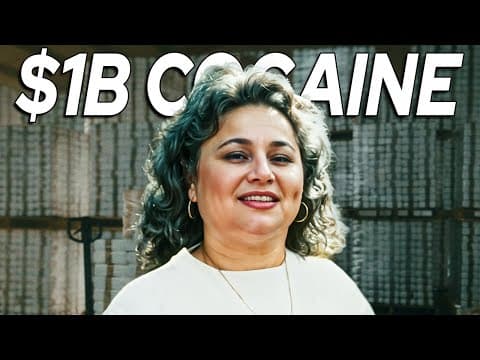
[0:00]What if I told you that one of the richest women in history wasn't a tech mogul, a Hollywood star or an oil heiress, but a Colombian grandmother who built a $2 billion empire from the shadows of Miami's cocaine underworld. Meet Griselda Blanco Restrepo. They called her the Godmother of cocaine. Others whispered she was the Black Widow. But here's what most people don't know. At her peak, this woman was generating $80 million per month. That's more money flowing through her hands every 30 days than most Fortune 500 companies make in a year. While Pablo Escobar grabbed headlines with his flashy lifestyle and political ambitions, Griselda was quietly building something far more sophisticated a criminal empire that would make her one of the wealthiest people on the planet. But this isn't just a story about money. It's about how absolute power corrupts absolutely and how the very violence that built her fortune would ultimately destroy everything she touched. Today, we're stepping inside the billion dollar world of the most feared woman in criminal history. From her $500 million real estate portfolio to her private jets, from her custom lingerie smuggling operation to the motorcycle Hitman she allegedly invented, this is the rise and fall of Griselda Blanco's Cocaine Empire. But before we dive into the billions, we need to understand where this all began. Because Griselda's story starts in the most unlikely place, absolute poverty. Born in Colombia in 1943, Griselda Blanco grew up in conditions most of us can't imagine. Her childhood was marked by violence from the very beginning. Reports suggest that by age 11, she had already committed her first murder during a botched kidnapping attempt. Think about that for a moment. While most kids were playing with toys, Griselda was learning that violence was the ultimate currency. This wasn't some Hollywood movie. This was real life in the slums of Colombia, where survival meant adapting to brutality or becoming its victim. And Griselda, she chose to master it. By her late teens, she was supporting herself through theft and prostitution. But everything changed when she met Alberto Bravo, a drug trafficker who would become her second husband. Through Bravo, she entered the world of cocaine smuggling in the early 1970s. And that's when her true genius revealed itself. You see, while other trafficker were using crude methods like hiding drugs in dog cages, Griselda was thinking bigger. Much bigger. She commissioned a line of custom-made lingerie with secret compartments designed specifically for smuggling cocaine. Bra and girdles that could carry packages of what she called white gold past unsuspecting customs agents. This wasn't just innovation. This was the birth of a billion-dollar empire.
[2:55]Here's where Griselda's story gets absolutely insane, because what happened next would change the drug trade forever. In 1975, Griselda made a move that would define her entire criminal career. During a confrontation with her husband Alberto Bravo over missing money, a shootout erupted in a Bogota nightclub parking lot. When the smoke cleared, six bodyguards and Bravo himself were dead. Griselda survived with a gunshot wound to the stomach. But here's the chilling part. She had orchestrated the entire thing. This wasn't self-defense. This was a calculated execution that gave her complete control of their trafficking operation and it earned her a nickname that would haunt the criminal underworld for decades. The Black Widow. With Bravo gone, Griselda relocated to Miami in the late 1970s and this is where her empire truly exploded. Working in collaboration with the notorious Medellin cartel, she established control over cocaine distribution along the entire Eastern seaboard of the United States. The numbers from this period are staggering. At its peak, Griselda's network was smuggling more than three tons of cocaine annually into the United States three tons. That's 6,000 pounds of pure cocaine flooding American streets every single year from just one operation. But the real genius was in her distribution network. She wasn't just moving drugs randomly. She was supplying cocaine to a high profile clientele that allegedly included movie stars, Wall Street tycoons and famous professional athletes. This wasn't street level dealing. This was a luxury service for America's wealthiest markets. And the money, the money was beyond comprehension.
[4:40]Let me put Griselda's wealth into perspective for you. During the 1980s, her organization was generating $80 million per month. Every single month, that's nearly $1 billion per year in consistent cash flow. To understand how massive this is, consider that in today's money, we're talking about roughly $2.5 billion annually. That would make her operation larger than many multinational corporations. But here's the difference. Every single dollar was pure profit. No taxes, no shareholders, no regulatory compliance costs. This immense cash flow created a logistical nightmare that most people can't even imagine. The money was arriving so fast that it became impossible to count, let alone launder effectively. Her brother Roberto, who served as the cartel's accountant, later admitted that nearly 10% of all stored cash was lost to rats, mold and water damage. That's over $2 billion per year literally rotting away because there was simply too much money to properly manage. Think about that. Griselda was so wealthy that losing $2 billion annually to decay was just a cost of doing business. The cartel spent around $2,500 every month just on rubber bands to keep stacks of dollars together. On one occasion while hiding from authorities, Griselda burned $2 million in bank notes just to keep her daughter warm during a cold night money had become so abundant that it was treated as fuel. But where did all this money go? This is where Griselda's story becomes even more fascinating. With billions flowing through her organization, Griselda lived a life that redefined luxury. But unlike other drug lords who flaunted their wealth publicly, she was strategic about her spending. Her primary investment strategy focused on real estate, lots of real estate. DEA estimates placed the value of her total properties at over $500 million. But that might have been conservative. Research suggests she owned as many as 200 properties across Colombia and the United States, including large farms, estates, and urban properties. Her crown jewel was a massive 1,500 square meter mansion in the Lombardy urbanization of Medellin, surrounded by extensive gardens. But this wasn't just a home, it was a fortress designed to project power while providing security. In Miami, she maintained a lavish mansion that became legendary for its cocaine infused parties. These weren't typical social gatherings. They were displays of power where extreme depravities occurred under the protection of armed guards. The party served a dual purpose. They reinforced her status among criminal associates, while demonstrating the lifestyle that loyalty to her organization could provide. But perhaps the most telling symbol of her wealth was her private jet. While most people save for years to afford a vacation flight, Griselda owned an entire aircraft. This wasn't just transportation, it was a mobile command center that allowed her to oversee operations across multiple countries while living in absolute luxury. The jet also served a practical purpose. When you're moving billions in cash and coordinating international drug shipments, commercial flights simply aren't an option. Her private jet gave her the freedom to travel anywhere, anytime, without questions or customs inspections.
[8:09]But here's where Griselda's story takes a dark turn, because all of this wealth came with a price that would ultimately destroy everything she built. Griselda didn't just participate in the drug trade. She revolutionized it through violence. Her tenure in Miami coincided with what became known as the cocaine Cowboy Wars, a period of unprecedented brutality that transformed the city into a battleground. Her most infamous contribution to criminal tactics was the alleged invention of the drive-by execution, carried out by gunmen on motorcycles. This wasn't random violence, it was calculated psychological warfare. The motorcycle Hitman could strike anywhere, anytime in broad daylight and disappear into traffic before anyone could react. This tactic offered swift anonymity and allowed for public assassinations that sent a clear message, cross Griselda, Blanco, and death will find you anywhere. The psychological terror inflicted by this method helped stabilize her rule by making betrayal unthinkable for subordinates and resistance impossible for rivals. The human toll was staggering. Authorities estimate that around 200 homicides across New York, California, Florida, and Colombia were directly attributed to orders from Griselda. But these weren't just numbers. Each death was a calculated business decision, designed to protect her billion-dollar empire. One of the most notorious incidents occurred in 1979 at Dale and Mall. A truck labeled happy time complete party supply pulled into the parking lot carrying two of Griselda's assassins. When police recovered the vehicle, they described it as a war wagon due to its thick steel walls and dozens of high-powered firearms. But perhaps the most chilling example of her brutality was the 1982 assassination attempt targeting Jesus Castro. The hit went wrong when a drive by shooter accidentally killed Castro's two-year-old son instead Griselda's reaction revealed the depth of her sociopathy. She expressed no regrets about the toddler's death, declaring that she and Castro were now even. This level of cruelty wasn't just business. It was personal brand management through terror.
[10:27]Despite her meticulous organizational structure, Griselda's empire contained the seeds of its own destruction. And those seeds were planted in the very relationships that had built her power. Her pattern of eliminating husbands began early. After killing Alberto Bravo for allegedly skimming money, she reportedly had her third husband, Dario Sepulveda, murdered as well. This wasn't just about business disputes, it was about absolute control. But the greatest tragedy of Griselda's empire was what happened to her own bloodline. She had four sons, Dixon, Uber, Osvaldo, and Michael Corleone. Yes, she actually named her youngest son after the fictional character from the Godfather, perhaps recognizing the irony of a character who tried to escape his criminal family's grasp. The three older sons followed their mother into the drug business, and all three were killed under suspicious circumstances while Griselda was serving time in prison. Think about that. The violence she had unleashed on her rivals ultimately consumed her own children. Only Michael Corleone Blanco survived, managing to break free from his mother's dark legacy, though not before witnessing unspeakable acts of violence. The fact that her three oldest sons perished due to the conflict she had initiated, demonstrates that the violence she inflicted on others was ultimately turned against her own dynasty. This wasn't just criminal justice. This was poetic justice on a scale that even Shakespeare couldn't have imagined. By the mid-1980s, the walls were closing in on Griselda's empire. The same violence that had built her fortune was now attracting unprecedented law enforcement attention. On February 17th, 1985, DEA agents arrested her at her home in California. The woman who had evaded capture for over a decade was finally in custody. She was charged with conspiring to manufacture, import, and distribute cocaine and sentenced to 15 years in prison with a $25,000 fine. But here's where the story gets even more interesting. Florida prosecutors wanted to try her on multiple counts of first-degree murder, charges that could have resulted in the death penalty. Their case relied heavily on the testimony of Jorge Ayala, her former Hitman, who had agreed to become a government witness. However, the case collapsed due to an unprecedented scandal. It was revealed that Ayala had been involved in a phone sex scandal with two secretaries employed by the State Attorney's office. This breach of protocol severely compromised his credibility and created legal technicalities that derailed the prosecution. The institutional failure surrounding the Ayala scandal literally saved Griselda's life. Facing a collapsed case, prosecutors were forced to offer a reduced plea deal. In 1998, she pleaded guilty to three counts of second-degree murder and was sentenced to 20 years in prison, designed to run concurrently with her existing federal sentence. A potential death sentence had been reduced to a prison term that would eventually lead to her release and deportation. After nearly two decades in US custody, Griselda was granted compassionate release in 2004 due to frail health. She was immediately deported back to Colombia. Despite her lengthy imprisonment, her strategic money laundering had been effective. She had successfully hidden millions of dollars in various real estate holdings and financial instruments throughout Colombia. This vast financial cushion allowed her to live comfortably in an upscale gated community in Medellin. For eight years, it seemed like Griselda had achieved the impossible. She had survived the drug trade and retired on her ill-gotten gains. She was no longer the flashy cocaine queen of Miami, but she was financially secure and seemingly safe. But on September 3rd, 2012, the past finally caught up with her. While leaving a butcher shop in Medellin with her pregnant daughter-in-law, Griselda was shot dead on the sidewalk. She was 69 years old. The method of her execution was chillingly appropriate. She was killed by a gunman on a motorcycle, the very assassination techniques she was credited with inventing decades earlier. The irony was perfect and terrifying. Despite successfully evading the death penalty in the US justice system and retiring on her billions, Griselda remained subject to the lethal code of retribution she had pioneered. Her death was the ultimate manifestation of the terror she had unleashed. The woman who had ruled through violence died by violence, the innovator of motorcycle assassinations was killed by a motorcycle assassin. The cycle was complete. So what can we learn from Griselda Blanco's billion dollar Empire? Her story serves as the ultimate case study in how wealth built on violence is ultimately self-destructive. The estimated $2 billion fortune provided her with private jets, luxury mansions, and the ability to live like royalty. But this wealth was intrinsically tied to a culture of systematic violence and psychological corruption. The opulence she enjoyed was perpetually unstable and ultimately poisonous. It led to constant paranoia, the elimination of two husbands, and most tragically, the violent deaths of three of her four sons, her success guaranteed a life consumed by the very paranoia and lethal retribution she had unleashed. Griselda showed that while financial success can be achieved through ruthlessness, that success ultimately destroys the framework required for long-term security. She achieved the pinnacle of criminal power, only to discover that her power guaranteed a life of fear, isolation, and inevitable violent death. Her legacy lives on in the methods she pioneered, the violence she normalized, and the cautionary tale she represents. She proved that in the criminal underworld, there are no permanent winners, only temporary survivors.


