[0:00]Have you ever wondered why Japan has one of the longest life expectancies in the world, why their cities are spotless, why so many people seem calm, focused, and purposeful? It's not genetics, it's not luck, it's habits. Tiny habits that most people overlook, habits so small they seem almost insignificant. But that's exactly why they work. Today, I'm going to show you eight tiny Japanese habits that create massive differences in your life. Not in dramatic overnight transformations, but in the kind of deep, lasting change that compounds over years. These aren't complicated rituals, they're not time-consuming practices, they're small, almost effortless actions. But when you do them consistently, they reshape everything. Because in in Japan, there's a saying. The nail that sticks out gets hammered down. But there's another side to that philosophy. When everyone moves in harmony, the whole society rises. So let's talk about what that actually looks like in daily life. The first tiny habit is called Kaizen, and it might be the most powerful concept you'll ever learn. Kaizen means continuous improvement, but not the kind where you overhaul your entire life on January 1st and burn out by February. It's the opposite. It's about making improvements so small they're almost invisible. 1% better every day. That's it. In Japanese companies, this philosophy is everywhere. Toyota became one of the most successful car manufacturers in the world because of Kaizen. Not by making massive changes, but by encouraging every worker every day to find one tiny thing to improve. A process that could be one second faster, a tool that could be placed two inches closer, a step that could be eliminated entirely. It sounds insignificant, but when you do that every single day for years, the compound effect is staggering. And this doesn't just apply to factories, it applies to your life. Wanna get in shape? Don't commit to the gym for an hour every day. Do one push-up. Just one. That's so easy you can't say no. And once you do one, you'll probably do five, then 10, and before you know it, it's a habit. Wanna read more? Don't force yourself to read for an hour. Read one page. One page is nothing. But one page a day is 365 pages a year. That's more than most people read in five years. Kaizen removes the friction, it makes improvement invisible until the results become undeniable. Because the goal isn't to transform overnight. The goal is to never stop moving forward. And that brings us to the second tiny habit, Ikigai. Ikigai is your reason for being. It's the thing that makes you wake up in the morning, not your job, not your responsibilities, but the thing that gives your life meaning. In Okinawa, one of the blue zones where people regularly live past 100, almost everyone can tell you their Ikigai. And researchers believe that sense of purpose is one of the main reasons they live so long. Because here's the thing. When you have a reason to wake up, your body wants to keep going. But when life feels meaningless, your health declines, your energy drops, you age faster. Ikigai isn't about grand ambitions. It's not about changing the world or becoming famous. It can be as simple as tending a garden, teaching a skill, spending time with grandchildren, creating something with your hands. The key is that it's yours. It's not what society tells you to care about. It's what genuinely makes you feel alive. And here's the framework the Japanese use to find it. Ikigai sits at the intersection of four things: what you love, what you're good at, what the world needs from you, and how you can be paid for it. When you find something that touches all four, that's your Ikigai. And when you live according to that, everything else falls into place. But most people never sit down and ask themselves these questions. They just drift. They do what they're supposed to do, and they wonder why life feels empty. So pause, right now, and ask yourself. What do I love? What am I good at? What does the world need from me, and how can I support myself doing it? You don't need all the answers today, but if you start asking the questions, the answers will come. The third tiny habit is Harahachi Bu, and it's one of the simplest ways to live longer. Harahachi Bu means eat until you're 80% full, not stuffed, not satisfied, just 80%. In Okinawa, people say this phrase before every meal. It's a reminder, a tiny moment of mindfulness, and it keeps them from overeating. Because here's the problem. Your brain takes about 20 minutes to register that you're full. So if you eat until you feel full, you've already overeaten. You've consumed more than your body needed. And over time, that extra 20% adds up. It leads to weight gain, sluggishness, inflammation, all the things that make you age faster. But if you stop at 80%, you give your body exactly what it needs, nothing more, and that slight calorie restriction has been shown to extend lifespan in almost every species studied. Now, this doesn't mean starving yourself. It means eating slowly, paying attention, putting your fork down between bites, asking yourself, am I actually still hungry or am I just eating because it's there? Most people eat on autopilot. They finish what's on the plate because that's what they're supposed to do, but your plate doesn't know how much your body needs. So, the next time you eat, try this. Halfway through your meal, pause. Check in. Ask yourself, could I stop here and feel fine? If yes, stop. If not, keep going, but slowly. It's not about restriction, it's about awareness. And that tiny shift in awareness might be the simplest health habit you ever adopt. The fourth tiny habit is Shinrin-Yoku, forest bathing. This isn't exercise, it's not hiking, it's simply being in nature. Walking slowly, breathing deeply, noticing what's around you. In Japan, doctors actually prescribe this. They'll tell patients to spend time in the forest, not as a metaphor, as medicine, and the science backs it up. When you spend time in nature, your cortisol drops, your blood pressure lowers, your immune system strengthens, even your mood improves. There's something about being surrounded by trees that resets your nervous system, and researchers think it has to do with phytocides. These are compounds that trees release to protect themselves from insects. And when you breathe them in, your body responds. Your stress hormones decrease, your parasympathetic nervous system activates, you shift from fight or flight to rest and digest. But here's the thing, you don't need a forest, you don't need to live in Japan. You just need trees, a park, a trail, even a tree-lined street. The key is to go without distractions. No phone, no podcast, no goal. Just walk, slowly, and pay attention. Notice the light filtering through the leaves, the sound of the wind, the smell of the earth. Let your mind wander. This isn't wasted time, this is recovery. And in a world that's constantly demanding your attention, this tiny practice might be the most important hour of your week. The fifth tiny habit is Wabi-Sabi, and it's a mindset that changes how you see everything. Wabi-Sabi is the acceptance of imperfection, the beauty of things that are impermanent, incomplete, and imperfect. In the West, we're obsessed with perfection: flawless skin, perfect bodies, spotless homes, curated Instagram feeds. But that pursuit is exhausting, and it's a lie. Because nothing is perfect, nothing lasts forever, and nothing is ever finished. Wabi-Sabi says, that's okay. In fact, that's where the beauty is. A cracked teacup isn't broken, it's lived. A weathered wooden table isn't old, it's full of history. A wrinkle on your face isn't a flaw, it's a map of your life. When you embrace Wabi-Sabi, you stop chasing the impossible. You stop comparing yourself to airbrushed images. You stop feeling like you're not enough. Instead, you start appreciating what is, right now, as it is. And that shift is freeing. Because suddenly, you don't need to fix everything. You don't need to be more, do more, have more. You can just be. This doesn't mean giving up. It means accepting that progress is messy, that life is imperfect, and that's not a problem. That's the point. So, the next time you notice something imperfect in your life, pause. Instead of seeing it as something to fix, ask yourself, what's beautiful about this? That crack in the wall, that scar on your hand, that mistake you made last week, they're not flaws, they're proof you're living. The sixth tiny habit is Gaman, and it's one of the most misunderstood concepts in Japanese culture. Gaman means endurance with dignity. It's the ability to tolerate difficulty without complaint. To persevere through hardship without breaking down. Now, in the West, this might sound like toxic positivity. Like just suck it up and don't feel your feelings. But that's not what Gaman is about. Gaman isn't about denying your pain. It's about not letting your pain control you. It's the quiet strength that says, this is hard, but I can handle it. I don't need to broadcast my struggle. I don't need validation. I just need to keep going. And there's something powerful about that. Because when you stop complaining, you stop reinforcing the narrative that you're a victim. You stop feeding the story that life is happening to you. Instead, you take responsibility. You accept that difficulty is part of life, and you choose how you respond to it. This doesn't mean you suffer in silence. It means you don't let suffering define you. And in a world where everyone is constantly sharing their struggles online, looking for sympathy, looking for likes, Gamen is a reminder. You don't need an audience to be strong. You just need to show up. The seventh tiny habit is Omoiyari. Compassionate consideration. Omoiyari is the ability to put yourself in someone else's shoes, to anticipate their needs before they ask. To act with kindness, not because you have to, but because you're thinking about how your actions affect others. In Japan, this is everywhere. People speak quietly on trains so they don't disturb others. They clean up after themselves in public spaces. They bow and they greet you, not out of subservience, but out of respect. It's a society built on the idea that we're all connected. That your actions ripple outward. That when you make life easier for others, life becomes easier for everyone. And this isn't just polite, it's practical. Because when everyone practices Omoiyari, trust increases, stress decreases, society functions more smoothly. But more than that, Omoiyari makes you happier. Because when you shift your focus from yourself to others, your own problems shrink, your perspective widens, and you feel more connected to the world around you. So try this. The next time you're about to do something, pause and ask, how will this affect the people around me? If you're playing music, is it too loud? If you're talking on the phone, are you in someone's way? If you're leaving a space, is it cleaner than when you arrived? These tiny acts of consideration cost you nothing, but they create a ripple effect that changes everything. The eighth and final tiny habit is Kintsugi, the art of repairing broken things with gold. When a bowl or vase breaks in Japan, they don't throw it away, they repair it. But instead of hiding the cracks, they fill them with gold. And the piece becomes more beautiful than it was before. Kintsugi is a metaphor for life. You will break, you will fail, you will be hurt, but that doesn't make you worthless. It makes you real. And when you repair yourself, when you put the pieces back together, those cracks become part of your story. They're not something to hide, they're something to honor. Because the strongest people aren't the ones who never broke. They're the ones who broke and rebuilt themselves, and they carry that gold with them. So if you're going through something hard right now, remember this. You're not damaged, you're being transformed. And the version of you that comes out the other side will be stronger, wiser, and more beautiful than before. Don't hide your scars. Let them shine. So here's what you need to remember. These eight tiny habits aren't quick fixes, they're not life hacks, they're principles, and principles take time. Kaizen teaches you that small improvements compound into massive results. Ikigai gives you a reason to keep going. Harahachi Bu protects your health with one simple rule. Shinrin-Yoku restores your mind in minutes. Wabi-Sabi frees you from perfection. Gaman builds your resilience quietly. Omoiyari connects you to others through small acts. And Kintsugi reminds you that breaking isn't the end. You don't need to adopt all eight at once. Pick one, start tiny. Let it become part of who you are and then add another. Because the Japanese don't chase transformation. They build it, one tiny choice at a time, one small habit at a time. And over the course of a lifetime, those tiny habits create massive differences. A life that's calm, purposeful and deeply fulfilling, not because it's perfect, but because it's intentional. If this shifted how you think about habits, hit subscribe. Because the secret to massive change isn't doing more. It's doing tiny things, consistently, quietly, without needing the world to notice. And that's something worth building.
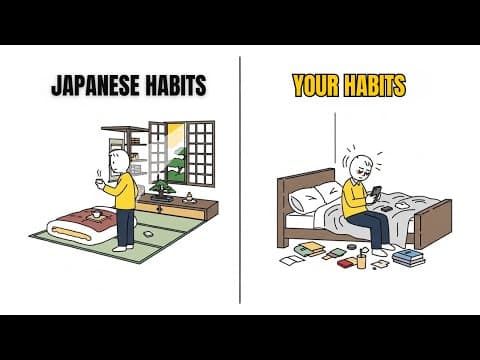
8 Tiny Japanese Habits That Make a Massive Difference
What’s The Next Level
16m 0s2,277 words~12 min read
YouTube auto captions
Transcript source
YouTube auto captions
This transcript was extracted from YouTube's auto-generated caption track. The transcript below is server-rendered so it can be read, searched, cited, and shared without opening the original YouTube player.
Pull quotes
[0:00]Have you ever wondered why Japan has one of the longest life expectancies in the world, why their cities are spotless, why so many people seem calm, focused, and purposeful?
[0:00]Tiny habits that most people overlook, habits so small they seem almost insignificant.
[0:00]Today, I'm going to show you eight tiny Japanese habits that create massive differences in your life.
[0:00]Not in dramatic overnight transformations, but in the kind of deep, lasting change that compounds over years.
Use this transcript
Related transcript hubs
Watch on YouTube
Share
MORE TRANSCRIPTS


