[0:00]History has a habit of compressing thousands of years into a single sentence, and nowhere is that compression more dangerous than when we talk about the ancient Americas. Three names, three civilizations spoken in the same breath, as if they were chapters of the same story, as if they shared the same gods, the same language, the same fate. They did not. The Maya, the Aztecs, and the Incas were radically different systems of human organization, born in different environments, answering different questions about how to survive, how to govern, how to understand the universe. One flourished in tropical jungles for over 3,000 years and never unified under a single ruler. Another rose from the middle of a lake and built an empire in less than two centuries. The third conquered the longest mountain range on Earth, without horses, without wheels, and without alphabetic writing, and still administered millions of people with extraordinary precision. These are not the same story. These are three entirely different answers to a shared human question: What does it mean to build something that lasts? Time periods. The first thing most people get wrong about these three civilizations is not what they did it is when they existed. Maya civilization begins to take shape around 2000 BCE. While Rome was still a village of shepherds, the Maya were already building monumental architecture in what is now Southern Mexico, Guatemala, Belize and Honduras. Their classic period runs from roughly 250 CE to 900 CE, six centuries of extraordinary literary, astronomical, and artistic achievement. And even after their great cities are abandoned, the Maya do not disappear. They persist, reorganize, and are still present when Spanish ships arrive in the 16th century. Maya civilization spans roughly 35 centuries. The Aztec Empire is incomparably shorter. The Mexica arrive in the Valley of Mexico as a marginalized migrant group in the 12th century. Their capital Tenochtitlan is founded around 1325. The Triple Alliance that constitutes the actual imperial structure forms in 1428. That gives the empire roughly 90 years of dominance before Hernan Cortes arrives in 1519 and destroys it in 1521. The Inca Empire is shorter still. The dramatic territorial expansion that creates Tawantinsuyu begins in the mid-1400s under Pachacuti Inca Yupanqui. Francisco Pizarro begins its conquest in 1532. The entire period of Inca imperial dominance lasts roughly one century. The Maya were building their greatest cities while the ancestors of the Aztecs were still nomadic groups in Northern Mexico. When the Aztec Empire reaches its peak, Maya city-states are still functioning in the Yucatan Peninsula. These civilizations are contemporaries, separated by geography, cultural tradition, and entirely different ways of organizing the world. They do not replace each other. They are not rungs on a ladder. Geography, technology and society. To understand any civilization, you must stand where it stood and feel the environment pressing from every direction because environment does not merely influence how people live. It determines what problems they must solve and therefore what kinds of societies they build. The Maya heartland is tropical lowland jungle: humid, dense, humid and biologically complex. There are no great river systems to organize around. What the Maya have is thick forest, seasonal rainfall, and an urgent need to understand the sky. In the jungle, where vegetation blocks the long view and seasons are defined by rain rather than temperature, astronomical observation becomes a survival technology. The Maya developed one of the most sophisticated calendrical and astronomical systems in the ancient world, tracking Venus with mathematical precision, correlating celestial cycles with agricultural seasons. Their cities are planned urban environments with palaces, temples, and astronomical observatories. But the jungle also produces political fragmentation. You cannot project power across hundreds of miles of dense forest, and so the Maya world becomes a world of independent city-states. Now move north and west up into the high plateau of Central Mexico. At the center of the Valley of Mexico sits Lake Texcoco. On a swampy island in that lake, the Mexica built Tenochtitlan. Their engineering solution, the chinampas, artificial islands built from aquatic vegetation and mud, generates multiple harvests per year and feeds a population estimated between 200,000 and 300,000 people, making Tenochtitlan one of the largest cities in the world at the moment of Spanish contact. Now cross to South America into the Andes, the second highest mountain range on Earth. The Inca solution to extreme altitude and terrain is one of the great engineering achievements of any pre-industrial civilization. Their royal road network stretches approximately 40,000 km through mountains and crossing passes above 5,000 meters. Relay runners carry messages across the entire empire at speeds unmatched until modernity. Terraced hillside farms called andenes convert near vertical slopes into productive agricultural land. A network of storehouses filled with freeze-dried potatoes and preserved meat functions as an imperial insurance system, capable of feeding armies and supplying disaster relief across millions of people. Political systems. The Maya political world is a world of independent kingdoms, each ruled by a divine king called a K'uhul Ajaw. These rulers derive legitimacy from claimed divine descent and compete through warfare, marriage alliances, and diplomacy. There is no Maya emperor. Tikal does not rule Palenque. Each major city is its own sovereign entity. This is not a sign of underdevelopment. It is the political structure that a fragmented jungle environment makes possible, and it sustains Maya civilization across thousands of years. The Aztec Triple Alliance is an imperial structure built on tribute extraction. Conquered regions deliver food, textiles, luxury items, and sometimes people to Tenochtitlan. Local rulers remain in place as long as tribute flows. Autonomy continues, this model enables rapid expansion but leaves behind profound resentment. Conquered peoples have every reason to resist, and when the opportunity arrives to ally with anyone willing to break Mexica power. This is exactly what happens when Cortez arrives. The Inca system is something else entirely. The Sapa Inca is a living God, the divine son of the Sun. And unlike the Aztec tribute model, the Inca do not simply demand goods from conquered peoples. They reorganize them. New territories receive Inca roads, storehouses, and administrators within years of conquest. Local elites are brought to Cuzco to be educated in Inca customs. Their children serve as political hostages while becoming culturally Inca. The Inca do not rule over subordinate kingdoms, they build a unified imperial state. Economy, military, and religion. The Maya economy is built around long-distance trade, connecting ecologically diverse regions. Jade, obsidian, cacao, salt, and quetzal feathers move across hundreds of kilometers through decentralized merchant networks. The Aztec economy incorporates market systems at a scale that astonished the Spanish. Cortez described the great market of Tlatelolco as larger and better organized than any market he had seen in Spain. But the engine of the Aztec Imperial economy is tribute, a constant flow of extracted goods from subordinate regions into the capital. The Inca economy operates almost entirely without markets and without currency. Communities owe the state labor rather than goods through the Mit'a system. In return, the state provides food, clothing, and tools from its vast storehouse network. It is a state redistribution economy sustained by collective obligation rather than exchange. Maya warfare is primarily about prestige and the capture of rival kings for ritual sacrifice. Permanent territorial absorption is rare. The Maya world remains politically plural throughout its history. Aztec warfare serves two purposes simultaneously: imperial expansion for tribute and the acquisition of sacrificial victims to feed the sun god and maintain cosmic order. Inca military expansion is driven by the logic of full administrative integration. When the Inca conquer a region, roads and storehouses and administrators arrive almost immediately. Religion in all three civilizations is not separate from government. It is government expressed in the language of the sacred. Maya kings perform ritual bloodletting to sustain cosmic cycles. Their temples are astronomical instruments aligned to specific celestial events. The Aztecs believe they live in the fifth era of creation, inherently unstable and destined for destruction unless actively sustained by human sacrifice. This belief institutionalizes warfare as both political and religious necessity. Inca religion centers on the solar cult administered directly by the state. The emperor is the son of the sun god Inti. A network of sacred sites radiating outward from Cuzco creates a spiritual geography that mirrors and reinforces the physical geography of Imperial administration. Why they collapsed differently. The Maya do not fall to the Spanish in a single moment. They had already experienced their own internal collapse centuries earlier. Between 800 and 900 CE, the great cities of the classic lowlands are depopulated over several generations. The result of prolonged drought, agricultural stress, and intensified warfare that political fragmentation cannot resolve. By the time the Spanish arrive, the Maya world is a mosaic of independent kingdoms with no unified leadership. The Spanish conquer them piecemeal over decades. The last independent Maya Kingdom falls in 1697, more than 150 years after Tenochtitlan. The Aztec Empire falls in a way its own structure makes almost inevitable. The tribute model generates resentment on a massive scale. When Cortez arrives with a small Spanish force, he becomes the military leader of a vast indigenous coalition. The Tlaxcalans, who successfully resisted Aztec domination, become his most important allies. The force that destroys Tenochtitlan in 1521 is overwhelmingly indigenous, powered by the accumulated rage of subjugated peoples. Smallpox devastates the city during the siege, making defense impossible. The Inca collapse follows its own logic. When Pizarro reaches the empire in 1532, he finds a state just emerging from a civil war between two brothers, Waskar and Atahualpa, triggered by the death of the previous Sapa Inca, likely from a smallpox epidemic that preceded the Spanish by years. Pizarro captures Atahualpa at Cajamarca in a surprise attack. Because all legitimate authority flows from the divine person of the Emperor, his capture creates a paralysis the system has no mechanism to resolve. Unlike the Maya world, where power is distributed across dozens of independent rulers, the Inca Empire concentrates everything in one person. Remove that person, and the entire structure loses its center. The biggest misconception and conclusion. Were the Maya less advanced than the Aztec? Were the Aztec less sophisticated than the Inca? The answer to both questions is no. And the fact that those questions feel natural reveals the assumptions we bring to ancient history. The instinct to rank civilizations from primitive to advanced treats centralized states, large armies, and territorial expansion as the natural goals toward which all human societies are moving. Under that framework, political centralization always appears as progress. But this ranking is an illusion. The Maya were not trying to build an Inca-style empire and failing. They were solving the specific problems of their specific environment, and they succeeded brilliantly for 3,000 years. The Inca were not a more evolved form of the Aztec. They were a different answer to a different question posed by a different mountain range on a different continent. The Maya developed one of only a handful of fully independent writing systems ever created by human beings. The Aztecs built a city larger than almost any contemporary European capital. The Inca sustained millions of people across the most extreme terrain on Earth, without wheels, without horses, and without alphabetic writing. These are not levels of advancement. These are different solutions evolved by different peoples in response to different circumstances. Three names, three civilizations shaped by jungles and lakes and mountains, by seasons and stars and rivers. The Maya read the sky with mathematical precision and carved their history into stone. The Mexica built a capital of breathtaking ambition on the surface of a lake. The Inca connected 4,000 kilometers of mountain territory with roads and bridges and the labor of millions. All three were present, alive and extraordinary when European contact arrived. All three were destroyed not by inferiority, but by disease, betrayal, and the specific vulnerabilities of their own political structures. Civilizations are not photographs. They are processes, long accumulating human experiments in organizing life, meaning, and knowledge. The Maya, the Aztecs, and the Incas deserve to be understood on their own terms, through the evidence they left in stone and rope and ceramic and chronicle. Not as curiosities, not as precursors to something greater, as what they were. Three of the most remarkable human experiments in organized life this planet has ever seen. If this history moved something in you, subscribe. There is so much more of this story waiting to be told. And tell us in the comments, if you could ask one question to a Maya astronomer, an Aztec merchant, or an Inca road engineer, what would it be?
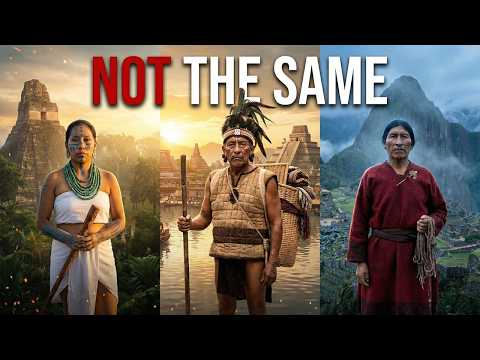
Maya vs Aztecs vs Incas | The Differences That Changed History
Civilizations Explained
16m 49s2,121 words~11 min read
Auto-Generated
Watch on YouTube
Share
MORE TRANSCRIPTS