[0:00]So, hello, I'm Professor Rohini Balakrishnan from the Center for Ecological Sciences at the Indian Institute of Science. And today, I'm going to talk to you about how animals and plants sense and navigate the world. And the first thing we have to ask ourselves is why do animals and plants need to sense and navigate their world?
[0:30]And when I say sense, I mean how do you perceive the world around you? And when I say navigate the world, I mean it both literally. How do you find your way around? But also, how do you solve the problems that you are faced with as you go through life? So why sense and navigate the world? Animals and plants need to feed, grow and reproduce. They need to find food, shelter and mates to do which, they need to be able to sense and perceive their world. They need to be able to navigate through it, and today what we're going to do is to try and see how animals and plants do this. So firstly, what kinds of stimuli do they use to sense the world? There's a whole range of stimuli that are available out there for animals and plants to sense, respond to and navigate. The most ubiquitous are chemicals. Chemicals are everywhere. Cells itself, life itself, actually consists of chemical molecules. And the environment is filled all round with chemicals. So right from the very beginning, even microbes have been able to sense their chemical environment. So this is a sense that is really ubiquitous to all taxa, to plants, to animals, to microbes. The other very widely used sense is vibration.
[2:37]So mechanosensing is also evolutionarily extremely old, and again, microbes, plants and animals have mechanosensors that can sense pressure, and sense mechanical disturbances in their medium. So this is another ubiquitous means of both navigation and communication. Sound consists of a particular subset in which you get more long-distance mechanical signals that can be perceived by animals. Magnetic fields. The Earth itself has a magnetic field, and many animals are actually known to be able to sense magnetic fields. But what they actually use them for is less obvious, and this has mostly been studied in animals that do long-distance migrations. Such as, for example, the Arctic turns over here, that migrate very long distances, or turtles that wander the Earth's oceans and then still come back to the beach on which they were born. And there's evidence that they can use magnetic fields to do this. A few animals are also known to use electric fields. These include electric fish and sharks, and they use it both to find prey and to communicate. But I'm not going to be talking too much today about magnetic and electric fields because we know a lot less and there's also not that much time to do so. So let's move on and look at our first problem. How does a male moth find a female moth to mate with? So moths are solitary animals, and males and females have to find each other to mate. And this brings me to the work of a pioneering entomologist and ethologist, Jean-Henri Fabre. And Jean-Henri Fabre, who was a contemporary of Darwin, was an entomologist who observed insects very closely and came up with hypotheses that he tried to test. And he wrote this wonderful chapter, 'The Great Peacock Moth', in which he describes how one night dozens of male peacocks moths invaded his house one night and entered a dark room housing an adult female peacock moth. This set him wondering, how did these males actually sense this female from so far away? They could obviously find her without light.
[5:24]So he released these moths outside the male moths, and the next night, he placed the female under a glass bell jar, and males didn't appear.
[5:39]But of course, one could then say, maybe they just got lost out in the countryside. But on successive nights, when he put the female in a box that actually allowed air to enter, males could find her, even if he moved the box around in the house. So it suggested that there was some signal emanating from her that needed a medium, possibly this could be a chemical. The fact that these peacock moths have large feathery antennae led Fabre to propose that perhaps they're using these antennae to smell her out. He tried to test this actually, by clipping the antennae of some males and releasing them, but very few of them came back so the experiment was inconclusive. In the 100 years after Fabre, however, scientists know a whole lot more about this. We know now that adult female moths release species-specific chemicals called pheromones in tiny quantities, and we know this because you can collect the air around a female moth and subject it to chemical analysis. And scientists have found that this consists of specific cocktails of chemicals, and in wind tunnels, in behavioral experiments, males can find females in complete darkness but need wind.
[7:27]They fly upwind once they detect the pheromone. Males approach pheromone extracts of females of their species, so chemical pheromonal cues are sufficient. So once they sense the smell, they then fly upwind to locate the source. And because they approach pheromone extracts, we can say that it's just the chemical cues are sufficient, however, they have to be coupled with a wind so that they know in which direction to go. Again, those feathery antennae that Fabre observed, we now know have thousands of olfactory receptors that are highly specific to species-specific pheromone components.
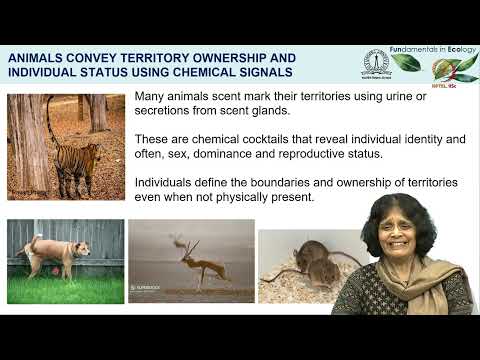
[8:08]Female antennae, on the other hand, are smaller and less feathery, lending further support to the hypothesis that indeed males are using these large feathery antennae to detect these pheromones that females are releasing, flying upwind to to try and find the females. So indeed, a really large number of animals use chemicals and pheromones to communicate. Mammals in particular use scent a lot, and they use it to convey territory ownership, individual status, using chemical signals. All of you must be familiar with dogs marking their territories with urine, you see cats spraying their territories as well.
[9:03]Undulates like antelope and deer also do this. Rodents use it a lot. What they do is using either urine or secretions from scent glands, they scent mark their territories.
[9:20]And these scent marks are actually chemical cocktails which you can analyze, and they reveal individual identity and often reveal the sex, the dominance and reproductive status of the animal that has produced the scent mark. Individuals also use this to define the boundary and ownership of territories even when they're not physically present. So it's like a visiting card that they leave around, and indeed mammals use this like social media platforms, which explains why your dog is always so interested in sniffing around as it's walking around. It tells them who's been there, who's territory this might be, is it a male or a female, and is this a territory owner that maybe if I fight, I might lose.
[10:14]So there's a whole lot of information in these chemical cocktails that animals leave around them, and they use it to communicate even when they're not physically present.
[10:28]Moving on to vision, let's go on to a different kind of problem. How does a bee find flowers to drink nectar and collect pollen? All of you, I'm sure, have seen colorful flowers around, and bees that come down to them to collect pollen. And people from time immemorial have believed that the bright colors of flowers must be helping bees to find them. But if that's the case, then bees should be able to see color. And the person who actually first tested this and showed it in a definitive way is Karl von Frisch, the Nobel laureate. Who in a series of experiments in the year 1914 demonstrated that bees can indeed see color. What did Karl von Frisch do? He trained bees to approach and feed on sugar water in a glass dish placed on a blue card. Once the bees had gotten trained to this, he then tested them in this kind of setup, the one you see below, in which you had the blue card surrounded by a whole range of grey cards of different shades, some providing contrast cues similar to the blue card. The whole thing was covered by glass to eliminate odor cues, and each card, as you can see, had an identical glass dish on it.
[12:12]No reward was offered.
[12:16]So the idea was that if bees were using contrast rather than actually seeing color, they would approach some of these grey cards as often as the blue. However, what he found was that bees unerringly approached the blue card. He repeated these experiments with other colors such as yellow, and was able to show that bees are actually able to see a range of colors. But how do the bees see these colors? To understand that, to understand how bees actually see colors, we have to examine their eyes. And like most insects, bees have these large compound eyes, which actually consist of hundreds and hundreds of facets, or ommatidia. And each ommatidium contains a number of photoreceptor cells that are sensitive to light. So scientists have examined the photoreceptor cells of these bees, and asked to what wavelength of light are these different photoreceptors sensitive? And that's what's shown on the graph above, over here. And what you see over here is on the X-axis is the wavelengths of light that they tested them with. And on the Y-axis is to which wavelength are you getting maximum response from these photoreceptors? And you can see that the photoreceptors fall in three classes. Those that are maximally sensitive to green light. Those that are maximally sensitive to blue, and interestingly, those that are maximally sensitive to UV. So bees are able to see UV. They have three kinds of photoreceptors. One of which includes sensitivity to UV, something that we don't have. But a whole range of other insects actually can see into the UV. In a study examining what wavelengths do flowers reflect the most. That is what is shown in the panel below, again, you have wavelength on the X-axis, and you look at what wavelengths are now being reflected the most by flowers. What you find is that there is a good match between the wavelengths that flowers reflect the most and the wavelengths that bees are most sensitive to. Suggesting that flowers have actually evolved to put out and advertise themselves with wavelengths that bees are most sensitive to, suggesting again, that these colors of flowers are actually being used to attract bees.
[15:02]But if you look at flowers through the eyes of a bee, they can look quite different, and that's what is shown on the three panels that you can see to your left.
[15:19]On the leftmost panel are pictures of flowers that are taken in normal light, that's how we human beings would see them. Knowing the sensitivities of bee photoreceptors, you can actually model how these would look to a bee, and that is what you can see in the middle panel, as you can see, the colors don't look exactly the same as how we would see them. And on the third panel, as you can see, it looks more blurry, they have now added the fact that a bee has compound eyes, and it has these multiple ommatidia, which actually makes images more blurry than with eyes like ours. As we said, bees have UV photoreceptors, that is they can sense ultraviolet light. So if you take a photograph of this flower in visible light, you can see that to us, it looks all yellow. But if you use UV light, then you can see that actually there is a strong color contrast at one part of the flower, and these strongly reflect UV. And these are nectar guides. These reflect UV light, and they actually guide bees towards the nectar. So the so the colors of the flower not only attract bees towards themselves, but these UV reflecting nectar guides act like runways that actually tell bees where exactly to look in the flower for nectar. The panel on your right again shows you that flowers look quite different to bees than they do to us.
[17:10]But having this UV sensitivity, and using this UV reflectance of flowers can actually also come at a cost. Because predators of bees such as spiders use bees' attraction to UV to their advantage.
[17:32]If you look at this panel, here again is a photograph of a flower with a crab spider sitting on it. To us, it looks like a white spider on a white flower, but if you look at the same thing in UV light, you will see that the spider really stands out, there's a big contrast. So whereas we initially thought that these crab spiders camouflage themselves in the flowers and caught bees as they came in, what we can see now is that bees can actually see these spiders very well. And it's probably the strong UV reflectance that is actually luring them. This has actually been shown in web-building spiders. For example, the spider shown in the panel here, reflects UV very strongly, as do web decorations of other kinds of spiders. And what scientists have shown is that either if you paint the UV reflecting part of the spider or remove these web decorations, then the number of insects that these webs catch goes down quite a bit. Showing that these actually by reflecting UV might act as lures bringing bringing the predators, telling the predators that the spiders, or rather allowing the spiders to lure their prey. Animals in general use a whole range of colors to select mates, you get brightly colored males in many species, in fish, in lizards, in birds.
[19:14]The more brightly colored they are, the more likely they are to be chosen by females. So their bright colors of males have actually evolved via sexual selection.
[19:27]On the other hand, animals also use bright colors to advertise their toxicity. So there's a whole range of animals including insects and snakes and frogs who are toxic. So if a predator eats them, it would be sick or die. But it only is a useful defense mechanism if you can advertise it. So chemically defended taxa advertise their toxicity to predators using bright colors.
[25:05]Let's move on from owls to bats, and bats are very interesting, they're also nocturnal, and they navigate their way using sound.
[25:20]They do this by using sonar. They emit ultrasonic sound pulses through their nose or mouth. You can see these a spectrogram showing these sound pulses. On the X-axis is time, and on the Y-axis is the frequency or pitch of the sounds being emitted.
[25:44]And these are known to help it navigate and find prey.
[25:52]And how do we know that? Bats that are deafened and those that are prevented from emitting calls, or when placed in anechoic environments, find it difficult to avoid obstacles or locate prey easily. And what we now know is that echoes of these pulses reflecting off objects around them are used to avoid obstacles and to detect and recognize prey. Some bats even use echolocation to locate flowers. You can see this hanging Liana flowers in a Costa Rican forest, and these nectar feeding bats approach flowers that have an upright vexillum. Vexillum is one of the petals, you can see it here. It's sort of triangular and concave, and when a flower is ready to be pollinated, then the vexillum becomes upright. And this vexillum acts as a concave mirror and reflects echolocation calls back to the bat. So you can imagine if a bat is flying around, then only where there's an upright vexillum, it'll actually get these strong echoes coming back. How do we know that it actually uses this? If you remove the vexillum, or even better, if you place a little bit of cotton wool inside it, then this greatly decreases bat visits. If you place cotton wool, you actually get rid of the echoes. So this shows you that they actually need the echoes and are not using scent or anything else to approach it. So the floral echoes actually guide the bat to find these flowers in the dark. So let's go on to ask a question of another animal that's actually nocturnal and finds its mate in the dark. How does a cricket find its mate? So cricket males sing calling songs to attract females, and let me play you one of the calls. This is the call of a false leaf bush cricket. You can see it there.
[28:16]It's the green one. So that's the species one. And here's another species. You can hear the call.
[28:29]This is an understorey cricket. One of them calls at 3 kHz as you can see in the power spectrum over here. And another has all its energy at 5 kHz, so at a different frequency, at a different pitch.
[28:51]If you take a sound recording of the entire rainforest in which these two cricket species live, and make a spectrogram, that is you have time on the X-axis and you have frequency on the Y-axis over here. Then what you can see is that there are a number of different bands with different song patterns. Each of these is the call of a different species, and the different species partition their calls into different frequency bands. So they're calling at different frequencies.
[29:38]The fact that males actually call at different frequencies, as you can see here, 3 kHz and 5 kHz, is helpful for females. Here, you can see the ear of a cricket, the ears of crickets are on their forelegs, and here are the eardrums in the close-up. And if you ask what frequencies are these ears most sensitive to, and you can do this by broadcasting sounds of different frequencies to the ear and looking at the response.
[30:17]What you can see is that the ears of females are actually maximally maximally responding to the frequencies at which the males of their species sing.
[30:31]Which means that crickets are tuning in to the frequencies of their own species songs. So cricket ears act as frequency filters filtering out irrelevant noise and tuning their ears to conspecific male songs.
[30:50]But insects can also use substrate vibration in order to find mates. Here you can see an experiment done in the lab where there's a T-shaped structure, and a female false leaf bush cricket is standing at one end, and sound is played back from one of the speakers. That's the female that you can see in the video, which I'm going to play to you. And soon, you will hear the playback from the speaker.
[31:30]And watch the female. See how she shakes the leaf.
[31:39]Every time the male emits a chirp, the female shakes the leaf.
[31:46]We can measure that. We can measure that by focusing a laser beam using a laser vibrometer on the branch on which the female is standing and play back the male's call. When you do that and make a recording, you can see clearly here's the acoustic call of the male, and in between the chirps of the male, are the replies of the female that are actually vibrational replies. So we have here an acoustic vibratory duet. Females are replying to the male acoustic chirps with vibrational signals, which alternate with the male chirps. But is this really a signal? To prove that it's a signal, you have to show that the males actually use these vibrational replies. You can do that in a different kind of experiment, and in this experiment, again, you have a Y-shaped branch, and the male is at the end of the Y. And you can play back the vibrational signal that is recorded from the female through an electromagnetic actuator. So you are actually setting this branch into vibration. You can set it up such that you vibrate the branch exactly after every chirp of a male, exactly as in a real duet. So this end of the branch is vibrating, the other arm is not vibrating, and you ask how often does the male choose to approach the vibrating branch? And you can see that males invariably choose the vibrating branch. The other panels are controls, you know, without vibration or disconnecting the vibration or in silence, and you can see it's a very specific response. So males are actually using this. So they choose the branches through which females reply to their acoustic signals, showing that they're actually communicating using vibration. Vibrational communication is actually extremely widespread in the animal kingdom. Spiders use vibration a lot in their courtship displays to identify which prey is approaching their web. The tiny tree hoppers, which are bugs, use vibrations along the stem for mother-offspring communication, to send alarms through them. Mammals, particularly mammals that burrow, drum use vibrational communication by drumming against the walls of their burrow. They can use it to send signals even across burrows and for territorial territorial defense. Elephants have been shown to use seismic communication. So if you play back the calls that elephants make, putting their trunks very close to the ground, you can show that there's a seismic component to this, which actually evokes, for example, alarm responses in elephants that are far away. You can see that in the cover of physiology that is there on the upper right.
[34:57]We've talked so much about animals, and we've talked of plants as signalers with their bright colors, okay? Or putting out sense. But do plants communicate? Okay. So here we have a somewhat cluttered slide, but I'm going to take you through it. Here we have some tobacco plants in the center, and if you look below, there's a caterpillar, a herbivore, who has attacked the tobacco plants. When the caterpillar attacks the plant, the plant releases volatile organic compounds or VOCs, which often includes jasmonic acid or its derivatives.
[35:57]These chemicals actually attract predators of the herbivore such as this bug, which is then attracted towards this tobacco plant that has been attacked. And these predators eat the eggs and larvae of the herbivore. This was shown in an experiment where if you put jasmonic acid on the stem of a plant, you attract these predators, and the survival of the herbivore eggs and larvae goes down dramatically. So the plant appears to be calling out to the predator of the herbivore, so it's like enemy of my enemy is my friend, and calling out using volatile signals. In addition, neighboring plants respond to these volatile organic compounds by strengthening their chemical defenses. So it seems that plants are able to communicate with other plants, plants are able to communicate with animals. But a number of questions remain. How are these volatile organic compounds are actually sensed by the plant? Are these actually signals? Or is it just that the plant puts them out and animals are exploiting them and other plants are exploiting them? If it's a signal, then why warn your neighboring plants because their neighboring plants might be competitors? So there are a lot of questions and this is a very exciting field of study. But one of the most exciting things that we've come to know very recently is that plants can hear. Plants apparently can hear and respond to pollinators.
[37:39]So let's see what's being done here. So here's an Oenothera or a primrose plant, and the primrose plant produces nectar that attracts bees. If you now play back sounds to this flower, if you play back sounds of lower frequencies, either the sounds of a buzzing bee nearby, 250 to 500 Hz, or other low-frequency sounds below 1 kHz. What you find is that within minutes, plants increase the concentration sugar concentration of their nectar. The effect doesn't happen for ultrasonic signals above 35 kHz, above 30 kHz, and of course in controls where there's no playback. So when you play back sounds similar to buzzing bees, the plants actually respond very quickly by increasing sugar concentration. What does that do? It will get bees to come back and it will get bees to recruit and more pollinators to come there.
[38:46]How does a plant sense this signal? It's been shown, possibly, that petals can function as a flower's ears. So in this experiment, again, they played back high frequencies, intermediate frequencies and lower frequencies, 1 kHz and below to a flower, a primrose flower. And you see on the Y-axis the vibration of the flower petals. And you can see that again, the low frequencies, which is what buzzing bees produce, cause strong vibrations in the petals, suggesting that petals can function as a flower's ears. As controls, if you put a glass jar over the flower and play the sounds of a buzzing bee, so that the acoustic signal doesn't reach, you don't get this response. So this takes us back to Jean-Henri Fabre as well, putting a jar on this flower and showing indeed that it's not scent or something else, it's actually sound that seems to be allowing the flower to respond to the bee in a very adaptive way.
[39:58]So finally, I hope I've shown you in this lecture how a number of different animals and plants use various different kinds of stimuli to sense the world and to solve their problems of finding food or mates. And I hope that has given you a little bit of a glimpse to this fascinating diversity of strategies that plants and animals use to sense and navigate their world.
[40:47]So this ends this lecture, and we will now see you in the next lecture, continuing our understanding of how animals and plants manage their lives.


