[0:14]Maria walked into the elevator at work. She went to press the button when her phone fell out of her hand. It bounced on the floor and went straight down that little opening between the elevator and the floor. And she realized it wasn't just her phone. It was a phone wallet that had her driver's license, her credit card, her whole life. She went to the front desk to talk to Ray, the security guard. Ray was really happy to see her. Maria is the the one of the few people that actually stops and says hello to him each day. In fact, she's one of these people that knows your birthday and your favorite food and your last vacation. Not because she's weird. She just genuinely likes people and likes them to feel seen. She tells Ray what happened, and he said it's going to cost at least $500 to get her phone back, and he goes to get a quote while she goes back to her desk. 20 minutes later, he calls her, and he says, "Maria, I was looking at the inspection certificate in the elevator. It's actually due for its annual inspection next month. I'm going to go ahead and call that in today and we'll be able to get your phone back and it won't cost you anything." The same day this happened, I read an article about the CEO of Charles Schwab, Walter Benninger. He's describing his straight A career at university, going into his last exam, expecting to ace it, when the professor gives one question. What is the name of the person that cleans this room? And he failed the exam. He had seen her, but he had never met her before. Her name was Dody, and he made a vow that day to always know the Dodies in his life. Because both Walter and Maria understand this power of helping people feel seen, especially as a leader. I use that story back when I worked at General Electric. I was responsible for shaping culture in a business of 90,000 employees and 150 countries. And I found that stories were such a great way to connect with people and have them think, what would I do in this situation? Would I have known Dody, or who are the Dodies I need to know in my life? I found that no matter people's gender or their generation or their geography in the world, the stories resonated and worked. But in my work with leaders, I've also found they tend to be allergic to telling stories. They're not sure where to find them or they're not sure how to tell them, or they think they have to present data and that there's just not room to tell story. And that's what I want to focus today. Because storytelling and data is actually not this either or. It's an end, they actually create this power ballad that connects you to information differently. To understand how, we have to first understand what happens neurologically when you're listening to a story and data. So, as you're in a lecture or you're in a meeting, two small parts of your brain are activated. Wernicke's and Broca's area. This is where you're processing information, and it's also why you tend to forget 50% of it right after you hear it. When you listen to a story, your entire brain starts to light up. Each of your lobes will light up as your senses and your emotions are engaged. As I talk about a phone falling and hitting the ground with a thud, your occipital and your temporal lobes are lighting up as though you are actually seeing that fall phone and hearing it hit with a thud. There's this term neural coupling, which says as the listener, your brain will light up exactly as mine, as the storyteller. It mirrors this activity, as though you are actually experiencing these things. Storytelling gives you this artificial reality. If I talk to you about like walking through the snow and with each step, the snow is crunching under my shoes, and big wet flakes are falling on my cheeks, your brains are now lighting up as though you are walking through the snow and experiencing these things. It's why you can sit in an action movie and not be moving, but your heart is racing as though you are the star on screen because this neural coupling has your brain lighting up as though you were having that activity. As you listen to stories, you automatically gain empathy for the storyteller. The more empathy you experience, the more oxytocin is released in your brain. Oxytocin is the feel-good chemical, and the more oxytocin you have, the more trustworthy you actually view the speaker. This is why storytelling is such a critical skill for a leader because the very act of telling a story makes people trust you more. As you begin to listen to data, some different things happen. There are some misconceptions to understand. And the first is that data doesn't change our behavior. Emotions do. If data changed our behavior, we would all sleep eight hours and exercise and floss daily and drink eight glasses of water. But that's not how we actually decide. Neuroscientists have studied decision-making, and it starts in our amygdala. This is our emotional epicenter where we have the ability to experience emotions, and it's here at a subconscious level where we begin to decide. We make choices to pursue pleasure or to avoid risk, all before we become aware of it. At the point we become aware, where it comes to the conscious level, we start to apply rationalization and logic, which is why we think we're making these rationally based decisions, not realizing that they were already decided in our subconscious. Antonio Damasio is a neuroscientist that started to study patients that had damaged their amygdala. Fully functioning in every way, except they could not experience emotions. And as a result, they could not make decisions. Something as simple as do I go this way or this way, they were incapable of doing because they couldn't experience emotions. These were people that were wildly successful before they had the damage to their amygdala, and now they couldn't complete any of their projects, and their careers took big hits, all because they couldn't experience emotions where we decide. Another data misconception. Data never speaks for itself. Our brains love to anticipate, and as we anticipate, we fill in the gaps on what we're seeing or hearing with our own knowledge and experience and our own bias. Which means my understanding of data is going to differ from yours, and it's going to differ from yours, because we're all going to have our own interpretation if there isn't a way to guide us through. Now, I'm not suggesting that data is bad and story is good. They both play a key role. And to understand how, you have to see what makes a great story. It's going to answer three questions. The first is, what is the context? Meaning, what's the setting, who's involved, why should I even care? What is the conflict? Where is that moment where everything changes? And what is the outcome? Where is it different? What is the takeaway? A good story also has three attributes. The first being, it is going to build and release tension. So because our brains love to anticipate, a great story builds tension by making you wonder, where is she going with this? What's happening next? Right, a good story keeps you, keeps your attention going. And it releases it by sharing something unexpected, and it does this over and over throughout the story. A great story also builds an idea. It helps you see something that you can no longer unsee, leaving you changed because stories actually do leave you changed. And a great story communicates value.
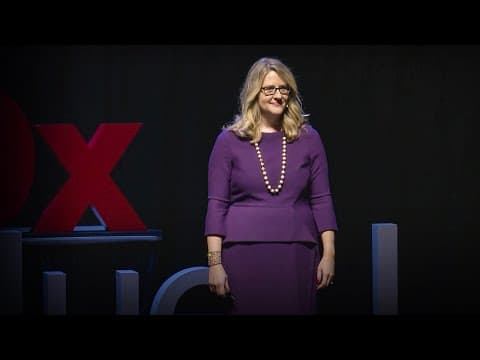
Karen Eber: How your brain responds to stories -- and why they're crucial for leaders | TED
TED
8m 31s1,334 words~7 min read
Auto-Generated
Watch on YouTube
Share
MORE TRANSCRIPTS