[0:00]Have you ever wondered how some people are just so good at interviewing? And maybe you have a friend or an acquaintance or someone you know of on campus or in your life somewhere who's just really, really good at landing extremely competitive jobs. Today, I'm going to share with you something that I have learned over the last five or more years that has allowed me to land multiple roles in very competitive industries, including investment banking in New York, on Wall Street, management consulting at BCG, which is an MBB consulting firm. And most recently at Google in their internal strategy department. I'm going to distill in probably a video that's less than 20 minutes, five plus years of messing up left and right and doing probably over 100 interviews at different companies. I'm going to give that all away to you now in a pretty short video. And so if you're still with me, make sure you full screen the video, lock in and give me your attention for just 20 minutes. I promise it will help you out, especially if you're job hunting or if you plan to in the future. The way I want to break this explanation up though, is first I want to talk about what most people do. And when I say most people, I'm talking about your average job hunter. And then I want to talk about what the elite interviewees are doing. The people that are landing these jobs that have less than 1% acceptance rates, at companies like Goldman Sachs or McKinsey. Because what you have to realize is everyone has the same information available to them, especially nowadays. In the internet age, anyone can Google how to pass the interview. But then why isn't everyone landing the offer? Why isn't everyone landing the job, right? It's because there's more to interviewing than just what you see online. And that information actually only gets you so far. But without beating around the bush, let's just get right into it. So there's two main components to answering the behavioral interview. And I'm talking about the behavioral interview today because I'm not going to talk about the technical portion of interviewing, which is specific to the various industries. So for example, if you're an investment banking, you have to study the finance technicals. If you're in consulting, you have to study the case interviews. If you're going for tech, uh, you know, sometimes there's actual technical like coding interviews that you have to do or in my case, it was also case interviewing for internal strategy roles. I'm not going to talk about that. I'm going to talk about how to answer these questions where you get asked to tell someone about a time where you had to demonstrate some kind of positive quality. Maybe it's tell me about a time when you had to demonstrate leadership, or tell me about a time when you had to demonstrate that you were a team player, or that you were persuasive, or that you had integrity when you were put in a moral or ethical conflict. Those kinds of questions come up in 99% of interviews, regardless of what industry they are. And for good reason, because oftentimes your interviewer companies are looking to test a certain set of core qualities that are universally sought after for employees. Now, what does the average person do though when they hear from the recruiter, oh yeah, you should prepare for these behavioral type questions. Well, you're probably Googling online or you're probably going on to YouTube and you know, before you find my videos, you're probably looking at other career advice videos. And you're hearing things like, oh yeah, use the STAR method. Make sure to write out and list out in bullet points, maybe or in a paragraph format, what you're going to actually say, or end the story with, oh yeah, everyone was pleased, everyone was pleased, it was a success. And make sure that you're professional in your delivery, right? So don't be vulnerable or don't speak casually because it's a professional interview, right? And you want to demonstrate that you can be a professional person. That's what most people do. Now, there's nothing inherently bad about any of this, right? The STAR method, for those of you who maybe aren't familiar, means situation, task, action, and result. It is a very good way to structure your stories because it ensures that you actually talk about what the situation was, what actions you specifically took, and what actually ended up happening. But secondly, listing out what you did, isn't inherently bad either. But it's only to guide you again and to give you a sense of structure as you talk through the story. With these last two as well, I'm going to touch on these in just a second. But what you're going to see is that these things that most people do, that 90% of people are doing. Are not necessarily bad. But there's actually a ton of nuance with giving behavioral interview questions. Now, let's talk about what that nuance is. But before I get into it, actually, I want to give you two stories, exact same facts, but told in two completely different ways. And I want you to imagine that say you're interviewing me, for example. You're the interviewer, and there are two candidates, back-to-back, same exact facts to their story, same exact outcome, but told in completely different ways. Let's start with candidate one. So let's say that the question being asked is, hey, tell me about a time when you had to convince leadership of your position. Yeah, happy to. So my freshman summer of college, I interned at a startup. It was a tech startup. We were selling software and I was a sales intern. Now, the company was based in Silicon Valley and most of its customers were based in the US, as a result. And at one point in the summer, the founder of the company came to me and said, hey, Matt, we're doing really well in the US, but we actually want to explore expanding into the British market. You know, I think that because the people in the UK are also English speakers, that they'll also like our software. And so being the sales intern, I went out and I started talking to people, and I realized pretty quickly that there actually is quite a few nuances between the US and the UK market. And the people in the UK market actually weren't as interested in our product. And so I went back to my boss, um, and actually before I did that, I did a little bit of my own research, and I discovered that maybe the German market would be a better place to start, especially if we were going to expand into the the European space. And I went to him, and I said, hey man, I think that we actually shouldn't go into the UK market. I think that we should go after Germany because it's more attractive. And he completely disagreed with me, and he basically shot down my idea, and I was really upset. But a week later, I came back to him with a better proposal. This time I'd done a little bit more research, and he was totally impressed when he saw all the work that I had done. And ultimately, we ended up going through with that approach, expanded into the German market, the company made a ton of money, and everything was a success. Okay, we're going to stop there. Now, candidate number two. Tell me about a time when you had to convince leadership of your opinion. Sure, absolutely. So, during my freshman summer of college, I interned as a sales intern at a fast-growing tech startup in San Francisco. And we were telling, we were selling software to other businesses in the US primarily. And at one point, the founder came to me and said, hey, Matt, I think that we should try to expand our footprint into the UK market. And the reason why I think this is because they're also English speakers, and I think that the value prop is also very clear to business owners, and so it feels like the right place for us to start our international expansion. Now, as a sales intern, I had been basically smiling and dialing all summer, talking to tons of customers, getting a ton of rejections, but also learning a lot and getting all those reps in. And so, you know, the first thing I did was I went and I talked to like 10 customers, potential customers in the UK market. And very quickly, I realized that actually, there is quite a bit of nuance between the UK and the US market. And for example, the regulations are very different, especially for the type of software that we were selling. There were some serious privacy concerns, and so because the difference in privacy regulations, a lot of these business owners were actually quite hesitant to adopt our product, even though they saw the value prop. And so, before I went back to my boss, I decided to do a little bit of my own due diligence, and I started thinking about other countries in Europe that might be open to this. And I realized through my research that the German market actually has very similar uh privacy regulations as the US. And so I went right back to my boss and I said, hey, man, look, I know you're super excited about the UK market, but I actually think we should go look into the German market because I've talked to customers in the UK market and they're honestly not that interested. And he came back at me and said, really, man? Look, I've been thinking about this idea for months and I hear you, but at the same time, we are a startup and we have limited resources, and so I don't think we can just go after some completely different market just because of a hunch that you have. And in that moment, you know, I'll be honest, I was pretty upset because it felt like he was just writing me off. But I knew that I had to persist, and so what I did was I said, hey, you know what, look, I totally hear you. Let me get back to you. I'm going to do a little bit more digging so that we can have more confidence in this idea. And for the next week, I basically talked to 10, 15 more potential customers in the German market, and I compiled and synthesized all those findings. I also did a bunch of research on my own, reading through a lot of the regulations and the legal requirements for this market. And ultimately, compiled it into a presentation, a tightly knit, concise presentation, and went back to my boss and said, hey, look, I know we had this conversation last week, but since then, I've talked to 15 more customers. I've analyzed very closely the German regulations, and I've done a lot more research, and I have a much higher degree of conviction now that this is still the right place for us to focus our efforts. And I know, and I hear you that the UK market is very promising. I do still think there is a lot of opportunity there, but I just wanted to bring this to you as a follow-up to our previous conversation. And when he saw that I genuinely wanted to help his company succeed and that I wasn't just trying to push my agenda around, but I genuinely wanted to help him and his company, I think something switched inside and he was suddenly very open to this new idea. And he took a look at the analysis and he saw that I'd put in hours of work into talk to all these customers and really um being boots on the ground doing a lot of due diligence. And ultimately, what actually ended up happening was we ended up expanding into the German and the UK market, but we just had to slightly adjust our approach in the UK market to work around those regulations. And the learning for the company was that every time we expand into the international markets, we have to be very thoughtful about how we approach the legal and regulatory side of things because of the nature of our product. And another big thing that I took away from that experience was that, look, sometimes if you get told no once, that doesn't necessarily mean it's the end of that. And if it's an idea or something that you really have conviction in because you are the closest to the data, then you shouldn't be afraid to come back again with an improved version of your original product or idea. And I know at McKinsey, for example, there are going to be many situations where you have to deal with senior folks as a junior consultant, whether it's your client or whether it's your senior partner. And many times they may disagree with me on certain things. But as the BA, as the junior analyst, oftentimes you're closest to the data and you're closest to the conversations with the customers. And so it's actually in your best interest to share your honest thoughts based on what you're seeing. And so that mindset, I really see myself bringing into a management consulting role at McKinsey. All right, I'm going to stop there. So that was a little bit of a longer winded story, but the reason why I kept it a little bit longer is I wanted to really show you how I tie in that detail and that storytelling into the second story. And you can really see and notice the difference between the two stories, even though the facts are completely identical. And so if two people walk into an interview with the same exact background and the same exact stories, But one person tells the stories in a more effective way, which I'm going to talk about how to do that in just a second. That second person is going to win nine times out of 10, with that one time being if like the first person's dad works at the firm as a senior partner or something like that. No shade being thrown. But now let's talk about what you need to actually do and what you can actually implement to turn your stories into the type that land top 1% roles at companies where the acceptance rate is literally less than getting into Harvard. So, step one is you got to show, don't tell. And this is easier said than done. When I say show, don't tell, I mean you need to actually immerse and engage the listener in your story. You're not just doing a regurgitation of facts. You're not just doing a restatement of facts. And this is why if you list out everything you're going to do in a sequential order, that's not a bad thing, but it's going to automatically cause you to start thinking in a sequential way. And if you just think of your story as like a set of facts and things that you need to cover and you're like, okay, I'm going to say this, and then I'm going to say that, and then I'm going to say this and then finally I'm going to end the story like that, what you're doing is you're actually going to make yourself tell the interviewer what happened without actually showing them. And so how do you actually show them? Well, the easiest way to do this is actually to just talk about more of your raw, unfiltered thoughts. So talk about what you're actually thinking in the moment of certain parts of the story. For example, when the founder of the company disagreed with my proposal that we should go look into the German market instead of the UK market. What did I say in the second story? Well, I said, yeah, you know, in that moment, I was I was really upset, like I was I was gutted. I felt like he just wrote me off. Those are my raw, unfiltered thoughts. And the reason why this is so effective is because you cannot filter your thoughts. You can filter what you say, but you cannot filter your thoughts. And so therefore, by talking about your thoughts, you're actually being a little bit more vulnerable and a little bit more authentic about admitting, okay, this was my gut reaction. Now some of you might be thinking, okay, but doesn't that potentially paint me in a bad light? Well, not if you don't stop there. After you've given your initial raw thoughts, then you need to transition into like, okay, what was your actual response? So, even though I felt gutted and I felt like he just wrote me off, and I was like, what the heck? I also knew that, look, I have a lot of conviction in this idea, and good things come to people who persist. And so, I'm going to go out and instead of just taking the L and calling it quits and curling up into a ball in a corner and just crying, I'm going to actually go out there and talk to like 10 or 15 other people in the German market. I'm going to do a bunch of analysis and research. I'm going to show the founder that I actually believe in this idea, and it's not just some random spur of the moment idea that I had one day and I just wanted to throw it at him and get my way, right? I'm actually serious about this, and I'm willing to invest serious time and effort into proving that my idea is valid. Whether or not he decides to take it is a whole 'nother matter, but it's all about showing that you actually care. But what's the other thing I did? I ended not just by talking about, you know, what I learned, or just saying, oh, everyone was pleased and it was a success and, you know, the company ended up doing it and and everything went well, right? Which is kind of what I said in the first story. Instead, I talked about how, okay, I learned that being persistent is really important and often times convincing or changing someone's mind requires you to maybe be okay with taking no at first, but not giving up. And so at McKinsey, I know that there are going to be many situations where you're working on a high-pressure case, as a junior consultant, you have to deal with people who are a lot older than you, like senior partners, you need to deal with clients who don't want to listen to you. And you have to basically convince them of your way. And so I can definitely see myself taking the experiences that I've learned from the startup to a consulting role, where I know I will run into these situations, but I am empowered to handle them in a way that is grounded in my own convictions. Knowing that, as a junior person at a company, you are typically the closest to the data or the analysis. You are the boots on the ground, and so you're actually closer than your senior managing partner, who's like 10,000 feet in the air. And so what I'm actually doing there is I'm not ending this story here. I'm ending by talking about what it would be like if I actually worked for them. I'm extrapolating. I'm doing what's called future pacing, where essentially you make them think about what it would be like if you were literally working for them right now. Forget all of this stuff, right? All of this interview prep advice, the only thing that really matters in an interview, well, I guess besides the technical portion, which is probably like 10% importance, as long as you can pass that, is, can you convince them and make them see you working for them? Can they envision you working for them? Especially if it's a very competitive, high-powered job, like consulting or investment banking, where you're going to be spending like 80, 70, 80 hours a week in the office with these people. They 100% have to see you in the office with them. They have to be able to envision it. If they can't, then too bad, doesn't matter how interesting your story is, or how good you are with the technical portion of the interview, you're just not going to get the job, because you have to convince them that they're not going to make a big mistake by hiring you. And they're not going to regret it when it's like 10:00 PM in the office on a Tuesday night and you're just like being super annoying or a net negative to the team. And so by extrapolating into the future, talking about everything that you learned, and then talking about how you will apply it in the literal role that you are applying for, you are essentially doing like an inception play, where if you've seen that movie, basically the whole premise of the movie is Leonardo DiCaprio goes into people's uh dreams and plants a seed of an idea so deep down that they don't they don't even know that it is their idea. That's essentially what you're doing here too. Is you're doing, you're like incepting the idea that, oh, this is what it would be like if Matt was working for me. Oh, wow. He would, yeah, like he would demon he would be a leader. He'd be super proactive. He'd be such a hard worker. Like I know I could depend on him. That's what you're trying to do. And so honestly, if you don't take anything else from this video today, I want you to just take this one thing away, which is that at the end of the day, there are just a few things that you need to accomplish with answering behavioral interview questions. One is obviously you do need to demonstrate the quality that's being tested. So, for example, leadership, or integrity, but most people stop there. The other thing that you need to do is with your delivery, you need to make the story engaging by really opening up and being a little bit more vulnerable and authentic about talking about your inner thoughts a little bit more.
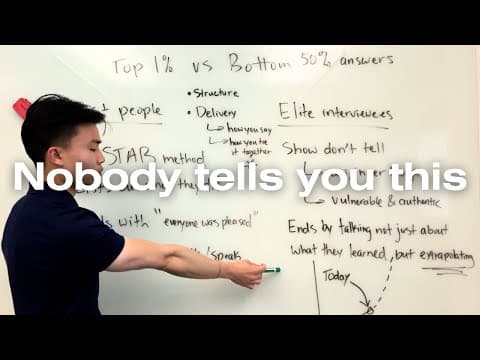
The best interview advice you never got (get into Google, BCG, top 1% roles)
Matt Huang
20m 19s3,811 words~20 min read
YouTube auto captions
Transcript source
YouTube auto captions
This transcript was extracted from YouTube's auto-generated caption track. The transcript below is server-rendered so it can be read, searched, cited, and shared without opening the original YouTube player.
Pull quotes
[0:00]And maybe you have a friend or an acquaintance or someone you know of on campus or in your life somewhere who's just really, really good at landing extremely competitive jobs.
[0:00]I'm going to distill in probably a video that's less than 20 minutes, five plus years of messing up left and right and doing probably over 100 interviews at different companies.
[0:00]And so if you're still with me, make sure you full screen the video, lock in and give me your attention for just 20 minutes.
[0:00]I promise it will help you out, especially if you're job hunting or if you plan to in the future.
Use this transcript
Related transcript hubs
Watch on YouTube
Share
MORE TRANSCRIPTS


