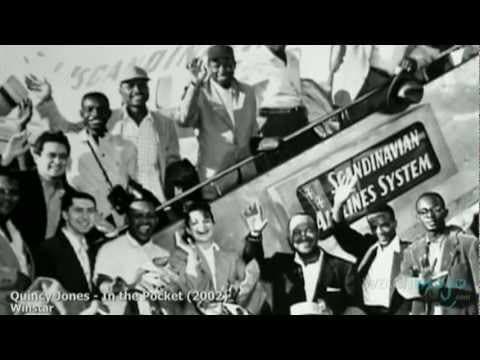
[0:06]With a career spanning over 50 years, this musical genius shows no signs of slowing down. Welcome to watchmojo.com and today we're taking a look at the life and career of Quincy Jones. Quincy Delight Jones Jr. was born March 14th, 1933 in Chicago, Illinois. While attending elementary school, he began playing the trumpet. His family then moved to Bremerton, Washington, where he attended high school and gained further musical instruction from arranger and producer Robert Blackwell. During the 1950s, Jones quit studying music at college to play trumpet on popular band leader Lionel Hampton's tour.
[0:48]He then moved to New York City, where he became a freelance song arranger for his friend Ray Charles and acts like Dina Washington, Count Basie, and Duke Ellington. Following a tour as trumpeter and musical director of the Dizzy Golespi band in the mid-1950s,
[1:06]Jones became the front man of his own jazz band and began recording music for ABC Paramount records. In 1956, he released the first of his over 30 albums, This Is How I Feel About Jazz. The next year, Jones moved to Paris to study music and soon became the music director of French record distributor Barclay Discs. During the next years, he toured North America and Europe as part of the Jones boys. Despite well-reviewed performances, the 18-piece big band failed to make ends meet and broke up. Mercury records founder Irving Green helped Jones bounce back by hiring him as musical director for the label's New York division. Within a few years, Jones advanced to vice president and became one of the first African-Americans to hold a senior management job at such a predominantly white business. The 1960s saw Jones arrange songs for some of music's biggest stars, namely Frank Sinatra and Ella Fitzgerald. In 1962, Jones released his 10th album Big Band Bossa Nova. It featured the popular tune Soul Bossa Nova, which has since appeared in numerous multimedia formats, like the Austin Power spy comedy series and in rapper Ludicrous's song Number one spot. Jones also began focusing his attention on film scoring. His first major project was 1964's The Pawnbroker. The movie's success allowed him to leave Mercury records and move to Los Angeles, where he composed the music for the drama The Slender Thread.
[2:44]Jones added more credits to his name over the next years, including Walk, Don't Run, In the Heat of the Night, In Cold Blood, and The Italian Job. Notable later scores included the 1978 musical The Wiz starring Michael Jackson and the 1985 Steven Spielberg directed period drama The Color Purple. Despite health problems, Jones released six albums that hit number one on the Jazz charts throughout the 1970s. Smackwater Jack, You've Got It Bad Girl, Body Heat, Mellow Madness, I Heard That, and Sounds and Stuff Like That.
[3:25]One of Jones's crowning achievements was his three-album collaboration with pop icon Michael Jackson. And their first joint venture happened at the end of that decade. 1979's Off the Wall sold over 20 million copies and cemented Jones's reputation as the most powerful producer in music. Next up was 1982's history-making Thriller, which sold an astounding 110 million copies and remains the best-selling album of all time. Their final collaboration was 1987's Bad, which sold over 30 million copies internationally. With famine ravaging Ethiopia during the mid-1980s, Jones helped put together the charity single We Are The World. Performed by a group of artists dubbed USA for Africa, the song's roster included a who's who of the music industry. The Platinum certified single won several Grammys in 1986. Over the years, Jones has been recognized frequently for his contributions to music, arts, and education. He has won over 20 Grammys out of his 70 plus nominations, was the first African-American to be nominated for an Oscar for best original song and score, and holds multiple honorary degrees and doctorates. In addition to music, Jones became a passionate social activist with his own entertainment company and released an autobiography. Pioneer, innovator, record breaker, and humanitarian are just a few words to describe Quincy Jones, who shows no signs of stopping in his later years. With so much creative fuel driving him forward, Jones's musical ingenuity seems limitless.


