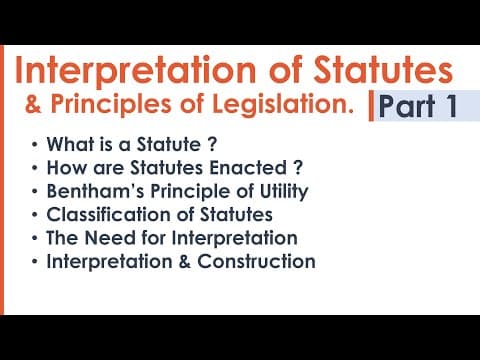
[0:00]Hello friends, this is Sanjay. This is part one of the series where I'm covering Interpretation of Statutes and the Principles of Legislation as per the standard LLB syllabus. The complete playlist for this series is available on the LawMint YouTube channel. In this part, we will start off by looking at what is a Statute, how statutes are enacted, what is Bentham's Principle of Utility in the creation of statutes? And the classification of statutes based on their duration, nature of operation and objective, the need for interpretation, and Salmond's and Denning's views on the need for interpretation. We will look at the situations when interpretation of statutes may be required, and we will also understand what is the difference between interpretation and construction of statutes. Let us start with a small activity. Pause the video here for one minute, and see if you can spot the difference between these two panels. So, go ahead, pause the video and unpause after one minute. If you found the difference, congratulations. If not, let me explain. You can ignore all of the graphics, they are just a distraction. Focus on the text. As a legal professional, you'll be dealing with, you'll be drafting or you'll be reviewing plenty of contracts and other legal documents. It is very important to pay attention to the language and the grammar of the documents and also to understand what was the original intention behind the words used. In the first panel, the boy is saying, let's eat, Grandma, which can be understood as the boy telling his grandma that they should eat something together, lunch or dinner or something. In the second panel, the comma is missing. So, the sentence now reads, let's eat grandma, which can be understood as the boy telling his brother that they should eat their grandma. So, the absence or the presence of a comma can completely alter the meaning of a sentence. As we will discuss in the context of interpretation of statutes, when you are reading a legal document, you will first try to interpret it precisely as what the words mean. But if that interpretation is leading to an absurd or an illogical conclusion, like the boys wanting to eat their grandma. You should look beyond the simple words and try to understand why this sentence was used, what was the situation when it was used, and interpret it as per what would have been the real intent of the author. Before we look at interpretation of statutes, we should first understand some basic aspects about statutes, starting with what is a statute. Various jurists and legal scholars have defined a statute in different words. Maxwell considered a statute to be the will of the legislature. Crawford said that a statute is the written will of the legislature, and the Collins Dictionary defines a statute as an enactment of a legislative body expressed in a formal document. You can see that there is an overlap in these definitions, and the main points that we can extract from these are that a statute is an act by the legislature, either by the State or the Central Legislature. It should be in a written format, so that there is no ambiguity and everything is expressed in black and white. It should be a formal document, that is, it should have gone through the formal process of creating a statute, the makers of the statute should have the powers, and it has been approved, etc. Though these two terms, statutes and laws are often used interchangeably, they are not the same thing. Because all statutes are laws, but all laws are not statutes. The term law has a wider scope. It includes statutes, which are the formal written laws, created by the legislature. It also includes rules and regulations, which may be based on the powers or the rights given by the statutes, and it also includes case laws, which are the judicial interpretation of the statutes. Article 13(a) of the Constitution defines the term 'Law' as including any Ordinance, order, bye-law, rule, regulation, notification, custom or usage having in the territory of India the force of law. In this series, we are specifically discussing about the interpretation of statutes. So when I say law, it means a statute, unless I indicate otherwise. Since we are talking about statutes, let's take a quick look at how they are enacted by the legislature, that is, how various laws come into existence. The legislative process in India involves several steps, which can vary slightly depending on whether the bill is a money bill, a financial bill, or an ordinary bill. This is a simplified version of the steps for an ordinary bill. First of all, a need is felt for a new law, or for amending an existing law. For example, when e-cigarettes started becoming prevalent in India, there were no laws that regulated them. So a need was felt for a new law. The process starts with a drafting of the bill. This is usually done by the relevant ministry or the government department. The draft is then reviewed and approved by the Minister in charge of that department. The bill then has to be introduced in either the Lok Sabha or the Rajya Sabha, but before that, the members of that house need to be notified. The draft bill is introduced in either House of the Parliament, except if it is a money bill, which is introduced only in the Lok Sabha. The first reading is the formal presentation of the bill in that house, where its title and main objectives are read and discussed. The bill is then published in the official gazette, so that all members of the Parliament have the opportunity to review it. The second reading is the most detailed phase of the legislative process, and it consists of three stages. First is the discussion stage, where members debate the general principles and the merits of the bill. The second stage is the committee stage, where the bill is referred to a parliamentary committee, which examines it clause by clause. Amendments can be proposed or public input may be sought at this stage, and then comes the consideration stage, where the House considers the committee's reports, and the members can discuss and vote on each clause of the bill and also on any amendments. In the third reading, the debate is limited to the acceptance or rejection of the bill as a whole, and no amendments are allowed at this stage. Members then vote on the bill. After passing one house, the bill is sent to the other house, where it goes through a similar process. If the second house suggests some amendments, then the bill goes back to the house where it originated for reconsideration. If the two houses disagree on the amendments, or if one house does not act on the bill within six months, then the President may summon a joint sitting of both the houses to deliberate and vote on the bill. Once both houses of Parliament pass the bill, it is presented to the President of India for assent. The President can give assent, withhold assent, or return the bill, if it is not a money bill, with a request for reconsideration. If the bill is returned and passed again by both the houses with or without amendments, and presented again to the President, then it is obligatory for the President to give assent. After the President's assent, the bill becomes an Act of Parliament. It is then published in the Gazette of India and comes into effect on the date mentioned in the act. If no date is specified, then it will come into force on the date of its publication in the gazette. Let us take a couple of minutes to talk about Bentham's Principle of Utility in the context of legislation. First of all, what is a law? One very simplistic definition of a law is that a law defines what is right and what is wrong. Now, the basic concept of right and wrong may be very subjective. For example, a vegetarian may say that killing animals is wrong. But for a non-vegetarian, animals are a part of the diet, so he or she may say that killing some animals is not wrong. That way, right and wrong may be very subjective. Now, Bentham's Principle of Utility says that it is the greatest happiness of the greatest number of people that is the measure of right or wrong. Happiness here means utility. So, if something creates utility or something is benefiting the maximum number of people, then that thing is right, or if something creates an inconvenience or hardship to the maximum number of people, then that thing is wrong. Even if it is creating utility to a lesser number of people.
[9:11]For example, when a speed limit is set on a road, it is intended for the safety of the maximum number of people, even though the speed limit is resulting in some people getting delayed. Similarly, when time limits are imposed on fireworks, the health and safety of the maximum number of people is taken into consideration, even though such time limits are restricting some people from using fireworks throughout the day and night of the festival. So, to summarize, while making laws, the utility of the maximum number of people is taken into consideration, even if such a law results in causing inconvenience or hardship to a smaller number of people. As I will discuss in a little more detail, statutes can be classified on the basis of their duration, their nature of operation, or their objective. The first criteria for classification of statutes can be their duration. They can be perpetual or they can be temporary. A perpetual statute does not have any specific time limit or end date. It is in force until it is repealed, either expressly repealed or the repeal is implied in some way. Most statutes are perpetual, such as the Companies Act or the Civil Procedure Code. On the other hand, temporary statutes are in force for a specific period only, so they have a time limit. A temporary statute may be extended or renewed, either expressly or through an implication. If it is not extended or renewed, then it will lapse. For example, ordinances issued by the President of India or by the Governors of States are temporary in nature. The articles of the Constitution that enable such ordinances also specify their expiry. For example, Article 123 says that an ordinance issued by the President of India will automatically cease to operate at the expiration of six weeks from the reassembly of the Parliament. The Finance Act is also a temporary statute because it has to be authorized annually. On the basis of their operation, statutes may be classified into prospective or retrospective. Most statutes passed by the legislature are prospective, which means that they will be effective from a future date on future acts or transactions. Statutes that are backdated, that is, statutes that cover acts or transactions that have already occurred in the past, are called retrospective statutes. In general, laws should be prospective and not retrospective, and the Constitution of India expressly prohibits conviction under retrospective laws. But Article 20, Clause 1, covers only retrospective criminal laws. Retrospective procedural laws and civil laws are not expressly banned. In fact, some amendments of tax laws, such as the Income Tax Act or the Central Excise Act, have had retrospective effect. Next, statutes can be either directive or mandatory. The best examples of directive statutes are the Directive Principles of State Policy, which are not mandatory, and they are not justiciable, that is, they cannot be enforced through the courts. Most of the other statutes are mandatory in nature, especially criminal or penal laws or tax laws. Such laws specifically prohibit certain actions or transactions, or may force persons to act in a specific way under specific situations, and mandatory statutes are justiciable, that is, they can be enforced through the courts. Before we look at the classifications of statutes based on their objectives, it is very important for us to understand that a statute may have multiple objectives. For example, the Companies Act is a codifying statute. Some parts of it are also declaratory. It is also a consolidating statute, because it consolidates some of the laws that preceded it. It prescribes some fines and penalties, so it also has some penal objectives. So, most statutes will not neatly fit into any single category. They will come under multiple categories depending on the context. Codifying statutes codify unwritten laws in orderly and authoritative statements. For example, there were several customs and traditions that were historically being followed by various communities and groups of businessmen. If anyone broke such customs, then that person would be punished by banning him or her from trading with anyone else in that group. Now, the Contract Act codified many such customs and traditions into an orderly and authoritative document. Declaratory, which are statutes that state or declare existing laws and not necessarily create new laws. For example, even before 2006, child marriage was already prohibited under different laws. However, these laws were not effectively implemented, and there was also some confusion regarding their application. So, the Prohibition of Child Marriage Act of 2006 provided clarity on the legal stance against child marriage. Remedial, curative or validating statutes remedy or cure defects in existing laws without making substantial changes. They may also validate judge-made laws or judicial precedence by including them in the statutes. For example, the Companies Amendment Act of 2015 was introduced to simplify the procedures and remove some of the ambiguities in the previous Companies Act of 2013. The new 2015 Act provided several amendments to cure the defects and clarify the provisions of the older 2013 Act. Amending acts are similar to remedial, curative or validating statutes because these are also making changes to existing statutes. But the crucial difference is in the scope or in the extent of the changes. While remedial statutes make small corrections or small changes, the amending statutes bring about significant changes. For example, the Information Technology Amendment Act of 2008 was an amendment to the Information Technology Act of 2000. The new Act introduced changes to tackle new forms of cyber crimes and it also included provisions for offenses like identity theft, cyber terrorism, and data protection, that were not prevalent when the original IT Act was passed. Consolidating statutes consolidate multiple statutes or rules into a single statute. For example, even before 2016, people, firms and companies were becoming bankrupt, but these situations were being handled under different laws in different ways. The Insolvency and Bankruptcy Code of 2016 brought together these fragmented laws related to insolvency and bankruptcy of corporate persons, partnership firms, and individuals into a single legislation. Enabling statutes remove restrictions or disabilities. They may make certain actions lawful. They may create new powers or permissions for individuals, organizations, or government bodies. For example, the original Constitution had right to property as a fundamental right, which meant that the State could not take over private property easily. The Act or the statute to amend the Constitution to move the right to property from a fundamental right to a lesser constitutional right, was an enabling statute, since it now enabled the government to take over private property more easily for public purposes. Many statutes have prohibitory, disabling or restraining objectives. For example, the Child Labor Prohibition and Regulation Act of 1986 specifically prohibits children from being employed in several sectors or industries. Penal statutes like the Indian Penal Code specifically impose penalties, punishments or forfeiture. Permissive statutes permit certain acts, without making them mandatory. For example, the Right to Information Act grants citizens the right to access information that is under the control of public authorities. From a citizen's perspective, it is permissive, because it allows citizens to seek information, but it does not make it mandatory.
[18:04]Repealing statutes are laws that are enacted to revoke existing legislation, either in part or in whole. When a statute is repealed, it becomes invalid. But certain provisions called the saving clause may be included in the repealing statute or the new statute to preserve the actions that were taken under the old repealed law. A good example is the Repealing and Amending Act of 2019, which repealed 58 obsolete and irrelevant laws. Whenever a new act is passed on the same subject, it usually repeals the older act, partly or fully. If it is specifically written in the new statute that the old statute is repealed, it is called explicit repeal. If the new statute is so inconsistent with the old statute that both cannot reasonably coexist, then the older statute is automatically considered to be repealed, and this is implicit repeal. Now that we know what are statutes and the different classifications of statutes, let us now talk about the need to interpret statutes. As you are aware, the legislature makes the law, the executive implements the law, and the citizens follow the law. But what happens if the executive is unclear about the law? What if implementing the law as the executive understood it, is leading to an injustice or an absurd situation? Or what if the citizens have a concern that the law, as implemented, is negatively affecting their fundamental rights or constitutional rights? In fact, the need for interpretation usually arises when there is a disagreement between the executive and the citizens. This is where the judiciary comes in. The courts will look at the law, all the available evidence, the situation where the law is sought to be applied, and then they will interpret the law so that it fulfills the actual intent of the legislature. Salmond's view was that looking at the mere text or the letter of the law is not sufficient. We should understand the actual intent or the spirit of the law. He said that interpretation or construction are the processes through which the courts ascertain the actual meaning of the law. Lord Denning, who was a British barrister and judge, brought out two more points. One is that when a law is made, it is impossible to predict all the possible situation and circumstances where the law may need to be applied. For example, you made laws for normal cars, and suddenly you have driverless cars, and you need to interpret how the existing laws will be applied to this new situation. The second point he made was that English language is not precise, as we have seen the absence or the presence of a comma can completely change the meaning of a sentence. Therefore, interpretation is the process by which the courts determine the actual meaning of a statutory provision for the purpose of applying it to the situation before them. This is a quick list of situations where interpretation of statutes may be required. Ambiguity, when the language of a statute is not clear or is open to more than one reasonable interpretation, then the courts will need to interpret the statute to determine the legislature's intent. Vagueness, that is, if a statute is vague and does not specifically address a point in issue, then interpretation is necessary to apply the statute to specific situations. If the literal meaning results in absurdity, that is, if applying the literal meaning of the statute's words would lead to an absurd or illogical outcome, then that is unlikely to be the legislature's intent. Or conflicting statutes, when two or more statutes appear to provide conflicting instructions on a particular issue, then interpretation is used to resolve such conflicts. Or gaps in the law, sometimes statutes may not address every possible situation that may arise, and the courts will have to interpret the statutes to fill these gaps. Changes in society and technology, as society and technology evolve, situations may arise that were not foreseen by the legislature. So, the courts may need to interpret statutes to apply them to these new conditions and contexts. Case law development, when higher courts provide interpretation of certain statutes, then the lower courts are often required to interpret those statutes in line with the higher court's decisions. Application to specific cases, where courts interpret statutes to determine how they apply to the specific facts of a case before them. Use of undefined terms, that is, if a statute uses terms that it does not clearly define, then interpretation may be needed to understand the meaning of these undefined terms in the context of the statute. Drafting errors, that is, if there are errors or omissions in the statute, then interpretation is needed to ascertain what the corrected statute would likely have intended. And finally, new evidence of legislative intent, that is, if new historical documents or legislative history materials come to light that clarify the actual intent behind a statute, this might necessitate a reinterpretation of the statute's provisions. In this subject, there are two terms that we will be using quite frequently, which are interpretation and construction. Though these two terms are sometimes used interchangeably, there is a difference between them. For example, if there is a case related to an accident, and there is a question whether this particular type of accident is covered by the Motor Vehicles Act or not, then the courts will first have to interpret the Act. What does the text of the law say? Then comes the construction part, which is where the court determines how the Act will be applicable to the specific situation. So, interpretation focuses on determining the meaning of the statute, and construction focuses on giving effect to the meaning of the statute. Interpretation looks at the language and the literal text, and construction takes it to the next level to consider what could be the result of the different possible interpretations of the statute. Interpretation is used in case of ambiguous language, or if there is a conflict or contradiction between the provisions of the same statute. Construction looks at the specific situation, whether it is covered by the statute or not, and how to resolve conflicts between different statutes that are applicable on the same situation, and also how to deal with new or unforeseen situations. With that, we will end this session. If you have any questions or feedback, post a comment below. Don't forget to like, share and subscribe. We will meet again in the next video. Take care and stay safe.