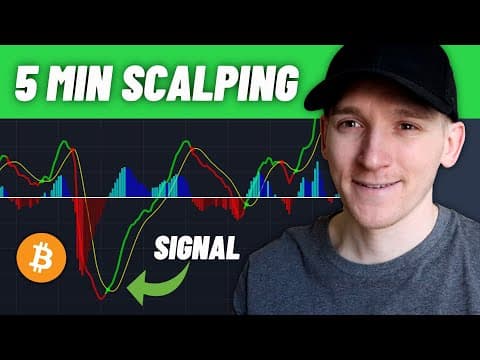
[0:00]A scalping strategy for the five minute time frame. This can be used on the one minute, five minute, 15 minute. It's really up to you, but what I want to impress in this video is the indicators we're using right here and then the trade signals for entries, right? Because with scalping you're just looking for that good trade entry to try and ride up a wave of momentum in the market.
[0:18]So we're going to look at that in this video and then including how to actually enter these trades and get your sizing right when trading. I trade crypto so we're going to look at trading Bitcoin right here. I'll leave time stamps below.
[0:28]The first thing we can do is just get some support and resistance levels on our trading chart because as you can see, support and resistance often are areas where price has bounced from. So, of course, they bounce from there and then they break through from there.
[0:43]But all we want to do is just get these major support and resistance levels on the chart just to have that in the back of our mind because if we are trading near a major support and resistance level, then maybe we can just be a little bit careful with our trading versus some of the signals that we're getting from, you know, very low time frame entries.
[0:54]So if you're up near a support and resistance line, you can make a decision at the time on how you think the market is trading at that time, whether you think you're going to reject off of that, which we got here or you or you think, you know, you're actually going to bounce off of that like we got here. So you're going to have to do that at the time that you're trading based on what you think the market is doing, but they're important to get.
[1:21]Now when you're trading in the middle of these, maybe with a trend up, then you're maybe, you know, having a bias towards actually going long here and taking long positions as well.
[1:29]So for me, I just trade between a support below and a resistance above, and then the move from one to the other.
[1:36]So you're either thinking we're rejecting off that or we're getting bounced off the support level. So that's number one. When trading on these low time frames like 5 or 15 minutes, how much money can we actually make? How much can the asset actually move by?
[1:45]Obviously, it depends on the asset, but for crypto, Bitcoin, ETH, you're looking maybe at a 25 to 75 basis points move over a short time frame.
[1:56]So you're trading around, you know, let's say 50 basis points as a move for your trade. Now that's not a lot in percentage terms. So people either trade with large size, or they trade with leverage to make the size of their trade larger than what they actually have to put in.
[2:13]So what we're going to do is use Apex Pro. Apex Pro is Bybit's on-chain exchange. So this is for more, you know, advanced traders.
[2:20]If you have a Metamask wallet, you can just send some USDC into your wallet. You can connect it to the exchange and then go ahead and trade futures with leverage.
[2:27]Now, obviously, I can't recommend this. This is for experienced and more professional traders for sure.
[2:33]There are other centralized exchanges where you can trade this. You can trade in the spot market without leverage as well, of course, but the percentage gains are very small.
[2:41]You can still take this for your entry signals, though, but for more advanced traders, Apex, I'm going to use this as the example.
[2:46]From here, we can go and put our indicators on TradingView to actually get some trade and entry signals. Now, TradingView is free, these indicators are free, so if you want to use TradingView, sign up for an account. I'll link them below.
[2:57]Now, you can use two indicators for free on TradingView. If you want more than that, you do have to go for the pro version, but you can probably get away with the free version as well, to be honest.
[3:05]So what we're going to do is go to our Bitcoin chart. We're going to check the five-minute time frame. Go to indicators. First thing we're going to do is put a simple moving average on here.
[3:14]That's just going to show us this blue line. So if you come up here and put the settings on, you can change the color. Inputs, I've put 100 periods.
[3:22]This is slightly longer term. Now, this isn't a long-term moving average because we're looking at 100 five-minute periods. So what we're really looking at is a very short-term moving average, but I just want to use this as a broad indicator of if the price is below here.
[3:36]I don't want to be taking long positions. If the price is above, then I might want to look into taking long positions. So that's number one.
[3:44]The second thing is we're going to use this indicator, which is Candle Plot MTF.
[3:48]So again, go to indicators, type in candle plot, should be this one right here.
[3:54]Now, on the settings on this, I just want to change this in inputs. Candle type, I've just put Heiken Ashi. So what is that?
[4:04]Well, what it tries to do is take a bunch of candlesticks together and give you a broader candlestick. So it's not one period of time to the other.
[4:12]It takes a little bit of data from the previous candlestick, a little bit of data from the current candlestick, and gives you like a new candlestick.
[4:18]This is trying to flatten out the candlestick movements and give you more of a trend within the movement of price.
[4:27]So what I want to do here, looking at this, is really understand where the longer term trend is of that price because the candlesticks over five minutes are, you know, look very volatile.
[4:36]But what I want to see is where is the kind of trend of price movement, right? So where the candlesticks are purple, this is obviously down, like a downward trend, right?
[4:47]If you think about this period in time, what it's doing is taking a a step back on a longer or a higher time frame and saying what's the trend in that.
[4:56]So you're kind of overlaying shorter term or low time frame price movements over a higher time frame price movement.
[5:05]And so that's good to see just to zoom out on the same low time frame chart, right? So what we're seeing here is, you know, a downward movement in price, despite this volatility, a downward movement in price.
[5:15]So we don't want to be going long when the candlestick or the actual price is under the moving average, and we don't want to be going long when the general trend over a longer time frame is down, right?
[5:27]So that's just taking our long positions out of the equation. Now, on the bottom here, you can see MACD. I'm going to use this for trading signals.
[5:32]So you go to MACD. I think it is the MACD custom indicator multi time frame. Very simply, we're just going to use this. This is a momentum indicator.
[5:40]So it's showing us where momentum is. You can see as the price fluctuates up and down, so does the momentum indicator, right? And so very simply, what we want to do is find areas where the momentum is crossing towards being bullish or to the upside.
[5:58]Right, and that's going to have a momentum to the upside. So you can see green here, green here, green here.
[6:04]Now, we don't trade these because the price is underneath the moving average and the candlesticks here are, you know, bearish. So these are not what we trade.
[6:15]But as you can see, these indicators are giving me an idea of is the price momentum bullish or bearish and the actual signal is when the momentum is green, so the momentum is to the upside.
[6:28]But of course, that momentum indicator, we use that with others to actually go ahead and trade or not. So when price action is bearish like this, even if we get a bullish indicator, we do not trade.
[6:40]We wait until price is above that moving average and we get a potential entry signal.
[6:49]This one would not work because we're still below. So we have to go around and see where are the entry signals.
[6:55]So there's potentially one here, although again, momentum is slowing down, so not very good. There's potentially one here as well because we're above.
[7:04]So where is our entry signal? We are waiting for price candlesticks to be above this moving average, and the larger candle plots to be looking towards more of an uptrend, and then eventually getting the MACD entry signal where momentum has picked up to the bullish side.
[7:23]Once we have a potential trade entry, we can then work out, can we open a position? How much can we trade with? What is the size that we can trade with?
[7:32]And that depends on many factors, so I'll explain it simply. So the first thing is, we get a trade signal. We have the price above the blue moving average.
[7:40]We have fairly bullish momentum in the, you know, longer or higher time frame candlesticks. We also get a MACD bullish crossover. So that is probably a trade signal that we might want to take.
[7:51]So we get the trade signal on this candlestick right here, so we would look to enter on the next candlestick or around when you get the signal.
[7:59]So because these are five-minute time frames, five minutes is enough to obviously get your trade in, you know, within the candlestick.
[8:06]So we have this trade entry here and it looks like we're going to enter around this position. So we're taking a long position and we want to put the the stop loss somewhere.
[8:18]Now, if you're trading very short term, we're just going to go in here, we're going to put the stop loss somewhere around the low of the previous candlestick or the previous move. So you're looking somewhere around here, right?
[8:30]So if we're entering around this candlestick, so I'm just going to put it, you know, around here. Let's put the entry a little bit worse than we actually might get it, cuz I want to enter around this candlestick, let's say.
[8:40]We want to get the previous candlestick low or some area where we think that is a decent support and resistance level for this little move. So maybe we're putting a stop loss roundabout this move, which seems about right.
[8:53]So that stop loss, as you can see is around nine basis points. Now, if you want to move it down, you can to this. That gives you a trade more breathing room.
[9:02]Why would I put it here? It just, you know, you can see the support and resistance line, right? So this candlestick here, this candlestick here, this one here, it seems like there's a buyer at that level at least coming in.
[9:14]So it's up to you. So let's have uh that's around 18 basis points, which to me, to be honest, is probably good because you're thinking 18 basis points.
[9:23]That can move very quickly in that direction. Now, to the upside, what are we looking at? We would be looking at a ratio of at least 2 to 1.
[9:32]So you'd be looking around 30, 40 basis points. So let's put 40 basis point, 40 basis points on here, right?
[9:41]So that would be a trade entry at this price because we have all of the confluence of the indicators. We enter at this price, 26774. That's our stop loss, 26727, and a potential take profit, uh 26880.
[9:53]Now, from here, how do we actually go and enter that position and how do we know how much money to use in the trade and how much risk that we're taking in this trade?
[10:02]So we can work this out on a trading system. So, firstly, you know, if you don't know how to do this, then you can just demo trade this.
[10:06]So on a lot of crypto trading systems, you'll get demo trading for free. Bybit has it as well. So I'll link them below if you want to try out demo trading. Demo trading here, you can enter everything, open, you know, kind of paper trading positions and see that as well.
[10:18]So I'll link them below if you want to see that. But we have the entry, stop loss and take profit price. So now what we can do is go to a trading system and actually put these details in.
[10:26]So we can go to a position size calculator. I'll link this one below. So you put the open price in, we're trading Bitcoin. Now, if you're trading a different asset, you need to put that in because each asset has, um, you know, a different price per unit.
[10:40]So you need to know how many units of the asset that you want to trade. So we know the open price is 26774. That's the open price here.
[10:47]We know the stop loss is 26727, and we know the take profit is 26880. So we can do our stop loss price here. You don't need to know about the take profit.
[10:55]We just have the stop loss price and then the account balance. Now, this can be 100, 1000, 10,000, right?
[11:02]It's up to you how much you're putting in. I'll just do it very simply for $100 balance. Risk 2%. So maybe risk 1 to 3%, something like that per trade.
[11:10]We know a dollar amount on $100 balance would be a money at risk at 2. If you put $1000 balance and your money at risk is $20 each trade, then the balance of your trade is 0.4 of a Bitcoin right here.
[11:34]So we know the we know the Bitcoin unit balance that we can trade now. So what we can do is go back to our trading system.
[11:40]We have a limit order here. Now, when you're trading on, you know, low time frames, you may just want to go for a market order.
[11:47]kind of open up the position and then sort out the stop loss and take profit off the after which you can do and you just edit the position down here.
[11:54]But for this example, we'll have this as the limit price that we're opening the position at.
[12:01]Now, from here, we want to press buy long with TPSL, take profit stop loss. We have the stop loss in here at 26727.
[12:08]Take profit doesn't matter too much. Like I said, you can edit that after the fact if you want to get the trade done.
[12:13]All we have to realize here is what is the size of order that we need to trade in order to have a stop loss price that loses around $2.
[12:24]And you can see uh right here that that would be around 0.04. Now, it's not letting me trade 0.04.
[12:31]Why is that? I have a balance in the account here, and that is what's what I'm using to fund this position.
[12:40]But importantly, the actual position size is $1,000, and I've got $100 in the account to fund that position.
[12:47]That is using leverage, right? So I'm using 10x leverage here, which gets us around about where we want to be, which is we have $1,000 position, and we know that the loss that we're taking on this stop loss,
[12:59]the percentage is only 18 basis points. And so we know that we have to trade with $1,000 because an 18 basis point move on $1,000 would be $1.80, so around that $2 price, right, including some commissions.
[13:12]So we need to trade with $1,000 balance. What if you don't have a $1,000 balance? Well, you can use leverage to collateralize that trade. You're only losing $2 if the trade goes against you, but you have enough size to actually make it that trade of $1,000 and a $2 loss, or $10,000 and a $20 loss.
[13:30]So that's up to the individual to use. I can't recommend using leverage, of course. It's up to more experienced traders to do this if if they wish.
[13:38]But what we can also do is just increase leverage here a little bit more to 15, and that will let us trade with 0.04. You can see the trade size is the same entry and stop loss and now you're losing around that $2.
[13:51]You're only putting $71 in the trade with 50 with 15x leverage. But the trade size is the same. You're just putting less down, which means that trade size can go up a little bit.
[14:00]But remember, our stop loss is $2. And so we've got plenty of collateral to fund that trade and the potential loss. It's absolutely vital that you have a stop loss in place when trading with leverage or when day trading or speculating on the low time frame charts.
[14:20]This is the riskiest type of trading. You're going to get stopped out a lot. The price is going to move against you a lot. And so really what you're looking for all of the time is just trying to get a good entry for a next leg in the market.
[14:31]And if it starts to starts to go against you, you really have to get out because this is the riskiest type of trading. You're going to appear in a position that moves against you. So that stop loss is important to know exactly the dollar amount that you're risking each time.
[14:44]You can use leverage to your advantage if you want, or you can simply just put more money down into trades and not use any leverage.
[14:50]But the actual risk, if you've got that stop loss in place is actually the same. So that's up to the individual trader to use with experience.
[14:58]Let's look at three more entry examples as well and just see how this strategy plays out. So what we're looking for right here is an entry signal where we have price above the moving average and fairly bullish price action.
[15:12]So, as you can see, this candlestick isn't great. However, we are getting a bullish indicator here, and the potential trade is, you know, to the upside. So, long position, we can put that in.
[15:24]Somewhere like this, you would put the stop loss at the bottom of the previous candle or somewhere, you know, where you got support again.
[15:32]And then you would be looking at 2 to 1 upside. So if we get 2 to 1 upside something like that, you're now looking at only a 26 basis points move, an eight basis points move.
[15:42]Now again, an eight basis points move that is extremely likely that you're going to get wicked out, right? Because it's just so, so close to the actual price. It can just move in a second.
[15:50]So maybe just give yourself a little bit more, 20 basis points, 15 basis points, and then maybe look at something more.
[15:59]Now, again, this is up to the individual trader. You can either be very, very strict with a 2, 2.5 to 1 ratio on the stop loss or to say I'm just using this as a potential entry.
[16:32]So I get a good entry with a wave up and then I can maybe change later on. But if you're not like that, if you're not more experienced, just be very tight. So that would be a trade there.
[16:42]Now, look at this to see if we actually went through with this trade. That would have been, you know, a decent trade. We would have got out, right?
[16:49]So that would have been a decent trade. So let's look at another one where we have some indicators. This one right here, we would not trade.
[16:56]Price is kind of below and we have, you know, a big sell-off kind of below, right? So we wouldn't go for that.
[17:01]We're looking for an uptrend. Nope, because the price is below. Price has flipped up again. We're looking at potential uptrend here. Not a great entry, right?
[17:10]Price is getting a little bit more volatile, but again, we look for that long entry around this candlestick. This candlestick's moving a lot. So we could have got a very bad entry here, but, you know, let's say somewhere in the middle of that candle.
[17:21]We're looking for a stop loss potentially around here because we're looking at the previous candle wick. So a pretty big stop loss and then you're looking for something 2 to 1.
[17:32]Now, as you can see, a trade like this, not really great to trade, right? It's a little bit, things are getting a bit volatile, things are getting a little bit out of hand.
[17:42]So this is probably a a news event or something happening in the market. Very difficult to trade this. Um, now again, you you might have traded this well, but you might not have been able to trade it well because of the speed that this was moving.
[17:54]So this strategy can potentially work best when things are just trending a little bit more and there's not too much move moving the market over time.
[18:03]We have another one here. We wouldn't trade that. We have another one here. We probably wouldn't trade that. It's under. And then we look at one here.
[18:11]Now, we wouldn't trade that either because what's happened here is a massive move to the upside, and you wouldn't have been able to catch it.
[18:19]So again, with big moves, uh this was a news event and obviously got sold off as well. So again, you can't really trade big moves.
[18:28]So the volatility here is difficult to trade, which just goes to show, you know, trading short-term on the low time frames and scalping, the riskiest way to trade.
[18:40]You'll get a lot of false flags, a lot of stop loss losses and stopped out, which is why you need that stop loss. I'll leave some day trading videos in the description if you want to know more. Links below to TradingView, Apex and everything as well. I'm James with MoneyZG. Thanks for watching and I'll see you in the next one.


