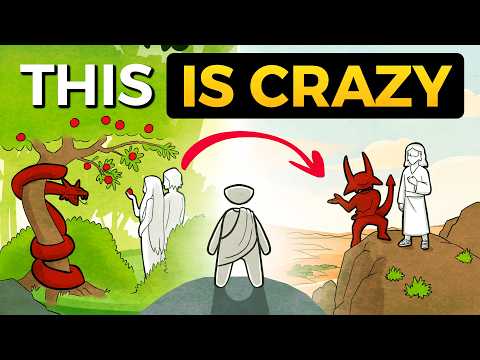
[0:00]Have you ever compared the temptation narratives of Eve in the garden and Jesus in the wilderness? Both stories feature a crafty tempter who used the same three strategies against both Eve and Jesus. The same three strategies he uses against you and me every single day. What surprised me the most though is how this comparison pulls back the curtain on a plan so ancient, so precise that Satan himself didn't see it coming. And by the end of this video, you'll understand exactly why. After my mates and I studied this passage for hours, we've compiled 16 connections between the garden temptation and the wilderness temptation. That seriously surprised me. I mean, going in, I was expecting like four or five, but we somehow landed on 16. We've grouped these connections under three neat categories for you to follow. First, the strategy of Satan, where we'll break down the enemy's strategy move by move and teach you how you can resist it. Then the response of the tested, where you'll see exactly why one stood and one fell. We're going to analyze both Jesus and Eve in their responses to being tempted by the devil. And finally, the result of the test, where the full picture comes into focus and a hidden reversal most people never see appears through the pages. Look, this video isn't for everyone, but if you love the Bible and want to get deep, then this one is for you. And I have one simple request. Could you do me a favor and check that you're subscribed? Here's the deal, if you choose to subscribe, I promise that my team and I will work tirelessly to provide you the best quality Bible content we possibly can. We start where everything starts. Genesis 2. God has spoken a world into existence and called it good. He has formed a man from the dust of the ground, breathed life into him and placed him in a garden. Then from the man's own side, a woman. Together they walk with God. Together they tend the ground. Together they live in something we've never fully experienced. A life overlapping with their creator. At the center of the garden stand two trees. First, the tree of life, which they eat from freely. Immortality for them isn't a distant hope. It's their daily reality. And then, the other one. One boundary, one restriction. See, Adam could eat from any tree in the garden, but this one, the tree of the knowledge of good and evil. This is the setting of the first temptation humanity has ever experienced. Now, hold that image, because we are heading to a very, very different place. And the contrast is going to hit harder than you expect. Here we are in Matthew 4. The setting couldn't be more different. No garden, no abundance, no comfort. Just desert, rocks, heat. A man walks alone at the outermost edge of his physical limits, carrying the full weight of being human in a broken world. How did he get here? Is he lost? Quite the opposite, it turns out. Let me clear up some drama for y'all. Therapy is not from the devil. Getting therapy is not a lack of faith in Jesus. In fact, it's often a method used by God to bring about healing in people's lives. But here's the catch. I personally will not go to therapy unless the therapist is a Bible-believing Christian. And what's awesome about BetterHelp, today's paid partner, is that they have over 34,000 qualified therapists, hundreds of which are Christians. I filled out this really excellent survey that asked me about my life, my faith, and even my denomination to match me with a therapist that would really get me. I did my first session recently, and it was fantastic. I shared with my therapist some struggles I'm having at church recently, and he shared some new light on areas I've never thought about. In regard to avoiding temptation, one of the cool things that I learned was that every temptation always has a way out, and most of the time the way out is through confessing and openly sharing with friends. When I did therapy, I was calling my friends three times a week to check in and remain accountable. This might be the decision that finally breaks the shackles on the trauma or addiction that has been burying you in shame. Give it a try today using my link betterhelp.com/bibleanimations for 10% off your first month. Matthew 4:1 says that this man, the son of God, was led by the Spirit into the wilderness to be tempted by the devil. Not only is Jesus not lost. He is exactly where God wanted him to be. Led by the Spirit. Before we go any further, sit with that for a moment. What happens next isn't an ambush or a surprise. The temptation that follows wasn't Satan catching Jesus off guard. God initiated this deliberately. Now, before we get into the connections, we need to understand what was actually at stake in the garden. Because the tree of knowledge of good and evil is one of the most misunderstood objects in all of scripture. Most people assume it was simply forbidden fruit. A rule, a line not to be crossed, but it was something far more specific than that. The word used here is da'at or knowledge. But the word isn't simply intellectual knowledge like we normally think of. It's experiential. Watch what that transfer actually did. Before the tree, Adam and Eve lived in a world where they had only experienced one category. Good. Everything God made, he called good, and they had no framework for evil because evil wasn't even present in their experience. Good was what God called good, and they received it from him rather than deciding it for themselves. Recipients rather than judges. The tree would change everything, however. But it wasn't the tree that triggered the fall of man. It was the slithering tempter who perched in its branches. Yes, none other than Satan, the adversary of mankind, who masquerades as an angel of light, prowling around like a roaring lion looking for someone to devour. Jesus himself names him the prince of this world. But that title deserves a closer look, because it tells you more about Satan than he'd probably like you knowing. The word Jesus used is Archon. It means ruler, governor, authority figure. But an Archon is rarely the top of the chain. So how did Satan get the title at all? Did he seize it from God, win it in some cosmic wager? No. It was given to him freely. Not by God, but by Adam. When God created humanity, he gave Adam dominion over the Earth. Adam was the appointed governor, ruling creation on God's behalf, but when Adam obeyed Satan instead of God at the tree, he didn't just break a rule. He switched allegiances. In a sense, Adam traded his dominion over the earth for the knowledge of evil. Satan became the prince of the world not by conquest, but by receiving what was freely handed to him by the one person authorized to give it. Now, keep in mind, evil can only twist what already exists. Everything that exists was created by God and called good by him. But every single temptation you will ever face is one of those good things twisted back on itself. And he's been using the same three moves since the beginning. John gives us the framework in his first letter. For everything in the world, the lust of the flesh, the lust of the eyes, and the pride of life, comes not from the father, but from the world. Three categories. The desire to feel, the desire to have, and the desire to be. But notice, these aren't just categories on a page. They're the literal structure of both temptations, point for point. Five connections hide inside Satan's strategy alone. We're going to break it down and analyze it so you know how to resist him when he comes for you. Satan's plan. He's not impulsive about it. Genesis 3:1 tells us that the serpent was more crafty than any other beast God had made. Not stronger, crafty. Shrewd is another way to put it, showing sharp practical intelligence, often seen in the decision-making of business deals. Just as Satan calculated his approach to Eve in the garden, patient, strategic, choosing the perfect moment. He did exactly the same with Jesus. He waited for Jesus to reach his weakest physical form to tempt him and played him on the devil's own home turf, the wilderness. If that's the level of strategy he brought against the son of God, don't think for a second he's going to be any less deliberate with you. But here's something about his strategy that will become critical by connection 5. The three moves he uses haven't changed in thousands of years. When Eve looks at the fruit, what does she notice first? The woman saw that the tree was good for food. It would satisfy. It would taste good. There's nothing wrong with food, there's nothing wrong with hunger, but Satan knew this desire could be warped. Just as Satan used fruit to tempt Eve, he used bread to tempt Jesus. The strategy is identical. Satisfy the body. Give it what it's crying out for, but the conditions couldn't be more different. And we'll see just how different they are when we get to connection 9. The second thing Eve notices is the fruit was pleasing to the eye. There's an aesthetic to this temptation. It doesn't just promise satisfaction, it presents itself as beautiful. Now, watch Satan take the same angle in the wilderness. The devil took him to a very high mountain and showed him all the kingdoms of the world and their splendor. In the garden it was a single piece of fruit. In the wilderness, it was every kingdom on Earth. Different scale, same play. Now, this is where it gets dangerous, and this is where the Eden connection goes deeper than most people realize. Satan isn't bluffing in either case. In Eden, he knew Adam and Eve would truly receive the knowledge. In the wilderness, Luke 4:6 is critical. Satan says, I will give you all their authority and splendor. It has been given to me and I can give it to anyone I want. And notice, Jesus doesn't dispute the claim. He doesn't say, those aren't yours to offer, because Satan is telling the truth. That authority was given to him. It was given to him by Adam. The serpent offered Eve a shortcut. Be like God. Skip the process. Satan offers Jesus the same deal. Rule the nations, skip the cross. But think about what Jesus would have had to do to accept this. He would have had to do what Adam did. Take his instructions from Satan instead of from the Father. He would have had to switch allegiances. And the moment he does, he becomes another Adam. Another Vice Regent who handed his authority to the wrong king. The cycle repeats, nothing is redeemed, no one is restored. Jesus says, no. Not because the kingdoms aren't real, not because Satan can't deliver, but because the only way to reclaim what Adam lost is to do what Adam couldn't. Remain submitted to the Father, even when the cost is the cross. You don't undo a rebellion with another rebellion. You undo it with obedience. And woven into all of this is an older, darker lie. You will not certainly die, the serpent tells Eve in Genesis 3. For Jesus, it's the same whisper dressed in different clothes. You can reign without suffering. You can have the crown without the thorns. But Jesus knew something Eve didn't. There's no shortcut that doesn't cost you everything. But this one's the deepest cut, because this is where Satan goes after identity. Genesis 3:5 says that you will be like God, knowing good and evil. That's the pitch. You could be more. You're not enough as you are. There's a higher version of yourself on the other side of this fruit, and God's holding it back from you. Now, watch how Satan repackages the same lies for Jesus. If you are the son of God, throw yourself down. In fact, the Greek here, 'ei', assumes the condition is true. It's closer to, since you are the son of God, prove it. Satan isn't questioning Jesus' identity. He's trying to weaponize it. See how both attacks are aimed at the same target. Identity. The dark irony, pride is the very thing that destroyed Satan in the first place. I will make myself like the Most High, he said. Now he's selling the same lie that unmade him to us. Three strategies, five connections, two very different outcomes. The same ancient battle plan, and it's the one he's still using on you and me right now. But Satan's strategy is only half the story. What determines the outcome isn't the attack, it's the response. And that's where these two stories diverge completely. So why does one stand and one fall? Because here's the thing that wrecked me when I saw it. It wasn't because Jesus pulled rank or reached for his divinity and overpowered the moment. If anything, Eve had the human advantage. She was in paradise. He was near death in a barren wasteland. The difference is how they handled the word. And in these next seven connections, that difference becomes devastatingly clear. Watch Eve. When the serpent opens with, did God really say? She responds, she engages, and here's the first crack. God says, you must not eat from the tree that is in the middle of the garden, and you must not touch it, or you will die. Except, God never said that. Go back to Genesis 2:17. God said, don't eat. He didn't say anything about touching. Eve has added that to the command, or perhaps Adam did when he passed it along. Either way, the word has already been stretched before Satan's even made his first move. Eve edits the command and expands the boundary. Jesus, three temptations, three responses, and every single one is a direct, precise quotation. Not a syllable added, not a word softened. Now, that might seem small, but it reveals something massive. Eve is already editing God's word. She's positioning herself as the one who decides what the command really means. The moment you start adjusting the word to fit the situation, you've already placed yourself above it. And honestly, that convicts me more than I'd like to admit. I catch myself doing the same thing, softening parts of the word of God to make me more comfortable. Now, watch Jesus. Three temptations, three responses, every single time, it is written. Not I think, not it seems to me, not, well, the spirit of the law suggests, just it is written. He doesn't engage, he doesn't debate, he doesn't nuance. He submits to the word as it stands and lets the word do the talking. Just as Eve placed herself above God's word, editing it, reinterpreting it, judging its validity for herself. Jesus placed himself under it in complete submission. Eve stood over scripture. Jesus stood under it. Keep this in mind because by connection 10, you'll see exactly where that line between over and under leads. Think about what Eve actually does in Genesis 3:6. She takes the fruit and eats it. Nothing. She doesn't die. So she hands it to Adam. They're putting God's word to the test, treating his command like a hypothesis instead of a verdict. And in the end, Adam never saw his thousandth year. Now listen to Jesus when Satan tells him to throw himself off the temple and let the angels catch him. Jesus quotes Deuteronomy 6:16. Do not put the Lord your God to the test. He's not just resisting a dare, he's refusing to do what Adam and Eve did. To probe God's boundaries looking for slack. Eve tested the word and decided the warning was empty. Jesus honored the word and refused to treat it as anything less than final. And then there's the covering. After the fall, Adam and Eve tried to cover their own shame. They sewed fig leaves together. It never works, though. You cannot cover what you've done with what you've made. So God does something they didn't ask for and probably didn't understand. The Lord God made garments of skin for Adam and his wife and clothed them. Did you see what happened there? Pay close attention to this. An animal had to die. This is the first death recorded in scripture. The first blood ever spilled. And it wasn't spilled by human hand, it was spilled by God's. He killed something innocent to clothe the guilty. And he did it willingly without being asked. Just as God killed an animal to cover Adam and Eve's shame, God provided his own son as a sacrifice to cover ours. The covering in Eden was an animal skin. It wore out. The covering in Christ is his own blood. That one holds. We even have the appearance of angels in both stories. After the fall, the Cherubim with flaming swords are set to block the way back into the garden. After the wilderness, angels are sent to attend to Jesus, serving him. The same beings, but completely opposite job descriptions. That shift from judgment to ministry, that's the whole gospel in just a few lines. Now watch the contrast that frames everything. Adam fails in paradise, in his home, in abundance, surrounded by God's presence, surrounded by good fruit, and was exiled to the wilderness. Jesus succeeded in the wilderness, enemy's territory, demon central, in depravation, at the edge of physical death. And through his obedience, opened the way back into paradise. Adam had every advantage and lost in paradise. Jesus had none and won it back. Now, here is what most miss, and this is the connection that ties all before it together. We've seen the same enemy, the same strategy, and the same three lies. We've seen one fail and one stand, but there's one detail hiding in plain sight. A question nobody thinks to ask, who started each conflict? In Eden, Satan initiates. He enters the garden, he finds the tree God planted, he approaches Eve, he picks the time, he picks the place, he picks the target. Satan is the hunter. Now, remember what we read earlier? Then Jesus was led by the Spirit into the wilderness to be tempted by the devil. Jesus didn't wander into the desert and accidentally run into Satan. The spirit led him there. In fact, Mark's gospel uses the word ekballo, the same word used for casting out demons. The spirit didn't just lead Jesus into the desert, it drove him there. Satan didn't summon this fight, he didn't pick the time, he didn't set the terms, he didn't choose his opponent. He was the delivered one. Think back to Job for a moment. When Satan wanted to touch Job, what did he have to do? He had to ask permission. He had to stand before the throne and request access. He has never, not once in scripture, operated outside of God's sovereign hand. And here, in the wilderness, that is still true. Satan thinks he's the predator. He sees a starving man alone in the desert. An easy target. 40 days without food, no crowds, no angels. But Satan wasn't setting a trap. He was actually walking into one, and he had no idea. Here is what Satan missed back in the garden. He watched Eve reach for the fruit. He watched Adam stand there silent and then eat. And he thought he'd won. See, free will in their hands leads to failure. Your image-bearers aren't worthy. But all he actually proved was that the choice, free will, was real. God had placed the tree there knowing that risk, not to learn the answer, but to demonstrate it. To prove before the watching universe that free will was genuine, obedience wasn't compelled, and therefore love was possible. They could have said no, but they didn't. Satan didn't break God's design, he confirmed it. And God already had the final blow coming. Another human, same free will, same real choice, different outcome. Just as God planted the tree in the garden and gave Adam a choice, God led Jesus by the Spirit into the wilderness and gave him a choice. Both tests were set up by God, but the direction of the hunt reversed completely. In Eden, Satan chose the battlefield and God allowed it. In the wilderness, God chose the battlefield. He sent his son, he set the terms, he delivered the opponent. Let that land for a second. The hunter became the hunted. The trap setter walked into a trap of his own, and he didn't even realize it. This is what Paul is talking about in 1 Corinthians 2. None of the rulers of this age understood it, for if they had, they would not have crucified the Lord of glory. Satan has never understood what he's walking into. Not in the wilderness, not at Gethsemane, not at the cross. Every single time he thought he was winning, he was being outplayed. And if you think God only started out playing Satan in the wilderness, go back to the garden. Because while the fruit is still being digested and the shame is still fresh, God turns to the serpent and says something that should send a chill down your spine. I will put enmity between you and the woman, and between your offspring and hers. He will crush your head, and you will strike his heel. Theologians call this the Protoevangelium, the first gospel message. The first announcement of rescue spoken before the exile, before the consequences are even finished. And notice who God is talking to. Not Adam, not Eve. He's looking the serpent dead in the eye and telling him how this ends. A descendant of the woman, her seed, not Adam's, which already hints at something impossible, will crush the serpent's head. Satan will get a strike in, he'll wound the heel, but the head, the head gets crushed. And there's no coming back from that. That's not a reaction. That's not God scrambling to fix what just broke. That's a commander revealing his battle plan to the enemy. Because the enemy can't stop it, even if he knows what's coming. Jesus didn't do this as a private individual. He did it as a representative. Adam represented us in the garden. Christ represented us in the wilderness. In Adam, humanity fell. In Christ, humanity stands. So when Satan brings his accusations against you, and he will, the answer isn't your evidence. The answer is your representative. The case has already been decided. The verdict came in 2,000 years ago in a Judeaan wilderness. And if that's true on the cosmic scale, it can be true in your life, too. Every wilderness you've ever walked through, every attack that felt like it would break you, every moment you thought the enemy was winning. What if you were never the prey? What if you were the prize? You've watched two people face the same enemy, one in paradise and one in a wasteland. One with every advantage and one with none, and you've seen what made the difference. Not intelligence, not willpower, not circumstance. It was how they handled the word of God. Now, don't get me wrong, the accuser still brings charges. Revelation says he does it day and night, and he hasn't stopped. But here is what he doesn't want you to know. The case has already been decided. The wilderness settled it. The cross sealed it. And the empty tomb proved it. That's the gospel. The cross wasn't plan B. It was always the plan. And at the end of all things, there's a tree again. The tree of life standing on both sides of the river with leaves for the healing of the nations. The story ends where it began. Adam chose a living tree and gave us death. Jesus chose a dead tree and gave us life. If you've never said yes to him, you can right now. Not information, an invitation. If you have said yes, remember this the next time the accuser comes knocking. He's been outmaneuvered at every turn since the garden, and if the enemy of your soul couldn't beat a starving man in the desert. What makes you think he can touch you now that the same man is seated at the right hand of his father? If this Christ-centered approach to scripture is something you want to see more of, consider joining our membership for exclusive content or subscribe.
After this video, you won't see Temptation the same...
Bible Animations
28m 11s4,185 words~21 min read
Auto-Generated
Watch on YouTube
Share
MORE TRANSCRIPTS