[0:00]Hour zero, April 25th, 1986, Chernobyl Power Plant, located about two miles from Pripyat, a small town in Northern Ukraine. At just before midnight, the engineer mechanic Alexander Yuvchenko clocks in for his night shift, a shift that will go down on record as one of the most controversial few hours in history, creating a panic that will take over the planet. The mood among the workers is joyful. It's a beautiful night after a sunny day, and the May Day holiday is just around the corner. At home, sleeping in his small apartment is his wife, Natasha, and his two-year-old son, Kiril. The family's well taken care of, and although Natasha has some misgivings about the safety of nuclear power, only recently those fears were diminished when she heard a Soviet official on TV saying nuclear meltdowns don't happen. Or if they do, he said, they might be one every 10,000 years. In just over 24 hours from now, people who Natasha knows will be out on the street looking into the sky at a dazzling laser beam shooting into the stars. At exactly the same time, her husband will be in a party of four men who are exposed to deadly amounts of radiation after being sent to assess the damage at Chernobyl's reactor number four. Three of them will die in excruciating pain, their bodies destroyed from within. Alexander will survive because he doesn't enter the reactor hall, but only holds a door for his friends. The arm and leg and shoulder that he uses will later turn black. He'll tell Natasha with what he thinks could be his dying words that he's been turned into a mutant. Alexander will see things the Communist government will want to keep secret. Death by radiation is a monstrous thing to behold, and the Chernobyl power plant disaster will be one of the most monstrous events in world history. At the heart of the matter is a design flaw that the Soviets will not want to admit. What the capitalists can do, they can do just as well, or so they think. One thing you don't want at a nuclear power station is a total shutdown. If that happens, things can heat up, and if an explosion follows, what you have is a massive leakage of deadly radiation. So every reactor at Chernobyl has three backup diesel generators that will kick in if power suddenly lost. The problem is, it takes 60 to 75 seconds for them to fully power the coolant pumps. The theory, and it's only a theory, is that the slowing turbines after being turned off will create enough electrical power to keep the pumps running during that gap before the generators are running at capacity. To know if this works, they need to do some tests. The first came in 1982 and it wasn't successful. They tried again in '84, and again the results were not good. Then they tried in '85, and yet again, a message was sent back to Moscow saying things hadn't gone as planned. This was not what the big wigs wanted to hear, and they made that known. The pressure was on, excuse the pun. The reactor had already been slowed down to run at about 25% of its normal power. Importantly, the reactor's emergency core cooling system had been disabled, so it didn't get in the way of seeing if the turbines can power the generators. More importantly, some of the night shift workers that have arrived have been properly briefed about the test. The reason is the test should have happened on the day shift, but there was a power outage earlier in the day at a coal plant, so Chernobyl had to keep running at full power to give people their electricity. To fully appreciate this story, you need to know how we get the electricity from a nuclear power plant. So here we'll give you the very basics in layman terms. Inside the reactor, neutrons split uranium atoms, and that makes more neutrons. They split more atoms and we have more neutrons and so on and so on. This is a chain reaction and it produces a crap load of heat. You harness the heat and make it turn water into steam, and the steam runs those turbines that we already talked about. As they move, all this energy becomes electricity that ensures people like Natasha can cook, clean, eat, see, watch TV and stay warm in winter. All that heat and energy, of course, can be a bit unstable, so you have to control mechanisms to make sure there isn't an overload. If not, the chain reactions would just keep going and become highly dangerous. Control rods are the things used to slow down the chain reactions. These are a bunch of rods that can be inserted into the reactor in different numbers or in different lengths, allowing the nuclear technicians to control the rate of the nuclear chain reaction. They're made out of special materials that can absorb neutrons. So if all does suddenly go to hell, you will at least hope these rods can come and save the day. No one at Chernobyl doubts their safety. Or at least the less experienced operators don't. Hour one. Now you know the night shift isn't properly prepared for the test, and it might be their fault that the power out of the plant falls too much at 28 minutes past midnight on April 26th. They try to increase power, but something's wrong. They've never seen this before. This is partly because there's been a build up of Xenon during the test. You don't need to know what Xenon is, and to be frank, it's too complicated to fully explain, but when there's a build up of the stuff, it can cause Xenon poisoning. Xenon would usually burn away when the reactor is at full power, but the slowdown has caused a buildup, and the buildup has caused a further slowdown. This is not good. It's because of this over abundance of Xenon that even when the guys take most of the control rods out, 200 from 206, they still can't get enough power. As you know, by taking out the rods, they should get more power since the nuclear reaction isn't hampered. Doing this, though, can be pretty dangerous. In fact, they shouldn't be doing this in the first place. A young operator gets on the phone and asks, what shall I do? In the program, there are instructions of what to do, and then a lot of things are crossed out. The guy on the other end pauses and says, follow the crossed-out instructions. Hour two. At around 1:05 a.m., they have power stabilized, although the reactor is running well below what the shift supervisor, Anatoly Dyatlov, thinks is ideal. One day, he'll lie and say he wasn't in the room when mistakes were made, but he was. Don't forget his name. The reactor is certainly running at less power than is safe for a test, but they carry on anyway on the orders of Dyatlov. He doesn't want a black mark against his name in the form of another failed test. At 1:24 and 4 seconds, the test really starts, meaning they're going to simulate a power outage, and as we have explained, see if the slowing turbines can power the coolant pumps before the generators can turn on. This is when all hell breaks loose. What happens is a sudden and massive increase in power. It is dangerously high, and this is now very serious. So serious that someone hits the scram button. At Chernobyl, this was the AZ-5 button. It's an emergency off switch, which makes all the control rods drop down to stop the nuclear reactions. This is a big mistake. And one which exposes a few of the design flaws at Chernobyl. The rods have a graphite tip, which in short, actually increases the reaction rate, not the opposite as wanted. The boron in the rods reduces reactivity, but not the tips. As so many rods hit the reactor at the same time, there's a huge surge in reactivity. The operators don't know what they've done. The graphite tips are fixed in position, and the heat creates a massive amount of hot steam, in effect, a bomb. The operators are not aware of this, or they wouldn't have dropped the rods into the reactor already surging with power. The men in the reactor hall watch as this happens and is shocked to see those 200 rods and their caps, each weighing 772 pounds, jumping up and down with the reactor lid. It's as if they're being pushed by the power of God. The output of the reactor is now at 10 times the power it should be, and that's it. Bang, the bomb goes off. The world will never be the same again after this moment. The explosion causes the reactor's steel lid, weighing about 10,000 tons, or 2,000 medium-sized male African elephants, to fly off and go straight through the roof. Shortly after, there's another big explosion, likely down to a buildup of hydrogen from zirconium steel reactions. Bits of radioactive material and fuel are sent everywhere. Fires rage, and the core is exposed to the world. Right now, it's not obvious to most of the men in the plant what's happening. They all think the reactor is still intact, only because reactors normally don't just blow up. The roof is destroyed. The floor is in pieces. Radioactive materials are lying about everywhere. The air is filled with clouds of dust. Pieces of radioactive graphite are flung great distances, and radiation is now spilling into the atmosphere. To say this is bad would be putting it lightly. Soon a few men will know this, but one that knows it best will be too dead to tell the story. Right now, Alexander is in a state of shock. Just a moment ago, he was in his office with some colleagues reading some documents, but now everything around them is shuddering on the brink of what feels like imminent collapse. His first thought is, this is war. The USA has attacked us. He's not alone in thinking this. What else could have happened? The phone rings, it's the guys from building number three. Bring some stretchers, they shout over the noise. Alexander takes off down some dark corridors in search of the men he knows are the closest to the explosion site. As he gets closer to a deafening hissing sound, he finds his buddy. His face is horribly disfigured, so much so that he knows only who it is when he hears the sound of his voice. More people are injured, the guy tells Alexander. He then meets with Yuri Triyup, who's come from control room number four. He tells Alexander that Dyatlov has asked for the emergency high pressure coolant water to flood the area. Dyatlov still doesn't know that the reactor has blown, and he won't even believe it when he's told. Now waste deep in water, Alexander and a few other men try to get to the coolant taps, but through the door, they see the giant water containers have been blown apart. All the men are terrified. This is worse than I thought. Alexander looks around at what's left of the room and sees his colleague Kotemchuk on the floor, dead. He then looks up at the roof, or where the roof was, and he sees something magical, a great beam of light reaching to the heavens. It's magnificent and beautiful. And as things now stand, Alexander is not aware of how deadly it is. For a few seconds, he just stares at what he doesn't know are gamma rays and neutrons. A more experienced colleague who knows what it is, grabs him by the shoulder and pulls him away, likely saving his life doing so. Alexander sets off to the control room number four, and there he meets the other guys who've been ordered by Dyatlov to go to the reactor hall and lower the control rods by hand. This is madness, sheer madness. Alexander screams, there is no reactor hall. The reactor has blown up. There are no control rods. They've blown up too. There's nothing left but space. The guys think he's crazy. Reactors don't explode. Alexander has to admit what he's seen. He's only seen from the bottom floor. The men tell him he needs to assess the damage from above to really know what's happened. The four of them head to the reactor hall upper floor. Little do they know, this is a journey to the end of the night for three of them, anyway. As you know, Alexander only survives because he's the one that holds the door, being the strongest of the four. When the guys come out, they say nothing can be done. They look at Alexander and tell him he's right. They say the reactor hall now looks like a volcano crater. They understand that radiation levels are high. Of course they do, it's their job, but they don't know just how high. They look at the radiation level reader device they have, the dosimeter, and that needle is off the scales. But they still don't know how bad they are, because what is happening is so unprecedented. It's still only just after 1:55, but the firemen are already outside on the scene. They too don't have much of an idea of the gravity of the situation, and they start and try to put out some of the fires that have started in various places. They're not even wearing protective clothing. Some of them will die in agony very soon. Others will pass away in a month. Their immune systems destroyed by the radiation. Back in Pripyat, most people are in bed asleep, although a few are now standing outside, mesmerized by the ethereal beam in the sky. They don't know is caused by irradiated air. They just think it looks cool. In the years to come, stories told in the West will say there was a large group of them on a bridge, watching radioactive blue dust fall like snowflakes. This will be called the bridge of death. The stories will say they all died, but none of that is true. There was no bridge of death. Most people were asleep at the time. In the end, most people who were actually were close to the accident recovered, with just 20% of those who suffered acute radiation poisoning, biting the dust. As you'll see again in this show, it sometimes pays not to believe everything you see on TV or in the newspapers. If you don't know, the way radiation poisoning works on the body is it takes out electrons from atoms in a person's molecules, destroying the chemical bonds and thus damaging tissue. We don't need to tell you that this is not good for the person. In short, after an hour or two, diarrhea and vomiting can occur as tissue in the GI tract breaks down and bacteria is let loose on the body. Bone marrow stops producing white blood cells, and infections can't be fought. Since the person's immune system is incredibly weak, without an immune system, your countless bacteria eat you from within. This might take some time, so even though the person is covered in blisters and ulcers, they could start to feel okay after a couple days. But then a blood infection might lead to a deadly sepsis. For some at Chernobyl, even a blood transfusion and bone marrow transplant won't help them. One of the townspeople is Lyudmila Ignatenko. She's already awake and has seen the glow. Her husband Vasiliy is currently fighting the fires. The two are due to have a child in two months. Fast forward a week and his skin is covered in boils, and when he turns on his pillow, he leaves skin and hair behind. The lesions spread out and some of his skin now looks like a white film. At one point, he asks Lyudmila for a mirror, but when he sees his own disfigured face, he cries out in horror. Vasiliy will be buried in a zinc casket under cement. His body is still radioactive. Lyudmila is lucky she even got to see him. A nurse told her it was too dangerous. She looked at Lyudmila and warned, if you start crying, I'll kick you out right away. No hugging or kissing, don't even get near him. You have half an hour. Lyudmila will have much to say about this in time to come. She'll also lose the child. It'll be born with a congenital heart defect and liver cirrhosis and will die after a few hours. Many people will criticize her for this, asking why she visited her dying husband. The radiation from him contaminated her and the fetus, they'll say, but you can't just catch radiation from a cleaned person and there's no proof this is how the baby died. A falsity that will be talked about for years is the baby somehow took the radiation and that saved her. This is not scientific at all, but it makes a good newspaper copy and great TV. The consequences of this misinformation will mean the lives and lights of hundreds of thousands of babies are put out before they get going. We should say, though, that while seeing her dying husband wasn't the reason for the baby dying, it was very likely radiation exposure from somewhere else that led to the death. Back in 1986, the nurse that told Lyudmila not to touch her husband could have known radiation doesn't spread to people after they've been cleaned and are out of their contaminated clothes. It's not contagious. We should also tell you that a person's hand can't suddenly burn when they touch the hand of a contaminated person. That's TV, not reality. One of the firemen turns to his friend and jokes, saying, there must be an incredible amount of radiation here, we'll be lucky if we are all still alive in the morning. As the survivors will later testify, they were never told the reactor was on fire, only that there were regular fires to put out. Some of them kicked the radioactive blocks, even picking them up with their hands after they doused them. They would have never done those things, had they known the truth. One of the firemen who survived explained how little they knew, saying some of his colleagues went up to the roof to work from there. Sobbing, he said, then those boys who died went up to the roof. Vaschik, Kolya and others, Volodia Pravik, they went up to the ladder and I never saw them again. Hour three. Local officials have already arrived on the scene to discuss what's happening. When they're told, they're not told the entire truth, that's because only a handful of people right now truly understand that the reactor has blown up, and some of them are now burnt, vomiting. So, not in a meeting explaining what they've seen. Dyatlov still thinks what he always has, that a water tank has blown up and the radiation currently making some people very sick, is from contaminated water. He just can't believe that the core would blow, even though some people are starting to realize that a water tank blowing up wouldn't lead to so much destruction. Hour four. More firemen arrive to help with the fires. The last thing anyone wants is reactor three to set on fire, which is looking like a possibility. It soon safely shut down, but reactors one and two keep going until the next day. Inside reactor four is now a molten reactor core, a large graphite and concrete slag that's burning at around 1200 degrees Celsius. Hour five. Another meeting is held, now with experts. Some ask about the high levels of radiation, proffering a theory that the core might have blown. Nonsense, says Dyatlov, even though he's not far from keeling over himself. A second later, he throws up. A decision's made that no one will leave the town, not yet. Perhaps they can be evacuated in three days. All the phone lines are blocked in case anyone starts spreading rumors, which one official calls misinformation that can negatively affect the Soviet Union. Police soon start blocking roads, just as soldiers pass them on their way to help with the cleanup job. Hour seven. At 6:35 a.m., most of the fires are out, but by no means does this mean the problems are over. They're only just beginning. Real horror is taking place inside that reactor. A man who understands this horror is Valery Legasov, the deputy director of the Kurchatov Institute of Atomic Energy, and the man that will lead the commission to deal with the accident. He'll also be the one that testifies during the tribunal and as you'll see, he's the guy that exposes the Soviet Union shortcomings when it comes to producing nuclear energy. Hour eight. He's called on the phone. Soon he's at the airport with the man who will manage the crisis, Boris Shcherbina. In time, both these men will suffer from radiation poisoning, but for now, they still don't know exactly what happened. Hour 13. It's around midday when they attend the meeting to discuss matters. Legasov already knows about the people in the hospital suffering from severe radiation burns, so he and others agree the town needs to be evacuated. Hour 30. Legasov is driven in an armored personnel carrier to assess the damage for himself. It's bad, very bad. He says they have to get that main fire under control or radiation will be taken by the wind for many, many miles. Many parts of Europe, not just Ukraine, are at risk. This is a disaster of unbelievable proportions. It's agreed that dropping sand and boron on the reactor fire from helicopters might be the best way to go. Even though Legasov knows it might not work. They have no choice, he says. Something needs to be done right now. The military will help with the cleanup, and many men will be expected to risk their lives. These people will become known as the liquidators, and many of them will suffer long-term health effects from their work. Hour 33. Shcherbina gets on the phone with Moscow and reports. We've measured the radiation. Pripyat needs to be evacuated immediately. The station is close by and is emitting radioactive contagion, and people in the city are living it up full blast. Weddings are going on. Levels of radioactivity in the town are rising at an alarming rate. Earlier in the day, the level was between 14 and 140 millironkins per hour, but that's gone up to 180 to 300 millironkins. And in areas closer to the plant, 600. 50 millironkins or more per year can be dangerous with 400 millironkins per year killing you. The people in that town now have a much higher risk of developing cancer, and they have no idea about it. Still, in parts of the plant, the level is reached an astounding 20,000 millironkins per hour, and that's why some men died so soon after exposure. Hour 36. Sometime in the morning, the first helicopter start dropping the sand and boron on the fire. It's a perilous job. Getting too close to the hole where the reactor was can lead to acute radiation sickness. It's dangerous enough anyway, as can be seen when one helicopter collides with a chain and crashes, killing the men on board. Hour 38. The evacuation begins. From speakers all over the town comes a woman's voice, saying the same thing over and over again. Attention, attention. In connection with the accident at the Chernobyl Atomic Power Station, unfavorable radiation conditions are developing in the city of Pripyat. In order to ensure complete safety for Pripyat's residents, children first and foremost, it has become necessary to carry out a temporary evacuation. They're told to take everything with them that's important, including all their personal documents. They don't know it, but they're never going back to their homes. Just one hour before this announcement, families were enjoying the weekend. In the cafeteria, in the shopping mall, kids and their mothers were hanging out and eating ice cream. There were kids playing on the bumper cars. Then suddenly, they were told the ride was over. Now they're taken back when they hear the speaker say, comrades, on leaving your dwellings, please do not forget to close windows, switch off electrical and gas appliances, and turn off water taps. Please remain calm, organized, and orderly. What's startling is these people have not been told the full story and certainly aren't given any protective clothing. In spite of the fact that Soviet officials know about the dangerous levels of radiation, so far they don't want to cause too much panic, or for the word to get out about the disaster. Hour 42. Shcherbina calls Premier Nikole Ryzhkov and explains, there are no people left in Pripyat. There are only dogs running around. What happens to the mutts in the end is awful, but that's a few days away yet. Shcherbina's not exactly correct about all the people leaving. Some young folks have hidden so they can stay together in their parents' apartments and get it on for once with some privacy. They don't care much about some little radiation link. Old folks, too, have stayed behind, or some of them have. They're well past the age of moving away, and they're too tough to worry about radiation. Some have lived well through wars, famine, and Stalin's reign of terror. Hour 46. 116,000 people have left. About 1200 have stayed behind, mostly the aged and many of them women. Babushkas, as they say in Russian. They have refused to budge, but it's hard to argue with a stubborn babushka. One woman, Hanna Zavorotnya, is given a stern order to leave after she's been found by a soldier. She looks him square in the face and says, shoot us and dig the grave, otherwise we're staying. After listening to the soldier explain the danger, she replies, radiation doesn't scare me, starvation does. The world still doesn't know the extent of what's happened, and you can be sure the Soviet leaders are determined to try to keep matters within a fairly small circle. The KGB is told to stop the spread of panicky rumors and unreliable information getting out. Although nothing they can do to prevent what happens next. Hour 52. The Soviets get word that Sweden has detected radiation, and it has been identified as coming from Chernobyl. On top of this, soon the USA will have satellite photos of the disaster. The news carries as fast as the radiation, with presenters all over the world telling people that this major accident, something that's never happened before on this scale, could mean dangerous radiation being carried from Ukraine to other European cities. As the children of Chernobyl settle into their new surroundings, school kids in Germany are kept home in fear of radiation poisoning. Panic reverberates from North America back to Europe and into Asia. Hour 55. It's not until the evening that the official news is shown on Russian TV. A report states, there's been an accident at the Chernobyl Nuclear Power Plant. One of the nuclear reactors was damaged. The effects of the accident are being remedied. Assistance has been provided for any affected people, and an investigative commission has been set up. More Russian news follows, and this time with in-depth discussions. Not surprisingly, experts talk about the Three Mile Island nuclear accident of the USA and some other American nuclear mishaps. What the news doesn't talk about is what could happen at Chernobyl right now. A new kind of disaster could be in the works. Hour 58. It was thought the water tanks were empty, which isn't actually the case. To make things worse, fire hoses have been filling the place with more water. Soviet scientists are now saying that if the smoldering graphite, remember, heated to about 1,200 degrees Celsius, hits the water, there could be another massive explosion, even bigger than the last one. And that could mean Europe being hit with more radiation. They don't know it yet, but it's highly unlikely this explosion will happen. They think it could, and so tell three men who know the area inside and out that they'll have to drain the 20,000 tons of water through a sluice gate. These men know that there's a good chance they might not make it out and even if they do, they might not live very long after. Hence the name the Chernobyl suicide squad, Alexy Ananenko, Valery Bespolov, and Boris Baranov. Hour 60. Finding the valves in the dark is like finding a needle in a haystack, but they do it in the end. For them, it's just another day at work. They knew they'd be fired if they didn't do as asked, and unlike what will be said in years to come, they didn't get any reward for their work. As we've explained, there will be a lot of Western misinformation flying about in regard to the Chernobyl disaster. One falsity told time and again is that these three men all died shortly after they succeeded in their mission, but they didn't. They lived long, healthy lives after their time in the darkness of Chernobyl. Hour 66. The Soviet government is now worried that the molten core will burn through the cement and get to the groundwater, thereby contaminating it and spreading radiation to the rest of Ukraine and into Europe, possibly making some places uninhabitable. A mining team is brought in to dig a huge tunnel below the reactor to act as a cooling system, and they're given respirators for the work. But it's hard to breathe with them on. It's also very hot, but they don't work naked, as will be told in TV in the future. Again, it's a big job and a risky job for the 400 or so miners. The Soviets don't have to be too concerned because the core won't melt through the concrete. Obviously, they don't know that yet, and have to take all precautions. Hour 100. The debris removal starts. At first, the 100 tons of radioactive material said to be so dangerous that the men shouldn't go near it, they opt to use robots. But most of the robots break as soon as deployed due to radiation. The liquidators are chosen to do the job, men who are now camping close to the plant. Thousands of them are there, and in time, 600,000 or so of them will help with the cleanup. They're given protective clothing, but still told they shouldn't stay on the roof longer than 40 to 90 seconds, since the graphite and other materials up there are about as radioactive as you can get. Of the 5,000 men who do the job, some will go up as many as six times, but it's hard to say how many will have health problems because of it. Alexander, as you know, survives. He's flown to Moscow. His hair falls out and he finds it hard to breathe. His eyes, nose, and most of his face hurts, but then after a couple days, he and the other men all start to feel pretty good. As you already know, this doesn't mean they are good. One day, he's in pain again, and he pulls back his bedsheets to see massive ulcers and necrotic skin on his shoulder, hip, and calf. All the bits exposed when he held the door open. He's turning black and feels like he's a monster, telling himself he looks like some kind of radioactive mutant. Luckily for him, his body accepts the skin grafts and blood transfusions and bone marrow transplants do the rest. His arm is in a really bad shape and will stay in bandages for years. In the hospital, every so often, someone walks into the room and tells him another of his colleagues is dead. One of them first goes blind and then the infection in his blood finishes him off. For two months, Alexander lies in bed close to death, thinking about how it'll be when it's his turn to die. He will later be awarded medals for his bravery, but once he's better, he'll keep his Chernobyl experience mostly to himself. For many years to come, people in this part of the world will cross the street if they see a Chernobyl survivor walking toward them. These people, not educated about radiation, wrongly assume the survivors are contaminated. This fear has devastating consequences. Soon after the disaster, there are 150,000 elective abortions. Chernobyl, in fact, will make much of the world wrongly overestimate the dangers of producing nuclear power. This will go on for decades and is still a factor in some people's minds today when they think about nuclear energy. What or who is to blame for the disaster is the question that the Soviets and many other countries will be asking for some time to come. The investigations at the start will mostly blame human error, rather than technical error, and pick out a few names to shame and send to prison, such as Mr. Dyatlov. Sure, he messed up a bit, as did others at the plant, but the fault lies in many people going right up to the top brass in the Communist government. One year later. It's now 1987, and Legasov is very ill from radiation poisoning, and is in and out of the hospital all the time. He knows he's going to die, so he records himself on tape, telling the whole truth about how and why this disaster happened. Part of the tape goes, The Chernobyl disaster is an apotheosis. The pinnacle of all the mismanagement that has been carried out for decades in our country. There isn't a single culprit in this crime. When one looks at the chain of events, why someone acted in this way and another in that way and so on, it's impossible to point to a single culprit, an initiator of all the unpleasant events that led to the crime, because it's a chain that links to itself. He finishes off by warning that as he speaks, the Soviet Union does not have a safe nuclear power plant. Not because of the production of energy is dangerous in itself, but because too many mistakes have been made and too many corners have been cut. He says, when you can't hold the state accountable, then the state is broken. Two years later. In 1988, the day after the second anniversary of the accident, he's found dead in his apartment. Shcherbina, who'd become a close friend, said, Valery was too great. I loved him more than all the people I knew. He gave all of himself to work, to Chernobyl. He burnt out. Of 237 people that suffered acute radiation sickness, 31 died within a couple of months. The amount of people that died from cancer due to radiation poisoning reached around 4,000, and many more survived cancer. Still, the health effects of the disaster have been argued about for many years. As for Reactor 4, it was covered with a giant steel and concrete building called the Sarcophagus containment structure. An exclusion zone was formed, covering an area of around a thousand square miles of Ukraine. Over the years, the town of Pripyat became home to life again, but the wild animal kind, not the human kind. 20 years later. After all those pet dogs and cats, they were killed by special teams, not long after the disaster became worldwide knowledge. Some may have survived, though, because in the years to come, dogs in the town will be seen alongside wolves, brown bears, deer, badgers, lynx, and moose. In 20,000 years, the town of Pripyat might be safe again for humans to go and live there. You can visit now, but experts recommend you don't eat the wild mushrooms or other plants you can find there, and wear something you're prepared to throw away later. Radiation sucks, but we can't live without it. Now you need to watch what if there was a nuclear war between the US and Russia, or have a look at man receives highest dose of nuclear radiation. This is what happened to him.
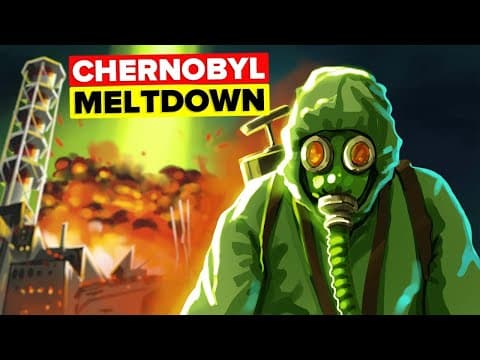
Chernobyl Nuclear Explosion Disaster Explained (Hour by Hour)
The Infographics Show
37m 6s6,128 words~31 min read
YouTube auto captions
Transcript source
YouTube auto captions
This transcript was extracted from YouTube's auto-generated caption track. The transcript below is server-rendered so it can be read, searched, cited, and shared without opening the original YouTube player.
Pull quotes
[0:00]Hour zero, April 25th, 1986, Chernobyl Power Plant, located about two miles from Pripyat, a small town in Northern Ukraine.
[0:00]It's a beautiful night after a sunny day, and the May Day holiday is just around the corner.
[0:00]At home, sleeping in his small apartment is his wife, Natasha, and his two-year-old son, Kiril.
[0:00]In just over 24 hours from now, people who Natasha knows will be out on the street looking into the sky at a dazzling laser beam shooting into the stars.
Use this transcript
Related transcript hubs
Watch on YouTube
Share
MORE TRANSCRIPTS


