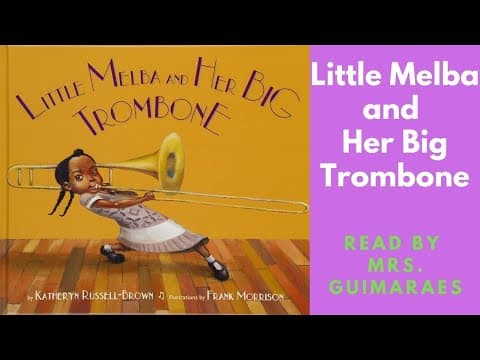
[0:01]Little Melba and her big trombone by Katherine Russell Brown. Illustrations by Frank Morrison.
[0:16]Spread the word, little Melba Doretta Liston was something special. The year she was born was 1926. The place was Kansas City where you could reach out and feel the music. The avenues were lined with jazz clubs, street bands, and folks harmonizing on every corner. All the hot music makers made sure they had a gig in KC.
[0:46]From as far back as her memory would go, Melba loved the sounds of music. Blues, jazz, and gospel rhythms danced in her head. The plink of a guitar, the hummm of a bass, the thrum-thrum of a drum, the ping-pang of a piano, the tremble of a sweet horn.
[1:10]Notes stirred and rhythms bubbled all through Melba's home. She couldn't get enough. Music was always on her mind. She daydreamed about beats and lyrics. Music was on Melba's mind at night too, when she should have been fast asleep.
[1:31]Melba loved to hum along with the radio. Sometimes the music sounded so good she cupped her ear to the majestic and closed her eyes. She especially loved Fats Waller with his growly voice and booming piano. The player piano came alive when Melba's kinfolk stopped by. While Melba pedaled, her aunties danced around the room.
[1:57]With all that music flying by, Melba wanted to create her own sounds. When she was seven years old, she decided to sign up for music class at school. What instrument could I play? Melba wondered. At the traveling music store, Melba eyed a long, funny looking horn. "That one!" she cried, "It's beautiful!" "A trombone!" Mama Lucille frowned, "It's big, and you're a little girl." "Pleaassse!" Melba begged. Mama Lucille bought the shiny trombone on the spot. She couldn't say no to her only child. Melba beamed from ear to ear and squeezed her new friend.
[2:42]That night on the porch, Melba listened to Grandpa John play his guitar. This time she had her own music maker. Grandpa John showed Melba how to cradle the horn. She tried to push out the slide, but her arm was too short. She had to tilt her head sideways and streetch out her right arm. Melba gave the horn a mighty blow. "Honk! Honk!" It sounded bad, like a howling dog. "I'm no good, Grandpa," Melba said tearing up. "If you can blow, you can play," Grandpa John said. "Now stand up straight and blow steady." Melba stayed up real late and practiced until she could play a simple tune all by herself.
[3:33]Even with her keen ear, teaching herself to play the trombone was no piece of cake. But Melba kept blowing her horn, getting better day by day. The cool brass of the horn felt swell on her fingers. Before long, Melba and her horn were making magic. She was only eight when the local radio station invited her to play a solo. Momma Lucille and Grandpa John were so proud as they watched little Melba play her big trombone.
[4:03]Hard times hit rock bottom in 1937. That's when Melba and her mother moved to Los Angeles. The long train ride took them five states west and worlds away from Kansas City. Melba's new teachers discovered that she was as smart as a whip. Her test scores were so high the principal skipped her up from sixth grade to eighth.
[4:29]In high school Melba joined Alma Hightower's famous after-school music club. Melba quickly became the star player in the club's band, the Melodic Dots. The other club members struggled to keep up with Melba. Jealous boys called her bad names. She tried not to care, but way down deep the names hurt. Melba used her horn to turn all those hurt feelings into soulful music.
[4:56]Melba's talent kept growing. She began writing music too. Then in 1943, when she was seventeen, Melba was invited to tour the country with a new band led by trumpet player Gerald Wilson. "Go meet the world!" Momma Lucille said, and hugged Melba good-bye. "You have my blessing." Melba could feel it in her bones- the jazz scene was calling her name!
[5:24]Traveling with the band was a thrill. Each city from Salt Lake to New York, was an eyeful of something new. Melba became a master musician. She composed and arranged music, spinning rhythms, harmonies, and melodies into gorgeous songs. And when Melba played the trombone, her bold notes and one-of-a-kind sound mesmerized the crowd.
[5:51]Still, Melba was lonely. She was the only woman in the band. Some of the men were cruel. Others acted as if she wasn't there. Melba let the music in her head keep her company. Rough times came when Melba traveled down South with singer Billie Holiday and her band. Some white folks didn't show good manners toward folks with brown skin. Hotel rooms were hard to come by and the band members often had to sleep on the bus. Restaurants didn't always want their business. In the clubs, audiences sometimes just sat and stared at the band, or didn't show up at all. Discouraged, Melba almost walked away from her trombone for good. But Melba's fans wouldn't let her quit! By the 1950s, all the cool jazz musicians wanted some Melba magic! Dizzy Gillespie, Duke Ellington, Quincy Jones, and more. They wanted to be on the bandstand with Melba and her divine horn. They wanted to play Melba's music. Melba and her music traveled around the globe, dazzling audiences and making headlines in Europe, the Middle East, and Asia. All her life, Melba kept composing and arranging music, kept making her trombone sing. Spread the word! Melba Doretta Liston was something special.
[7:26]You don't say.
[7:37]Pow!