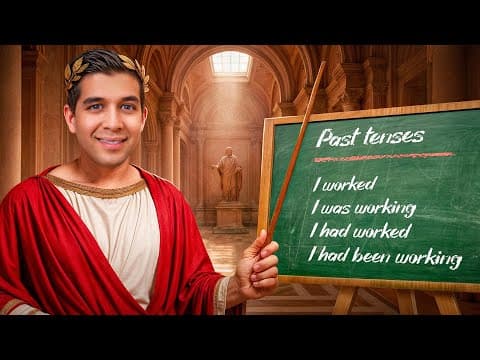
[0:00]Yesterday, I woke up at 7:00 AM. At 8:30, I was drinking my coffee. By 10, I had answered many emails. And I had been working on my new lesson since 9:00 AM. What do all these sentences have in common? All of them are in the past tense: past simple, past continuous, past perfect and past perfect continuous. As you know, in English, we have past, present, and future. And for each of these three times, we have four tenses: simple, continuous, perfect, and perfect continuous. Overall, there are 12 tenses. Now, in this lesson, we're going to focus on the past tenses, also known as the narrative tenses, because they are used to tell a story about the past. Now, by far, the most common past tense is past simple, as in I worked. I is the subject and worked is our verb in the past tense. Very simple structure. But when do we use it? We use past simple to talk about finished actions in the past. Something you did in the past, and it's over now. For example, she visited Paris last year. Last year, visited Paris, finished. She, subject, visited, verb. She visited Paris last year. Or look at this: I drank coffee this morning. This morning, drank coffee, finished, right? Something happened in the past and it's over. And if I look in my cup right now, there's nothing inside because it's finished. I drank it this morning.
[1:41]Another use of past simple is to talk about past facts. For example, talking about the dinosaurs. Dinosaurs lived millions of years ago. It's a fact and it belongs to the past. Past simple. We can also use past simple to talk about past habits. Something you did in the past as a habit. In this case, we often see an adverb of frequency, too. Remember adverbs of frequency? Always, usually, often, sometimes, rarely, seldom, never. In this case, we often see one of these in the sentence, too. For example, I often played football every weekend. This is a habit I had in the past. I often played football every weekend. He always visited his grandparents. He visited, he always visited. A habit in the past. Now, a small tip here: instead of this, you can also use used to or would, but that's a topic for another lesson. So, three uses of past simple: to talk about finished actions in the past. I drank my coffee this morning. To talk about past facts. Dinosaurs lived millions of years ago. And to talk about past habits, usually with an adverb of frequency. I often played football every weekend. Next is past continuous, or you may also see past progressive in some coursebooks. As in, I was working. I was working. I is the subject, was to be verb (am, is, are, was, were). Working, verb + ing. Remember the structure? It's quite simple. But when do we use past continuous? We use past continuous for an action that happened in the past for a duration of time, an ongoing action in the past. For example, at 8:00 PM, they were having dinner. They were having dinner. Subject, to be verb, verb + ing. Or look at this. Sorry, I missed your call. I was sleeping. I was sleeping. It was an ongoing action.
[4:01]Another use of past continuous, which is very interesting, is when a long action is interrupted by a short one. What do I mean? It's also called interrupted past in some of the coursebooks. It's something like this. Something was happening in the past, a short action cuts it off. She was reading a book when the phone rang. Now, what was the long action? The long action was she reading a book. And what was the short action that interrupted this long action? The phone ringing. Now, the long action, which was interrupted, is in the past continuous tense. The short action, which interrupted the long action, is in the past simple tense. And these two sentences are connected with either when or while. Look at this. While she was reading, the phone rang. This is the same sentence, but instead of when, the two phrases are connected with while. Now, what's the difference between when and while? Which one do we use before the present continuous sentence? While. While, present continuous. Which one do we use before the past simple one? When. When, past simple. Or let me give you another example. Let's say you are outside with friends or family. And then you're having a nice barbecue together, but suddenly, it starts to rain. Now, which was the long action that was interrupted by something else? You having a barbecue. And which was the action that interrupted what you were doing? It started to rain. So the sentence would be like this. We were having a BBQ when it started to rain. Or while we were having a BBQ, it started to rain. This is a very common use of present continuous. Another use of present continuous is when you are trying to set the scene for a story. What do I mean? Imagine you're telling a story about something that happened in the past and you're trying to describe the atmosphere. You're trying to say what the condition was like. So you would say something like this. It was a nice day. The birds were singing, the sun was shining, kids were playing, and the wind was blowing. I saw a man coming outside the Bank. You see, I was trying to tell a story, but before telling the main part of the story, I was setting the scene. And to describe the atmosphere and the setting of the story, I use past continuous. All right, so let's sum up, when do we use past continuous? We use it to talk about ongoing actions in the past. To talk about long actions interrupted by a short action in the past. And to tell a story trying to describe the atmosphere. Let's move on to the next one. Past perfect. This one is quite simple. Past perfect is like, I had worked. I had worked. Subject, had, past participle of the verb. But when do we use it? We use this tense to talk about something that happened in the past before another action in the past. What? Very simple, very easy. Something happened in the past, we use past simple, right? But if something else happened before that in the past, we use past perfect. Let's say there was a robbery. The thieves escaped, the police arrived. Two actions, both in the past, right? But before the police arrived, the thieves had escaped. Look at this. Look at this, pay attention. Which one happened first? The thieves had escaped first. And what happened after? The police arrived. The one that happened before the other one would be in past perfect. The thieves had escaped. And the one that happened afterwards is past simple, the police arrived. And to connect the two clauses together, we either use by the time or before. So, look at this. The thieves had escaped by the time the police arrived. See? Which one happened first? The thieves had escaped. And which one happened second? The police arrived. Or here's another one. Let's say I ate something. I ate a pizza. And then my aunt called me and invited me to dinner. But I was full, I was not hungry. So how would I say this? I had already eaten before she invited me to dinner. So first I ate something, then she invited me to dinner. Both of them in the past, but one of them was before the other action. The action before the other one is past perfect, I had already eaten. The action that happened after is past simple, my aunt invited me to dinner. And we connect them using before or by the time. I had already eaten before she invited me to dinner. This was quite simple. There is only one use case for past perfect. Something happened in the past before another action in the past. Moving on to past perfect continuous. This is also quite interesting. As in, I had been working. Subject, had, been, verb + ing. Now, this is the exact same context. Two actions happened in the past. One action happened before another action. That would be past perfect, right? But the action that happened before the other action in the past, was not a single action but was a continuous action. So, a long action, which happened before another action in the past. That is past perfect continuous. But what do I mean? Let me give you a few examples. Let's say some people were waiting at the bus stop. For the bus to come, right? But, before the bus arrived, see, the bus arrived, past simple. The bus arrived, but before that, they had been waiting for hours. See, two actions in the past. The bus arrived. They waited. But them waiting in the past was before the bus arrived. And it was a long action, for hours. So, we use past perfect continuous. They had been waiting for hours when the bus arrived. Or here's another example. Let's say there's a girl who's now in London. But she moved to London two years ago. Before moving to London, which happened two years ago, she studied English for a period of three years. See, two actions in the past. She moved to London. She was studying English for three years. Now, when you put them together, one of them is before the other one. Before she went to London, she had been studying English for three years. See, that's past perfect continuous. All right. That was it. Four tenses in the past. Past simple, past continuous, past perfect, and past perfect continuous. These four tenses together form what we know as the narrative tenses, because we use them to narrate a story. Now, before I end this video, I have five questions for you. A mini quiz with five questions to challenge your understanding of the past tenses. But before we begin the quiz, let me tell you something. Do you want to have the summary of this lesson and the summary of all my YouTube channel videos in a single PDF file for free? Then you can download my ultimate English book. This book has more than 500 pages of lesson summaries of all of my YouTube channel videos. And you can get it for free because you are a subscriber of this YouTube channel. But how can you do it? You can simply click on the link above my head, go to my website, enter your name, country, and email address, and click download. You will get the link in your inbox. That's 500 pages of lesson summaries, together with the link to the videos. So basically, you have everything on my channel in a single PDF file for free. Go ahead, I hope you enjoy it. And now, let's get to the quiz. Are you ready for the challenge? Let's start with question one. I dinner when the phone rang. I cooked dinner, I was cooking dinner, I had cooked dinner, or I had been cooking dinner.
[12:53]Very good. I was cooking dinner. Two actions in the past, the longer action was interrupted by a shorter action. I was cooking when the phone rang. Moving on to question number two. By the time we arrived at the cinema, the film .......... Started, was starting, had started, or had been starting.
[13:21]Excellent! Two actions happened in the past. One action happened before the other action. We arrived, but before we arrived, the movie had started. Past perfect. Let's go to question three. They for an hour when the bus finally came. They waited, they were waiting, they had waited, they had been waiting.
[13:49]Bravo. Two actions in the past, one before the other. But, pay attention. The one which was before the other action in the past is not a short action, but is a long continuous action. So, past perfect continuous. They had been waiting. And moving on to number four. While I TV, my sister finished her homework. While I watched, was watching, had watched, had been watching. Excellent. Easy, right? Two actions in the past, a long action and a short action. The long action would be in past continuous. I was watching TV. And the last one. Tom was tired because he all night. He worked all night, he was working, he had worked, or he had been working all night.
[14:48]Lovely. Two actions in the past. He was tired and he worked. But one of them is before the other action and was a long action. He had been working. And then he was tired. And that's it. I hope you've enjoyed this lesson. Don't forget to give this video a thumbs up and if you're new to my channel, click subscribe and turn on notifications. See ya.