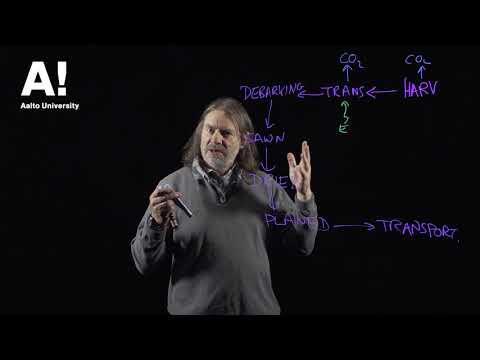
[0:10]So we can look at different parts of the process here. Um, harvesting and then the wood will be transported to the site, the sawmill site, and then in the sawmill we might go through these processes of debarking. And then it will go and it will be sawn. It will be dried, maybe it'll be planed. And then of course it'll be transported again to the site where it'll be used. And each of these processes use energy, and as a result of using the energy, so we've got energy in energy in, and we have an impact associated with the energy production, so that there are emissions of carbon dioxide. There may be emissions of other things coming out. Obviously, to do the harvesting, we're going to need fuel for the harvester, so there'll be emissions associated with that. The debarking operation may use electricity and that electricity will um depending on where the the uh the electricity generated, maybe it uses a coal-fired power station, maybe it uses a gas-fired power station, maybe it uses hydro. So there could be emissions associated with that. And with each of these processes we have to do an accounting process, which calculates what the emissions are in each stage. So I'm looking at carbon dioxide here. So we're assuming that what's going in here is electric and what's coming out is carbon dioxide emissions associated with the production of that electricity. So I'll look at that in a bit more detail next.
Life Cycle Assessment (10) Impact part2
Aalto University - Wood Science
2m 6s252 words~2 min read
YouTube auto captions
Transcript source
YouTube auto captions
This transcript was extracted from YouTube's auto-generated caption track. The transcript below is server-rendered so it can be read, searched, cited, and shared without opening the original YouTube player.
Pull quotes
[0:10]Um, harvesting and then the wood will be transported to the site, the sawmill site, and then in the sawmill we might go through these processes of debarking.
[0:10]And each of these processes use energy, and as a result of using the energy, so we've got energy in energy in, and we have an impact associated with the energy production, so that there are emissions of carbon dioxide.
[0:10]Obviously, to do the harvesting, we're going to need fuel for the harvester, so there'll be emissions associated with that.
[0:10]And with each of these processes we have to do an accounting process, which calculates what the emissions are in each stage.
Use this transcript
Related transcript hubs
Watch on YouTube
Share
MORE TRANSCRIPTS


