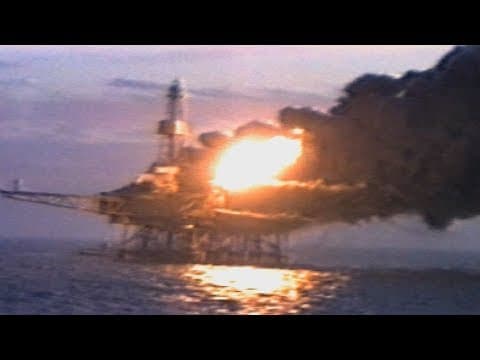
[0:05]My name is Ed Punchard, and uh I was on the Piper Alpha platform when it blew up on July the 6th, 1988. I was the diving coordinator, and I shared an office with the diving superintendent. I was working in my office, which was immediately above the dive skid on the lower level of the platform.
[0:32]We found ourselves in an office which was largely smashed. All the filing cabinets had fallen over and the ceiling had come in. The lights were out. There was a little bit of light trickling in from a corridor. I helped the diving superintendent into a breathing set and he said to me, um, go and find a way out of here. He went down to the dive skid to see what was going on there. There was, in fact, a diver in the water, who had to be recovered. I made my way up towards the control room. All the routes up to the other parts of the platform were blocked by smoke. By the time I made my way back down again, the diver had been recovered and the dive team gathered on the one corner of the platform that was free of smoke. There would have been about 20 of us who kind of wondered for a few moments what to do. I noticed that there was a ladder that went down to a swan platform. When I went down the ladder, I could see underneath the other side, where all the wellheads were, there was an enormous fire and a fire around the wellheads is an extremely dangerous thing. I called up and I said, we've just got to get off. And there was, in fact, a rope adjacent to where we were standing. I climbed down, it must have been 80 ft. And I reached out with my toe to try and grab the corner of the spider deck, so that I could walk along the gangway there. And all the people who were on that corner climbed down the rope, and by that time, the standby vessel, the Silver Pit had come close by. And they launched a fast rescue craft, a rib, which is an inflatable. We climbed down a small ladder, another 10 ft or so, and got picked up by the rib. Fire around the platform, all the platform is completely on fire, all the assistance.
[2:39]Seventy people are still missing in the North Sea after what looks likely to become the world's worst offshore oil disaster. In the aftermath of Piper, I, like many of the survivors, suffered from post-traumatic stress disorder. I think especially for somebody who was a diver, you know, somebody who might regard himself as being pretty resilient, that sort of thing can take you by surprise. But now when I look back at it, of course, I can see that it was a completely unsurprising thing to have occurred. None of us were trained to go into what effectively was a combat zone where you were surrounded by explosions and had to deal with, you know, quite a significant escape that was coordinated by just ordinary workers. And then had several hours involved in a rescue operation that was again largely coordinated by survivors. None of us were really trained for that. So the aftermath, I, I don't think was surprising. I think on a corporate level, it's essential to have a safety culture and appropriate safety regime.
[4:02]Be honored, respected and required from the very highest level of management. Now my own personal opinion of the oil company involved is such that I, I would say that didn't exist. I think it was absent. In fact, I think it's fair to quote one of the assessors at the inquiry, who said that with most incidents like this, you find a link missing from a chain. And he actually said in this case the chain was missing. It was that serious, on a corporate level, Piper Alpha was a tipping point. I think it was the moment at which modern systems of industrial health and safety were instigated in a new way, in a way which requires individuals and corporations to be much more self-motivated and self-proving.
[5:07]I think conducting regular safety audits of some form is an essential thing in any industry, and clearly with the systems and hazards involved with aviation that has an obvious relevance. There's something very important to remember about regulations, that it's almost as if too many regulations can take away capacity to deliver a good result. I describe it as the difference between traffic lights and roundabouts. Roundabouts require a certain skill level. They require a certain level of attention. Traffic lights don't.
[5:51]And there's a danger in having a reliance on traffic lights and there's an important vitality, skill and self-motivation, around safe working practices. It's a simple thing to remember, you know, traffic lights and roundabouts, and I'd encourage anybody who works in an environment where safety is vital, to keep thinking about that. Don't instruct your workers in such a way that they zone out, that they stop thinking. It's really important to find a way to keep people engaged, skilled, and motivated.


