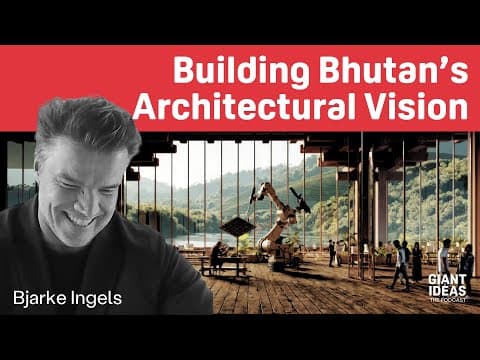
[0:06]Bjaka, thank you so much for joining us on Giant Ideas. I guess we'd love to start just by asking you a very simple question: why does architecture matter? The Danish word for design is uh is formgiving, which literally means form giving, because to design something is to give form to that which has not yet been given form. Uh, in other words to give form to the future, because when you're designing a space or a place, you're giving form to the world, or at least a part of the world, uh, that you would like to find yourself living in in the future. So, so it is really a fundamental question not of style or uh, you know, fashion or whatever, it's really a question of uh, of what kind of world, uh, would we like to live in? And do you see yourself more as a creative, as a designer, or or more of a practical craftsman? Um, I see myself um as a utopian pragmatist. Okay, tell us more. Cuz in a way, like on one hand you have uh what you could say is ideology or your sort of your your dream of what a perfect world would be or the ideal world would be. And on the other hand, you have the the practicalities of of of everyday life, of of the logistics, the functionality, the economics, gravity, uh, flow, traffic, uh, etc. like even like legal issues, uh, building code, uh, uh, you know, the the limitations and possibilities of various various materials. And it is somehow to while understanding and respecting and and in many ways, you can say what architects do is that we try to turn all the practical into something poetic. So so in that sense, like I I don't really believe in in sort of discriminating between let's say form and function because architecture is one of the few media where form and function, uh, you know, hardware and software is still actually integrated. In architecture, the the the flow of the spaces, the way that the light comes in, the way that your orientation is guided towards somewhere, the the the way you move up and down, the way things are placed next to each other, the form and the function is intrinsically connected. And in that sense, I would say if if and when our buildings end up looking beautiful or different, it is because they perform beautifully or they perform differently. Mm, reminds me a bit of um Marshall McLuhan's idea that the medium is the message to some degree, you know, like the the functionality and the form, the usage, the beauty, they're all kind of interlinked. I think um, McLuhan was was was very right. And you can say, like, the the medium in architecture is is space. Uh, and of course we we can construct space in all kinds of ways. We can contain it, we can condition it, we can frame it, but ultimately that that that that space is becomes the space of possibility or or or lack of possibilities if if we do a shitty job. But but but in that sense, I I think it's very true in architecture, the the two are inseparable. And talking of not doing such a good job, we had your collaborator Thomas Heatherwick on Giant Ideas a while ago. And Thomas Thomas, as you know, is is ultimately very, very, you know, optimistic. But he he he's quite negative on the world of architecture today and and is you know, was was damning in his indictment of quite a boring world that we are building now and so many of the buildings we tend to build are soulless, are quite flat, are boring basically in Thomas's view. Do you share that view that we don't we have to some extent lost the ability to build really interesting, beautiful, sustainable buildings apart from one or two instances? Where do you think we are? I mean, I mean, I think um, I mean, of course I I I know I know Thomas uh quite quite well, and I also know that, I mean, um, I I think he's um, as I I remember his mother was a jeweler, uh, of sorts, right? So I think um he he uh he definitely has an understanding of architecture that is very rooted in in decoration. Uh, so in that sense, I think the absence of decoration for him is like um a a layer that's missing. I I don't share exactly that mindset, because I I somehow love when when the when the decor, or what makes something beautiful or not, uh is isn't a um, is is not an added added layer, that it is intrinsically built into the way that the space is orchestrated. However, uh, I do I do think that it it you know, it is true. And and also, like when I started studying architecture, I really noticed how how bad a rep architecture has because I would sit at a dinner party and people were, like, so so what are you studying now? And I was like, um, yeah, I'm studying to become an architect. And then, uh, people would mishear me as as saying actor, and and they would be a moment of interest. And then, oh, no, no, architect. And then some Ah, okay. And then then typically, the follow-up question would be, so maybe you can explain to me why are all modern buildings so boring? A a lot of the decisions in architecture are made by by, you know, real estate investment companies, where it's typically a lot of people that have a background in business, and their um, sort like portfolio managers of various kinds for pension funds or whatever, like sort of, and for them the building is really just an an asset in in any asset class, and it is ultimately a a line item with some kind of ROI in an Excel sheet. So so therefore there's so far, the people that ultimately pull the trigger on or not, make the big decisions or not, are so far removed from the reality of what that line item actually signifies, uh, in the world. And and that means that a a lot of things sort of trickle down to the lowest common denominator. Also, the way that you assess uh costing at at a kind of high level is very much associated with how you assess risk. So anything that deviates from the absolute common like sort of lowest common denominator again is going to show up as a blimp that adds a a little bit of perceived risk and that adds a little bit of of added cost. And and therefore the the way that society and and the business of of real estate has been organized really wants everything to end up predictably the same, even if that's not what people are longing for when it actually gets built. So uh so so therefore, as architects, we have to somehow resist that kind of entropy by coming up with ways, and and the way we try to do it is that we really try to understand what are the success criteria for the people making the decisions ultimately, whether or not to build, whether or not to green light a project. And and we try to see what how are ways that we can demonstrate there is the possibility to maximize or or optimize the return to um to ensure the the long-term value proposition of of this particular asset. I again fundamentally don't believe that public and private interests are opposed. Because ultimately, if if a place becomes popular for the public, that means that you will have footfall on the ground floor for the retail. It it might mean that the sort of and then by by people coming there, like the lively restaurants, it might mean that they feel that, oh, well, this is actually a great neighborhood. So maybe the the the apartments will will rent, uh, more frequently at higher rates, etc. So the there there are so many ways where you can show that public and private interests are actually two sides of the same coin, but it just takes more work. You've earned the right to kind of get away from the what the modern world often demands because of economics in terms of rather boring buildings. Uh, so as Thomas, I do just want to ask, it's fascinating, you clearly are two big name architects. You have your own grand visions. What was it like collaborating? How did you make that work on the Google offices, for example, where you want to stay true to your own vision and your own integrity, but you're working together. I'm really curious how that collaboration worked out. you know, ultimately we had various kinds of, uh, uh, priorities and and we kind of swore an oath that the that we would never, um, uh, you know, uh, reveal who ended up doing what. Uh, so so they we wouldn't have to worry about it. Uh, but um, but but of course, we have different priorities and uh, and and so in that sense, the the collaboration naturally found it's its ideal, uh, constellation. Let's maybe make it specific for our listeners and give an example of of great architecture. Um, you've been commissioned to design the mindfulness city in Bhutan. Let's hear more about the mindfulness city. What's your vision for that? No, it's it's been a sort of labor of love the last two and a half years. Like um it just so happened that um the the King of Bhutan uh went to the coronation of King Charles. And then he did a stop over in Copenhagen. And and I was invited to for a dinner, uh, and uh I I ended up sitting next to him and he said that he had been curious about meeting me because he was he was into, um, uh, he was he was about about to launch this special administrative region, uh, of of 2 and a half thousand square kilometers, uh, in in the south of Bhutan on the border to to India. Uh, I I like this that it's a country with less than a million inhabitants and they have two neighbors, uh, China and India. Like the the two largest countries on earth. But but they somehow managed to retain their autonomy and, um, and and now they're seeing a sort of brain drain, where a lot of the young Bhutanese migrate to, um, to uh, to Australia, to Canada. They speak perfect English, they're well educated. But but they go there in pursuit of economic opportunity. So he was into this idea, could we create a framework, a new city from scratch that would be, um, tailored to be attractive for international investments, so we can provide the economic opportunities with within the country, but to do so without, you know, flushing the the the the baby out with the bathwater, without sort of reneging on all of the values that are that are essential to to Bhutan. And you can say the the nine parameters of gross national happiness are actually rooted in sort of Vajrayana Buddhist principles. So so we took those Buddhist principles and baked them into the the kind of planning of the city. So the city, it's in the tropical plains at the base of the Himalayas. Uh, it's uh 34 rivers flow through the the whole region. So the city is shaped by the rivers. So it has uh it it's also gently sloping down, so it's almost like patty fields, like each each city block is like a a terrace as it kind of steps down. Uh, we're using locally available materials, river rocks, uh, rammed earth, wood, bamboo. Um, and the the public institutions actually become the bridges that span over the rivers. So, uh, because of course the building has like the the city has no identity right now. So, uh, the identity that it gets is this kind of relationship with the rivers. Can you maybe give one example of how a a Buddhist value has been directly integrated into kind of a design choice that you've made for the city? No, I'm like one of them is is of course like um, uh, a respect for for nature, a respect for the environment. So it doesn't displace nature, it actually enhances it. It doesn't displace agriculture, it doesn't get rid of the rivers, it actually is shaped by them. Um, also, um, designed for for community like the the public space is always orchestrated so that, um, it can be animated by the the ground the ground level is always publicly oriented. So you'll have schools that spill out, and you'll have um, teaching happening in in in the public realm. Um, in instead of like paving everything with asphalt, most of the streets are permeable, so the tropical rains can seep into the into the ground. Um, so so um also we we ensure that you have spaces for for mindfulness, for for spirituality integrated in the in in the city fabric. So so sort of on on as many ways as possible, it it it is a city that is somehow rooted in the heritage, uh, shaped by the the natural environment, uh, that somehow still provides spaces and opportunities for the for the future of the country. And and Bjaka, as part of this mindfulness city, you're also building an airport, which is meant to be mindful as well. I remember talking to the musician Brian Eno about his album music for airports, and Brian had this view, I think I'm I'm not misremembering this,
[14:25]which is that the the unease that you feel in an airport and the sort of latent anger of the people is all around a underlying fear of death that they're all about to go up in an airplane and potentially die. Uh, which I thought was fantastic. And so he had this beautiful ambient music to try and, which I think was actually played in airports, to try and calm everyone down. What's your approach going to be to bring some mindfulness to airports? Yeah, I I I I think there's a lot of other reasons why you you would be tense and and borderline depressed in an airport than than fear of death. But but of course, death is always an option. But but um, like uh, you know, Bhutan is is interesting because it's the it's I think it's probably the most sustainable country in the world. They sequester twice as much carbon as they emit. There's 82% forest cover, and the same is true in the in the region. Um, so the the the the landing strip of the airport actually is framed by two rivers, and it runs across a a third river. So along the rivers, we bring the forest in. So the arrival plaza at the airport is actually under the canopy of this tropical forest. When you go inside, we have this kind of rainforest courtyard that separates arrival from departure. So, when you're going through passport control and security, you're you're next to a forest. When when you arrive and you're waiting for your luggage at the luggage belt, you're you're next to a forest. Um, and then finally we we've designed the airport, uh, using locally sourced mass timber. So it's kind of modular. It kind of echoes the the sort of the sloping roofs of the traditional Bhutanese architecture, but it it forms almost like a stylized image of a mountain range if you like. And and then one thing that's unique about Bhutan is that they have, like, eight large schools where they still educate artists, wood carvers, stone masons. So we're actually harnessing that that richness. So that all of the kind of mass timber super structure will actually be engraved with the traditional ornaments of of Bhutan. But because because of the vastness of the airport, we're having the artists do the kind of central spine, uh, then we're going to scan it and use milling machines to apply the the the kind of fabric to the to the rest of the of the airport. So in some way, it it again, it it captures this kind of quintessential idea of the city that you can actually embrace modernity and economic opportunity and and and global investment, uh, but without sacrificing your cultural heritage or or your natural environment. Is this what you mean when you you talk about hedonic sustainability? You you clearly have a an eye for an oxymoron and a phrase. So is that a good example of that? It it it's in some way like, you I've I've actually used the term ancient futurism for for for But to to opposite together.
[17:39]It it's like I I think very often like, and you can say like, if if we bring it a little bit into politics, like, um, cancel culture and a kind of polarized public environment where uh, where any kind of productive discourse between opposing viewpoints has been silenced to death through cancellation or polarization is is the opposite of oxymorons, and I think the reason that democracy, democracy is is an interesting form of of of rule, is actually that it provides a platform for uh, for people that are in disagreement to uh to find solution in parliamentarism. Uh, and and once once we eliminate that, because because to me the the path forward is always when you really understand and appreciate, um, what seems to be diametrically opposite or at least contradictory elements, but you also acknowledge that that there is a point here and this is also important. It has to be beautiful, but also has to be functional. It has to be economic, but it also has to be generous, or you know, like, so one once you can combine what seems, like, contradictions, you you suddenly open a whole new world of of possibility. Tell us then about this this particular contradiction, hedonic sustainability, because it's obviously something we're very interested in, because we back climate startups that we think are going to create huge amount of economic value and be good for the climate, which in itself is is perhaps, uh, has been oxymoronic in the past. But tell us about your version. It it's actually like I I think I stumbled upon the concept of our our first project ever was the Copenhagen Harbor bath. Uh, and it's essentially because the through investments in a surface drains, suddenly the the Port of Copenhagen had become so clean that you could swim in it. So on opening day, and you know, it's a tiny little project like had a million euro budget. Uh, but on opening day, suddenly all the Copenhageners are jumping in the port. They don't have to drive their car for hours to get to the beaches. They can actually jump in the port in the middle of the city. It's it's almost like, uh, you know, 1968 student riots in Paris, Sula Pavilla, Plush, you know, that you have the beach under the the cobblestone, right? That um, and and it just became so clear to me that that that the clean port is not only nice for the fish, it's amazing for the people that live in it. Uh, that that the sustainable city or building not only is better for the environment, it's also more enjoyable for the people that live in it. And suddenly instead of a sacrifice, this kind of Protestant idea of cold showers, it actually becomes desirable. And and you can say the electric car existed, you know, since my childhood. But it was always some shitty car, but when Tesla finally cracked it and made a car that was faster, you know, more athletic, safer, and beautifully designed, that's when the electric car started winning. So in some way, like, you can almost say, instead of always making sustainability a question of sacrifice or almost like a moral or political dilemma, what if you just simply make it a design challenge? If you design the same the sustainable future, so it is irresistible. It's it's better, it's more desirable, it's more enjoyable. That's how you win. I love that framing. I couldn't agree more that uh tackling climate change is really a systems issue to solve, right? It's it's a challenge of of redesign our systems more than anything to be delightful. It doesn't have to be, uh, necessarily a huge sacrifice, it's more about an intellectual challenge of redesign the systems. I think that that resonates a lot with me. Here in you speak about, um, the livable nature of Copenhagen, it also strikes me that you come from a rich history of of Danish design and Copenhagen is a very, very livable city. How much do you think, you know, growing up in the Danish ecosystem and environment and traditions has influenced your views as an architect? teenagers in end up moving, uh, away from home, uh, uh, uh, despising their parents. But but then what once they once they get a little bit of distance, they realize how much they owe them and how much they they they actually are like them. And and I think for me, it was it was not until I moved to to New York where where where I'm I'm sitting now. Uh, that I sort of realized that some of the things that like sort of unquestioned values such as, you know, environmental responsibility or social engagement, um, uh, like I I remember one of our first conversations with our first project in New York, and we were trying to make the sort of arrival plaza as as inviting and as and as engaging and as accommodating as possible, which is how you would do it, uh, in Denmark, but here it triggered all kinds of, you didn't want to make it so inviting that it would attract homeless people or people loitering, uh, or you know, like sort of, uh, so so in that sense, I started I started understanding that, um, that that of course, uh, in many ways, even though I I grew up criticizing and trying to change the or add to at least the Danish model, uh, I I also really realized how how um, how much I fundamentally subscribe to it and, uh, Um, and and I think it it's also interesting sort of now you just mentioned that the that you invest in in environmental startups that that that have the potential to to make it an incredible impact, and in doing so, uh, um, make, you know, people both environmentally and economically profitable. I I love this idea that that economy and ecology sound to the ears like opposites. Uh, but but as you can also hear, it's almost the same word because they're both they both come from the the ancient Greek root Okas that means house, because economy is the management of the household, and ecology is the study of where you live. Um, so in that sense, in in in the obsession with oxymorons, we came up with with the idea of economical thinking. Where where again that because you know, also as they say, you know, if you want to make a a billion dollars, uh, solve a problem for a billion people. Uh, and and you could probably not find a a bigger problem right now than than to, um, to accelerate the energy transition and to to to decelerate and eliminate climate change. So in that sense, also, um, just looking again at the fundamentals, I think it's also interesting to understand that when when things end up being a big problem, it's it's rarely
[24:58]because of their failure, it's often the byproduct of their incredible success. Bjarka, I think that's a lovely way to end part one. So much more to come in part two, but thank you for joining us on Giant Ideas. Thank you.


