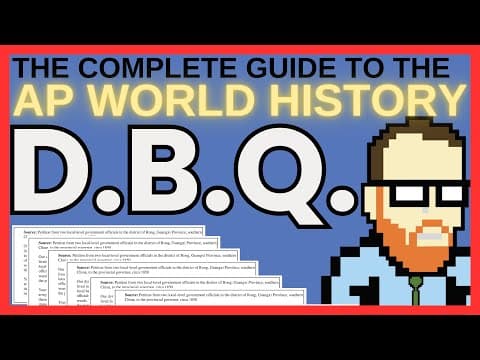
[0:00]The DBQ is the most valuable use of your time on the AP World History exam. There is no single other part of the exam that takes as much time or is worth as much to your score. And because of that, everyone freaks out about the DBQ. No worries, I've got you. I've been teaching AP World History for 20 years and have been an AP reader for a decade. I literally just finished a stack of these bad boys an hour ago. So, you're in good hands. I've been at this DBQ thing longer than you've been alive. And in this video, I'm going to walk you through exactly how you can get a perfect score on the DBQ section of your AP World History exam. Now, this video is all about getting to know how the DBQ works and how to be successful at writing one. But you want to see me write a real DBQ in real time, head over and pick up my ultimate review packet. I sit down in real time and walk you through how I would step by step work through a DBQ, like you will this map. This includes two never before seen DBQs that I had created by a content creator who has created content for the college board just for my ultimate review packet. Real time, neat DBQs and some legacy DBQs. Check it out. I've linked it below. So let's do this. Everything you need to know about the DBQ, or the Document-Based Question, in AP World History Modern.
[1:18]Step one, the prompt. The prompt will always read like this. Evaluate the extent to which... Don't freak out. This just means how much. They're about to ask you some pretty major historical thing you learned this year. Imperialism, fall of empires, growth of empires, something big. All they want you to do here is take a stand, make a judgment, pick a side. So, a little, a huge effect, it was a major cause. See those modifiers in there, you got to make a stand, make an argument. So the prompt will say, evaluate the extent to which and some major historical theme or event from the course. Once you've read this prompt, and this is a skill you're going to need to use throughout the first part of the DBQ writing process, annotate. I suggest you use that scratch paper they give you and immediately rewrite the prompt at the top. It will be your focus for the next hour and you want to make sure you're doing what it's asking. Every year I score a bunch of DBQs that are awesome responses, just not to this specific prompt. People just write what they want. Write it at the top, rewrite it. Hell, I do this when I'm scoring DBQs just to help me out, so you do the same. The prompt you wrote is your guide to the DBQ. You're going to read some docs and write a thesis and context, but it's dangerous to go alone. Take the prompt with you, keep checking back on it, make sure you are doing what it is asking you to do. Cool. You know the prompt. You know your focus. You know what you're responding to. Next, the seven documents. The college board and your testing administrator during the exam will tell you, you should take about 15 minutes to read the documents before starting to write your DBQ. Wrong. Wrong. You have as much time as you need and you should immediately start writing, but not writing the essay. You should start writing on the documents, but since you're taking it digitally, try a separate sheet of paper. So, underneath where you rewrote the prompt, create a guide to the documents. Again, this is what I do when I'm scoring them to make sure that I understand them. So, doc one, doc two, doc three, etc. Don't rewrite the docs, don't quote them. You are on the clock here. Doc one equals Hindu letter to a British diplomat. Quick bullet point or two underneath. If you pick up some sourcing ideas, mention that here. Done. Off to doc two and so on. This should take about 15 to 20 minutes just to get you organized. Read each document carefully and as you do, do what you did to the prompt itself. After all, your goal with the document is to read them a total of one time. You want to be able to get the information you need from the documents the first time, so you don't have time to keep rereading some random document over and over. But as you're reading the documents, and again, there'll be about this long, don't forget your old friend, the prompt. Luckily, you have it here at the top of your page. Check back, reread it, read it again. You aren't just reading documents for fun, you're reading these documents with the purpose of using the information in these documents to respond to the prompt. Remember, they suggest an hour to write the DBQ. Spend the first 20 minutes analyzing the prompt, make sure you're headed in the right direction and reading the documents, making sure you're reading and annotating with the intent that this information can help you write your essay in a few minutes. So that's the basics on how to get started, but there are some other things going on behind the scenes that a large percentage of students taking this exam won't notice. But I'm spilling the tea here. There are two hidden things in the documents. First super secret DBQ hidden item, groups. These aren't seven random documents. Some of the documents will be similar. Some will be from the same place or even about the same event. Others will have a similar tone or a similar message. Be aware as you're reading and annotating, how the documents work with or against each other. I like to say that some of the documents will be playing the same sport. Docs one, three and seven are playing baseball. Docs two and four are playing soccer and docs five and six are playing golf. They're playing the same sports, but some of the docs will be about the same topic or event. They will naturally cluster together. The average person reading these documents will just see seven documents, but you, oh no, you don't see seven documents. You see two to three sports or groups. Why does this matter? Well, if you were able to see past the documents to see them as two to four groups of documents, you just built the structure of your entire DBQ. And I'll go over how to structure your DBQ in a minute, but these different sports, these are your body paragraphs. After your introduction paragraph, write a paragraph about the baseball documents, skip a line, indent, write a paragraph about the soccer documents, skip a line, indent, write a paragraph about the golf documents. So the first super secret DBQ hidden item, these documents will be groupable. You will look out for possible groupings. The other second super secret DBQ hidden item, what's not here, what's missing? As you read the documents, of course, you'll see different documents playing different sports, three baseball documents, two soccer documents and two golf documents, but the college board will intentionally leave something out. They can include every single thing that might help you with the prompt in only seven documents. So, where is the second super secret DBQ hidden item? Simple, it's in your head the whole time. What else do you know about this topic? Look back at your annotated documents, all seven of them, right? Look at the prompt, look at the documents, and look back at the prompt. Now look back at the documents. Is there anything you know from taking AP World History all year long that could also support the argument that you made? So, two super secret things to keep an eye out for. One, there will be groups and two, something is not present in the document, it's beyond the documents. You've read the prompt, you've read the documents, you've grouped them together. That's the heavy lifting. You have your game plan now, you just have to implement it. So, remember, the DBQ is scored out of seven points. Here's how I would organize your DBQ to get these points. First point, contextualization. This is the Star Wars crawl. Look back at the prompt on your scratch paper. What do you know about this topic? Could you put this topic into context? Think of context clues that can help you understand what a certain word means. Well, your context in your DBQ is exactly that, just for your essay. So, start with a paragraph of background or context. If the DBQ's general topic is about imperialism, and it seems like half the time it's about imperialism, set that up. Give some background to it. Imagine this, a kid just transferred into your class. They have no idea what imperialism is. What two to four sentence statement could you say to catch them up? Know any vocabulary about it? Awesome, use that here too. And make sure you end your context by narrowing back down to whatever your prompt was about. For example, if the prompt was about railroads and empire building from units five and six, don't just give me a paragraph about the history and romance of rail travel through history. Make sure you end your context by getting back to the prompt. No matter where your context begins, it must end at what the prompt was talking about. Second point, thesis. Okay, you've given background to the prompt and we're still here in the first paragraph. We are still in the introduction, which is crucial. Why? Your thesis must be in either the introduction or the conclusion. So, after your context, your next sentence in this same paragraph should follow this formula. First, restate the prompt. So if it was, evaluate the extent to which railroads affected empire building, you write, railroads had a massive impact on empire building. Boom. Remember, you do have to evaluate the extent to which, which just means how much, so massive impact, that's a pretty big extent. Next sentence. Railroads affected empire building by blank. Name two or three measurable ways that railroads affected empire building. Don't just say a lot. Don't just say politically and economically. These aren't what the college board calls establishing a line of reasoning. You need to name actual measurable ways that railroads affected empire building. Try using action verbs here. Here's an example. Railroads affected empire building by connecting distant parts of their empire, building nationalism amongst the indigenous populations, and allowing empires to extract more wealth, more quickly to return back home. Look, I know what you're thinking, not fair. Freeman is an AP World History teacher. Of course he knew that. False. How do I know that? It was in one of the freaking documents. I would never associate railroads with nationalism like ever, but there were a few documents that talked about it. So, throw that into your thesis.
[11:23]All right, you have your thesis there at the end of the first paragraph. Reread it. Could you support that with any evidence from the documents that you just spent 20 minutes breaking down? The answer should be yes. Why? That's what the rest of your essay is about. Supporting this statement, this argument, this thesis with evidence from those seven documents. One last thing on your thesis, it will come back later. Or fast forward to the end and you can hear me talk about it then, but I will bring it up one last time at the very end of this video. We are not done with the thesis. This was just our first attempt. Third point, describing the documents. This is, without a doubt, the easiest point on the entire AP World History exam. I can't tell you that you're going to slay the SAQs. Those SAQ topics might be all the things you're weak on historically. Same for the LEQs. You could fall asleep during the multiple choice. I mean, it's pretty early in the morning. But this point, you can get. Yes, you. I don't care who you are. I don't care if you're some history guru, or this is the first history class you've ever taken. You will get this point. All you have to do is describe the content of three of the documents. That's it. Seriously. If you say doc one says this, doc two says this, doc three says this, boom. As long as you aren't just quoting the documents or reading the documents incorrectly, or misinterpreting what they're trying to tell you, then you get the point. So, whenever you bring up a document, before you try to use the document to support a thesis or get to the sourcing of it, just briefly write one sentence summary of what's going on in that document. That's it. Do this for all seven documents if you can. What if you completely screw up for the documents? It doesn't matter. You got three right, therefore, you get the point. There are a large number of people who get zeros on the DBQ. Not you. You will earn this point. For every document, briefly describe what it's saying. Point six, evidence beyond the documents. And I mentioned this earlier when we were talking about the second super secret DBQ hidden item. And at this point of your essay, you're probably like 50 minutes in, I'm guessing. This is generally the last thing people attempt, but the reason I mentioned the timing, you're a pro at this essay at this point. You know more about this specific topic right now than probably ever will. So, I'll ask it again, what's missing, what's not here? The college board calls this evidence beyond the documents. Do you know anything else that could support your thesis? It brings up another point. You can't just mention something else you know about this topic. You need to treat this like any of the other documents you've used earlier. Describe it and support it. Another thing you know. Maybe it's a DBQ about imperialism and the economy, and none of the documents talk about China. What? How could they leave China out? Well, they did it intentionally, just to give you a window to use your imperialism and China knowledge to drop a nugget about the opium wars here. Again, you can't just be like, oh yeah, this is like the Opium Wars. You must use this evidence to support your argument, to back up an argument you made in your thesis. This is tough. I got no help for you here. This is kind of the LEQ portion of the DBQ, meaning, you just got to know something else about the topic, and it also has to support your thesis. But this, wherever it fits into your essay. If you're talking about two documents that go over the impact of disease in the 20th century and none of the docs talk about the Spanish flu, boom. Describe the Spanish flu, support your thesis with the info from your Spanish flu knowledge. Point seven, complexity. Strangely, this is the easiest point to explain. Why? You just got to do two things from earlier, but you just have to do more of them. So, here are two ways to be complex. First, use evidence from all seven documents to support your thesis. And that's a pretty high bar. You can't mess up a single document here. Second, source four documents instead of just two documents. If you can do that, guess what? Your essay is complex. So, the big question, how do you end a DBQ? I mentioned this toward the beginning of your essay, and I told you that we weren't done with your thesis. We are not done with the thesis. This was just our first attempt.
[16:44]You've been dealing with these documents for about an hour at this point. You are more familiar now than you'll ever be. So, before you go, space down, indent, rewrite your thesis. Don't just copy it word for word. Can you be more specific? Can you add more to it? If you can, do it at the very end. And I know this seems like a small thing, but a large percentage of people who bomb their first attempt at the thesis, back in that first paragraph, rally at the end with maybe even just one word or phrase that is more specific or fits better into the rubric. This could save your thesis. That's how you DBQ. Now, I've written some of these in real time over my ultimate review packet and I've linked that down there in the description. I sit down with you, without all these fancy edits that you're used to, in real time so you can put your DBQ skills to the test. You can write it as I write it. I'm on all the socials, so follow, like, subscribe, whatever, but if you have questions, post them down below. I'll be sure to get back to you as soon as humanly possible. So remember, I am a real AP World History teacher. This year I have over 100 AP World students and they're all lovely. So, it may make me a day or two, but don't be afraid to reach out. If you have a question, I guarantee you some other person out there does too. They just aren't asking it. All right. Thanks for watching and good luck on the exam this May.