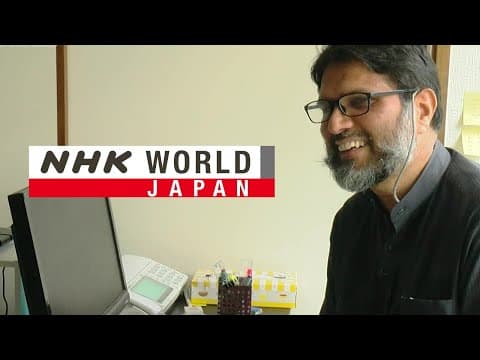
[0:11]It's just over a year since COVID-19 became a global crisis. The financially unstable have been hit hard. I am almost dead outside. No job, no money, nothing. Many people are suffering without being noticed. This Pakistani resident of Tokyo strives to offer a helping hand to those in need, regardless of race or creed. We discover what motivates him. Otska is a district in the northern part of Tokyo. Near the end of the shopping street stretching from the station, stands this narrow building. It's Otska Mosque. Built in 2000, it serves as a hub of emotional and social support for Muslims. 55-year-old Haroon Qureshi has lived in Japan for the last 30 years. He was involved in the establishment of Otska Mosque and now serves as its Secretary General. While running a trading company, he's playing a key role in the Mosque's work.
[1:28]Hello? Haroon gets many calls requesting consultation from foreigners of various nationalities living in Japan. The majority come from those held at immigration centers. Hello. What's the news? I've got a temporary release but must prepare 100,000 yen on bond. Detainees ask him to send money and daily necessities, contact their families and so on. And he answers these calls on a volunteer basis, wherever he is. Today, he's meeting a man temporarily on release from the immigration bureau after a four-year detention. I am almost dead outside -- no job, no money, nothing. How my life you expected to be? The man is in the process of applying for refugee status. He's unable to make a living as he's not qualified to work. ...about food, later you send me your address. We can send you some packages. After listening to the man for about one hour, Haroon hands over his own money to cover his living expenses for the time being. Japan accepts far fewer refugees than other countries. Those applying for refugee status try to get by somehow or other, while clinging to a thread of hope. Haroon receives up to 30 letters a month asking for consultation. He carefully reads each one. Mostly they are in detention center. Every day is tough. The letters express their uncertainty and helplessness. The reasons for detainees wishing to stay in the country vary. I've been in detention for over 7 years. Some will risk their lives if they return home, while for others, the basis of their livelihood is in Japan. I sometimes fail to help. Unfortunately, some people die as a result. The nation lacks understanding. Besides foreigners living in Japan, there is something else that Haroon has been concerned about since his early days in the country. Hello. It's the plight of the homeless. Hello. Have you had anything? Would you like a rice ball? Oh, yes. Thank you. Haroon regularly talks to the homeless in the park near his house and in the area around the Mosque. From about 10 years ago, he has been cooperating with this soup kitchen organized by an NPO. However, he has come to realize there's a limit to what he can do. A homeless man used to sleep here. He died two years ago in mid-winter.
[4:39]I sometimes cry. Why? Because no one talks to the homeless. No one listens to them, either. According to a survey conducted in January 2021 by Japan's Health Ministry, the total number of homeless in Japan is about 3800. Every year in this neighborhood alone, about 20 homeless people lose their lives in the park or on the streets. After graduating from a university in Pakistan, Haroon came to Japan in 1991 as an international student. He started a family in Japan, and he and his wife Hanako have four children. She is amazed by the number of requests Haroon receives and their contents. Some favors are quite unreasonable. But he still tries to help them. He accepts those who have been abandoned by society. What is it that drives Haroon to continue helping others so earnestly in a foreign land? At the core of his being are the teachings of Islam. We are one big family living on the same Earth. And because we all are the same family, regardless of skin color or creed, it's only natural to do whatever we can to help family members in trouble. Haroon follows in the steps of an important mentor. I love my father and carry his photo at all times. Now over 80 years old, his father continues helping people. Haroon is impressed by his vitality. When my father retired, he suddenly said he would start a 'Jihad'. And he launched a project to gather and help educate poor children and orphans. 'Jihad' means 'making an effort'. It empowers people, such as through education. Helping those in need is my 'Jihad'.
[7:03]Late April. Some Japanese university students gather at Otska Mosque. They're studying about the coexistence of Muslims and Japanese society. Today they are holding an online lesson at the Mosque in which local high school students are also participating. This is the space for prayer.
[7:32]Haroon also joins the lesson as a guest and introduces the Mosque. The students and Haroon first met in November 2020. And in March 2021, with Haroon's help, they organized their first food bank for needy families. The second food bank was planned for early May. However, the government has just declared a state of emergency in Tokyo because of the COVID pandemic. So the students are considering postponing the event. It may be better to do it. Haroon says a growing number of people are suffering from the pandemic. Considering infection countermeasures, the students decide to accept donations by mail as well. On the day of the food bank, the students work on a shift basis, to avoid getting too close together. The students' appeal has helped to increase the food items received, which now amount to a total of seven full cardboard boxes. Foodstuffs donated by Muslims who regularly visit the Mosque and local neighbors will be distributed to needy families. These students are clearly influenced by Haroon's example. If you have a person like Haroon who initiates action, it encourages those around to make a move. I want to do something for those in need. It will be really nice if the spirit of compassion gradually spreads. Haroon's personal 'Jihad' will surely continue as long as there are people in need. Hello? How can I help you?
[9:42]OK, I'll have a look at your profile. Yes. Goodbye.
[9:51]What did he want? He wants to get married!