[0:00]Want to perspective now and my guest on the program today is a Nobel Prize winning quantum physicist Serge Haroche. won the Nobel Prize in Physics in 2012 along with American physicist David Wineland for their work on studying quantum phenomena when matter and light interact. He's also taught at universities like Yale and Stanford and served as chair of Quantum Physics at the College de France. Now he's serving on the honorary committee of the International Physics Olympiad, a prestigious competition for aspiring scientists under the age of 20. For the first time in 55 years, it's been held in France and gets underway this Thursday. Serge Haroche, thank you very much for joining us today. Let's start a little bit uh from the beginning, what first got you into to physics, especially quantum physics, and um how did you, how did you get into it? At the beginning, it was not quantum physics, it was physics in general. I was really amazed by the fact that you can explain the world or try to explain the world with simple mathematics and so it happens in astronomy, in astrophysics, but also in physics. And the direction towards quantum physics was just by chance because I had very good teacher, charismatic teachers when I started my studies after high school and I was immediately dragged into quantum physics at that time. And for us laymen, can you explain a little bit about your research, specifically your methods in uh studying uh quantum physics, these most tiny uh parts of our atmosphere? Yeah, quantum physics is about the behavior of matter at the most elementary level, atoms, photons, which are the particle of light, subatomic particles which are studied in big accelerators. And when you understand the properties of these uh this matter at this scale, you can invent new devices which have changed our life during the last century. In fact, all uh the instruments that we are using daily without asking ourselves from where they come, come from our knowledge in quantum physics. The GPS is based on atomic clocks, uh magnetic resonance imaging which is used in medicine is also a quantum based on quantum phenomena, and I could go on and on talking about lasers computers. So all our surroundings, all our technological surroundings are based on the knowledge we have acquired of us the last century about quantum physics. In fact, quantum physics was established in the modern its modern form exactly one century ago in 1925. And so it's uh fitting that the Physics Olympiads take place this year in Paris. This year, the the year of quantum physics. How um when you're going about your research, um how have you approached such abstract ideas? Um particularly in your work that won you the Nobel Prize, was it something that you had to visualize? Yes, in fact, it's not it's not so much abstract. We do experiments and the experiment of course we acquire knowledge about the this world by using through instruments which do not give a direct access to what we are seeing, but we get indirect proof, indirect evidence of quantum phenomena by using lasers, by using accelerators, by using all kind of equipment and contrapction. And you arrived that it's not obvious because this world does not obey to the intuition that we have in the in the microscopic world. So we have to build up our intuition of these phenomena which some people or many people believe are strange. But of course, I don't like the word strangeness because there is a rational explanation for it. You are particularly interested in in light and what is light. You also wrote a book called The Science of Light. Uh what drew what drew you to that? I think light is very important if you think about it, almost all the information we get from the outside world is coming from light. I see you, you see me because of the light that we are scattering. Astronomy, which was the first form of modern knowledge, is based on the observation of the universe through the light that the stars are emitting and also through other kind of light which is not visible like microwaves. So it's very important to understand light as uh the carrier of all information. And also the discoveries about light have made possible to understand the world, the theory of relativity, the theory of quantum physics, all has come from puzzling properties of light which scientists have tried to understand over the centuries. And it has started much before quantum physics and it's a fascinating uh adventure. Many of the people that even non-scientists know about people like Newton or Einstein or Nils Bohr have been interested primarily about light and and the effect that light produced on matter. Well, that's it, the book is described as a passionate defense of this kind of blue sky research. So research that's not necessarily in pursuit of a goal, but but more about curiosity and wanting to um, you know, put faith in in these kinds of studies that could result in something more concrete in the future. Have you seen any any examples of that? Yes, of course, you you it's very important to insist upon the notion of curiosity. In fact, we do science not because it's useful, at least the scientists who are passionate by science do it because you acquire knowledge and it's part of civilization. The start of this might be the 17th and 18th century, the period of enlightenment. And it's very important that the word light is in the word enlightenment, the fact that we we are motivated by curiosity. And of course, after that and sometimes many decades after the discoveries have been made, you get applications, you get uh new devices, new tools which come from the basic science. But this is not the main reason we are doing, we are doing it because we are curious and the applications come afterwards. What is true is that if you don't do as you said Bruce Sky research, there will never be applications. So we have to invest in that, governments have to invest in that, knowing that the outcome will come much later. curiosity is very important. And on the topic of future discoveries in the next generation, as I mentioned, you're on the honorary committee of the International Physics Olympiad. What are you looking out for in this competition? Uh first of all, I think it's very important to have young people, young students from all over the world gathering in Paris. Of course, last year we had the Olympic games which were about sports. Now it's about physics. It's a quite different game and it doesn't have the same values, but it's very important, especially at a time when you have so many conflicts in the world, so many bad things happening. I think it's uh very comforting to see that young people, in spite of all the boundaries, can meet uh together and can share the same value, the same curiosity about the world around us. I think it's very important because this is the young generation which will be responsible for our future. The the young scientists of now would be the engineers, the young students of now would be the future engineers and scientists of today and they will have many challenges uh to meet. Any challenges in particular that you you think are in desperate need of solving? Yeah, uh there are first of all, of course, we have the challenges of technological challenges. How to mitigate the effect of global warming, how to get new uh sources of fuel which are not producing greenhouse effects. How to uh use solar energy in a more efficient way. All these problems have to be solved by physics. But you have also more fundamental issues. In in physics, there is a big mystery, the fact that quantum physics that we talked about is not uh uh giving deep answer to uh the physics of gravitation. Gravitation, general relativity and quantum physics are still not collected by a single theoretical frame. And this is a big issue for fundamental physics which needs another Einstein to solve and I hope that the young generation among the young generation will have this kind of person. I hope so too. And and back to this International Physics Olympiad, it's the first time that it's being held in France. What does that mean for the country, especially as a French physicist, um does this mean anything for France's influence on the world of science and education? Yes, I think it's very important because France has been a country which has been at the forefront of scientific discoveries over the centuries. We have now some problems in education as everybody knows, the fact that the level of students in in science has declined, but it's not the case at the highest level. We still have and we have very, very good uh young mathematician, young physicist who can compete with the best in the world. And this is what I'm sure they will show in these Olympiads. All right, the Olympiad which gets underway this Thursday, uh runs for several days. Serge Haroche, thank you very much for speaking to us on France 24.
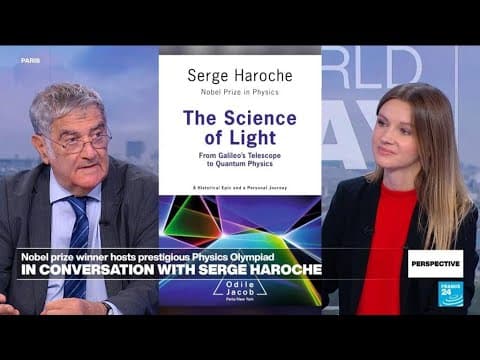
Nobel laureate Serge Haroche on the importance of being 'curious' for future scientific discoveries
FRANCE 24 English
10m 2s1,571 words~8 min read
YouTube auto captions
Transcript source
YouTube auto captions
This transcript was extracted from YouTube's auto-generated caption track. The transcript below is server-rendered so it can be read, searched, cited, and shared without opening the original YouTube player.
Pull quotes
[0:00]Want to perspective now and my guest on the program today is a Nobel Prize winning quantum physicist Serge Haroche.
[0:00]won the Nobel Prize in Physics in 2012 along with American physicist David Wineland for their work on studying quantum phenomena when matter and light interact.
[0:00]He's also taught at universities like Yale and Stanford and served as chair of Quantum Physics at the College de France.
[0:00]Now he's serving on the honorary committee of the International Physics Olympiad, a prestigious competition for aspiring scientists under the age of 20.
Use this transcript
Related transcript hubs
Watch on YouTube
Share
MORE TRANSCRIPTS


