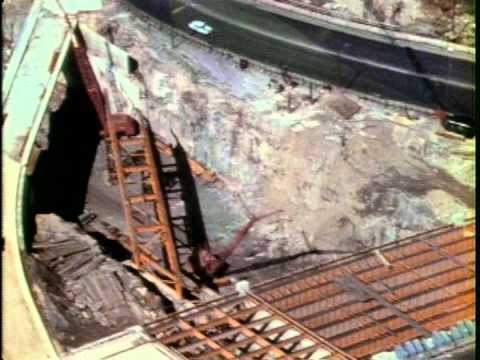
[0:03]Of all the federal projects under Robert Moses control, none would have more devastating consequences for the city and its people, or instil more rage against its executor than the Cross Bronx Expressway. A 225-foot wide concrete trench, 7 miles long, that would carve a path of destruction New Yorkers would never forget. This used to be an neighborhood. The neighborhood was called East Tremont in the Bronx, New York. Uh, the heart of it was where this road runs behind me, the Cross Bronx Expressway. It was predominantly Jewish. There was also Irish and Germans in it and some blacks. It was a neighborhood where everybody knew everybody else. It was a community, it was a place with a heart. Robert Moses tore this heart out. The Cross Bronx Expressway goes through about 12 or 15 different neighborhoods. And it just like went through the center of a great many. And I mean the idea was that it was built um, on a straight line and there was no account of, you know, who the people are and what they're doing. There was no question of, can we work this highway into existing life? This question never came up in the 1940s or 50s. They had the power to build in straight lines and they just did. These were still intact communities. People worked, people kept up their properties, people did business where they lived. This was a place where you did your marketing locally, uh you did your business locally. You got your first Holy Communion, read your haftorah for your Barmitzvah. It all happened right there. It was a culturally and materially self-sufficient world in a lot of ways. When they came here, this valley that you see here was of course filled with apartment houses. So they had to demolish scores of six and seven story apartment houses. But that was really nothing compared to the problems. They were going to have to blast through the ridge there. They knew that building this road was going to take 10 or 12 years, in fact it took 12 years. They knew they couldn't interrupt the subway service. So they were going to have to keep that subway line running while they blasted through that ridge. Also inside that ridge is one of the world's largest storm sewer mains, gas mains, electric lines, telegraph cables, sewers of all types, a whole mass of utility lines. Moses was going to have to ram this road through there, while keeping all those things in operation. I remember standing on the ground parts of the concrete and watching the engineering job, which was quite magnificent and sublime because you could see the destruction in one direction. Everything was being smashed to the east, and to the west nothing had been done yet. So it looked like a completely intact city, and yet you knew it was like the artillery shells were going to come down on it, you know, in a year, in two years, in a month, they didn't tell us. And all I could think of was that this didn't have to be. Now, that very afternoon, as it happened, I had an interview with Robert Moses. And I was asking him about this expressway. And I was trying to find a polite way to address the subject, and I said, was it perhaps more difficult to build an expressway through a crowded city than to build a parkway in empty Long Island? And he said, oh no, no, not at all, not really. I said, well, what about the Cross Bronx Expressway? He said, oh no, there was no real trouble up there. I said, well, was there hardship for the people? He said, no, no, he said, they just stirred up the animals there. So I just tell fast. And that was all we had to do. And of course, it was all he had to do. Because that was the reality of political power in New York at that time. I was stood on the ramp parts of the concourse and said, I'll someday I'll get that bastard. And there were a lot of other people too who were standing there with me and watching the job and said, we hate that creep, someday we'll get him. Uh, I mean, he'd made a lot of enemies over the years, you know, people who were willing to do anything to get him. We don't pay too much attention to the critics. Yeah, they will build anything, no critic ever build anything in my knowledge, and they don't bother us. New York, uh, has too many critics. We ought to get rid of some of them.
Marshall Berman on Robert Moses
Patell and Waterman's History of New York
5m 4s788 words~4 min read
YouTube auto captions
Transcript source
YouTube auto captions
This transcript was extracted from YouTube's auto-generated caption track. The transcript below is server-rendered so it can be read, searched, cited, and shared without opening the original YouTube player.
Pull quotes
[0:03]Of all the federal projects under Robert Moses control, none would have more devastating consequences for the city and its people, or instil more rage against its executor than the Cross Bronx Expressway.
[0:03]A 225-foot wide concrete trench, 7 miles long, that would carve a path of destruction New Yorkers would never forget.
[0:03]Uh, the heart of it was where this road runs behind me, the Cross Bronx Expressway.
[0:03]And I mean the idea was that it was built um, on a straight line and there was no account of, you know, who the people are and what they're doing.
Use this transcript
Related transcript hubs
Watch on YouTube
Share
MORE TRANSCRIPTS


