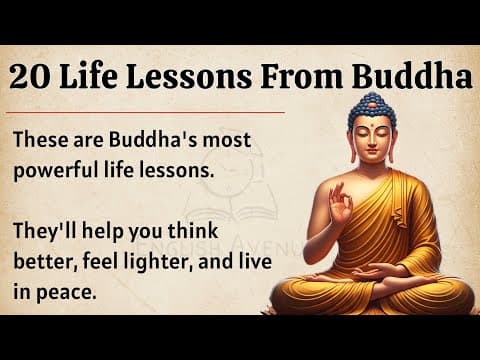
[0:00]Welcome. Today, I'm not here to give you motivation for 5 minutes. I'm here to give you wisdom for the rest of your life. This is not just a video. This is a mirror. A mirror that will show you who you really are. A mirror that will teach you how to stop suffering, how to let go of your pain, and how to take back control of your life — starting today. We live in a world that is loud, stressful, and constantly pulling us in every direction. Everyone wants success. Everyone wants happiness. Everyone wants peace. But here's the truth that most people don't want to face: You can't find peace in the world... If you don't have peace in your mind. You can't change your life if your thoughts are full of anger, jealousy, doubt, fear, and attachment. You want peace? You want strength? You want to stop overthinking? You want to feel happy for real, not just pretend? Then you must learn from one of the greatest teachers who ever lived — Gautama Buddha. He didn't just talk about God or prayer. He talked about the mind. He talked about discipline, focus, letting go, and awakening. He gave us lessons that can free you — not just for a day, but for life. And today, I will share the 20 most powerful, life-changing lessons from Buddha — explained in the simplest, most emotional, and most powerful way you've ever heard. These are not just quotes. These are truths. They are tools. And if you understand them, your entire life can change. Not slowly. Not someday. But now. So don't skip. Watch till the end. And if this video helps you even 1% — Subscribe to this channel. Because we don't make ordinary videos. We make videos that transform lives. These are Buddha's most powerful life lessons. They'll help you think better, feel lighter, and live in peace. And yes — listening to this in English will also improve your English fluency. If you want to watch Buddha's full life story, it's available now on our channel. Let's begin. Lesson 1: Your Mind Is Everything — What You Think, You Become. This is one of the most powerful teachings in all of Buddhism. All that we are is the result of what we have thought. The mind is everything. What you think, you become. What does this mean? It means that your entire life — your emotions, your relationships, your habits, your fears, your confidence, your decisions — they all begin inside your mind. If your mind is full of fear, you will live a life full of hesitation. If your mind is full of anger, you will destroy your peace. If your mind is full of weakness, you will never see your true strength. But if your mind is full of clarity, If your mind is trained to stay calm, If your mind knows how to focus on peace, Then your life becomes peaceful, even when the world outside is not. Imagine two students. Both are smart. Both are sitting in the same classroom. Both are preparing for the same exam. But one student is thinking: I'm going to fail. I can't do this. I'm not smart enough. While the other student is thinking: I've studied well. I'll give my best. I can do this.
[4:03]Now ask yourself — Who will feel calm during the test? Who will remember more? Who will have more focus? Who will pass? Same school. Same teacher. Same exam. But completely different results — because of different thoughts. That's what Buddha meant. Your mind creates your life. If you don't control it, your life will always feel like chaos — even when everything is fine. So train your mind. Speak good things to yourself. Don't let negative thoughts stay in your head like poison. Replace fear with belief. Replace doubt with effort. Replace anger with understanding. You don't become peaceful by luck. You become peaceful by training your thoughts — every day. Your mind is not your enemy. It is your most powerful tool. What you think, you become. Lesson 2: Peace Comes from Within — Do Not Seek It Outside. This lesson is short in words — but deep in meaning. Peace comes from within. Do not seek it without. Buddha is telling us a truth that most people never understand. Everyone is searching for peace — in money, in relationships, in success, in travel, in material things. But no matter how much they get... they still feel something is missing. They still feel tired. They still feel anxious. They still feel lost. Why? Because peace does not come from outside. You can sit on a beach and still feel stressed. You can be rich and still feel empty. You can be loved by the world and still feel alone. Because peace is not a location. It's not a possession. It's a practice. And it begins inside you. Think of two people stuck in traffic. One is shouting, hitting the steering wheel, angry at every car. The other is sitting calmly, listening to music, breathing slowly. Same traffic. Same road. Same delay. But completely different experience. Why? Because the first person gave their peace to the outside world. They believed that peace only exists when everything goes their way. The second person? They didn't let the outside world control their inside world. And that's what you must learn. The world will not give you peace. It will give you reasons to lose it. So you must create peace inside your thoughts, your breath, your focus, your response. Don't depend on people to calm your mind. Don't wait for perfect conditions to feel okay. Start with yourself. Sit in silence for 5 minutes a day. Listen to your breath. Be present in this moment. Say this to yourself: I have the power to stay calm, even if the world is not. When you find peace inside... you carry it with you — everywhere. True peace is not found. It is created. And it always begins within. Lesson 3: The Root of Suffering Is Attachment. This lesson is one of the most difficult to accept... but once you understand it, it will free you forever. What does Buddha mean by attachment? Attachment doesn't just mean loving someone. It doesn't mean caring or being close. Attachment means: You are afraid to lose something. You feel pain when things don't go your way. You are holding on — even when it's hurting you. It's the emotional dependence on people, situations, outcomes, and expectations. And Buddha says — This is the root cause of your pain. Let's say you fall in love. You give your heart to someone. You build dreams together. But one day — they leave. Or they hurt you. Or they change. And suddenly... your whole world falls apart. You can't eat. You can't sleep. You cry for days, months... even years. Now here's the truth: The love was not the problem. The care was not the problem. The problem was your attachment to how things should stay. You were not just in love — you were attached to that person being there forever. And when that didn't happen... you broke. Buddha is teaching us: Pain is natural. But suffering is optional. You can love someone deeply, but also understand that: People change. Things end. Nothing is permanent. If you cling too tightly to how you want life to be, you will always suffer when life changes — because it always does. How to apply this lesson: Love people — but don't depend on them for your happiness. Work hard — but don't tie your self-worth to success or failure. Enjoy the moment — but don't cry forever when it passes. Letting go doesn't mean you don't care. It means you are free from fear. You stop holding life like a fist — and instead, you hold it like open hands. Let go of your tight grip. Let go of needing everything to be perfect. Let go of the fear of losing. Freedom is not getting everything you want. Freedom is not needing everything to stay. And that... is true peace. Lesson 4: Let Go of Anger — It Will Burn You First. Holding on to anger is like grasping a hot coal with the intent of throwing it at someone else. You are the one who gets burned. This lesson is so simple... and yet so powerful. Because most people don't realize this: Anger is not strength. Anger is a wound that you keep scratching — again and again. You may think that being angry gives you power. But actually, it takes away your clarity, your peace, your sleep, your health, and your joy. Imagine you get angry at someone who insulted you. You keep thinking about it all day: How dare they say that? I'll show them. I'll never forget this. You talk to your friends about it. You lose sleep over it. You feel pain in your chest. Your face feels hot. You're filled with stress. Now ask yourself: Are they suffering? Or are YOU? They moved on. But you... you are still holding the hot coal. This is what Buddha is teaching. Anger feels powerful for 5 seconds — but it destroys your peace for days, weeks, even years. You're not punishing them. You're punishing yourself. What to do instead: Learn to pause. Learn to breathe before reacting. Ask yourself: Will this matter in 5 days? In 5 months? In 5 years? And most importantly: Forgive — not because they deserve it. Forgive because you deserve peace. Let go of the hot coal. Walk away from the fire. Protect your peace like it's the most expensive thing in your life — because it is. Don't let someone's action become your disease. You deserve better. Lesson 5: Nothing Is Permanent — Everything Changes. Nothing lasts forever. Everything changes. Everything passes. This is one of the most beautiful and powerful truths of life. It may sound sad... But actually, it's the most hopeful lesson of all. Why is this so important? Because if you understand this — you will never become arrogant in success, and you will never feel hopeless in pain. You will live with more gratitude, and less fear. More freedom, and less control. Because now you know: This too shall pass. Your sadness — will pass. Your stress — will pass. Your heartbreak — will pass. Even your happiest moments — they will pass too. Nothing is fixed. Everything is moving, changing, flowing — like a river. Think of a rainy day. You're stuck at home. The sky is dark. You feel lazy and sad. But after some time... the rain stops. Clouds move. The sun comes back. Birds start singing again. And suddenly... the world feels beautiful again. Now ask yourself: Where did the darkness go? Nowhere. It simply passed. And just like the weather — your emotions, your situations, your pain — they are all temporary. Don't build your life around temporary emotions. When you're sad, don't think it will last forever. When you're happy, don't become lazy or proud. When you lose something, don't think your life is over. Because every moment is part of a bigger cycle. Everything is moving. And everything will pass. So breathe. Let go. Trust the process. You don't need to control life. You just need to flow with it. And that, my friend, is the secret to calm. Lesson 6: You Only Lose What You Cling To. This lesson is deeply connected with the last one — but it has its own unique power. And most people never realize this truth until it's too late. Buddha is teaching us something that feels uncomfortable at first: Loss is not the problem. Clinging is. When we cling too tightly to: A person (they must never leave), A job (I can't lose this or I'm nothing), An identity (I must always be the best), A belief (I am always right), Then we are no longer living in peace — we are living in fear. And here's the irony: The tighter you hold something, the more likely it is to slip away. Like sand in your hand — if you close your fist too hard, it escapes faster. Imagine you're in a relationship. You love your partner — but slowly, you begin to fear losing them. So you become controlling. You keep checking their phone. You question where they go. You stop trusting. Why? Because you're clinging. And what happens? They feel trapped. They feel suffocated. They lose freedom. And finally... they leave. Not because they didn't love you. But because you held them so tightly... they couldn't breathe. You thought your fear would protect them. But your clinging became the reason you lost them. Love fully — but let people be free. Work passionately — but know when to rest or change. Dream big — but don't become a slave to the outcome. Tell yourself: I can enjoy what I have without being afraid of losing it. Because once you stop clinging, you start living. You stop fearing the waves of life — and you start surfing them with joy. Lesson 7: Do Not Dwell in the Past. Do Not Dream of the Future. Focus on Now. This may be one of Buddha's most famous lessons — and also one of the hardest to practice. Because let's be honest: Most people are trapped in the past — always replaying regrets, mistakes, heartbreaks. Others are lost in the future — always anxious, worried, or obsessed with success. But the present moment? They miss it completely. Think about it. The past is just a memory. The future is just a possibility. The present is the only moment you are actually living. And every time you miss the present... you are throwing away your life one second at a time. Let's say you're having dinner with your family. Your mother cooked your favorite dish. Your father is smiling. Your brother is making jokes. But you... You're scrolling your phone. Thinking about a fight from last week. Worrying about tomorrow's exam or deadline. You're physically present... but mentally gone. And then one day, that dinner becomes a memory. You wish you had enjoyed it more. You wish you had been there. This is what Buddha is warning us about. You are not living if you are only remembering or planning. You are living when you are feeling, noticing, experiencing — now. When you walk, just walk. Feel your feet. Look at the trees. When you eat, just eat. Taste your food. Don't scroll your phone. When someone talks to you, listen with your whole heart — not just your ears. It's not about meditating on a mountain. It's about waking up to your own life. Because the present is not just another moment. It is the only moment where joy, peace, healing, and love exist. Everything else... is a shadow. Lesson 8: Health Is the Greatest Gift. Contentment Is the Greatest Wealth. This one may surprise you — because it sounds so simple. But Buddha is teaching us one of the most ignored truths in modern life. People are chasing: More money. More status. More followers. More things. And in that chase... they destroy the two things that truly matter: Health and Contentment. You may have the latest phone, fancy car, or big apartment... but if you can't sleep at night, if your chest hurts with anxiety, if your body is always tired, then what do you truly have? Health is not just not being sick. Health means: A calm mind. A strong body. A peaceful heart. Good sleep. No addiction. That's the real luxury. You can buy a bed, but not rest. You can buy a pill, but not peace. You can buy a gym membership, but not discipline. Take care of your body like it's a temple — because it is the only place you have to live. You may earn $1,000,000 and still feel empty. You may have fewer things — and feel completely full. Why? Because happiness is not about how much you have — It's about how much you enjoy what you have. The man who is grateful for little is richer than the man who is never satisfied with much. Start sleeping on time. Drink more water. Eat food that gives energy, not just taste. Go for walks. Move your body. Sit quietly with yourself, even for 10 minutes. Write what you're grateful for — every day. Don't just chase the life you want. Take care of the life you already have. Because as Buddha says: Health is the greatest gift. Contentment is the greatest wealth. And both are already in your hands — if you choose them. Lesson 9: Hating Someone Is Like Holding a Hot Coal — You Burn Yourself First. This is one of Buddha's most shocking and brutally honest truths. And the reason it's so powerful... is because it's true. We think when we hate someone, we are punishing them. But actually, we are poisoning ourselves. We think if we keep remembering the pain, we'll never be hurt again. But actually, we are hurting ourselves again and again — by choice. Imagine someone betrayed you. Lied to you. Broke your heart. It's normal to feel anger. Pain. Disappointment. But here's what happens if you hold on to that anger for too long: You think about them daily. You feel stress in your chest. Your mood is ruined. Your sleep is affected. You feel bitter toward life. And the worst part? They are living their life. They've moved on. You are the only one still suffering. Imagine holding a hot piece of coal in your hand. You want to throw it at the person who hurt you. But as you wait... your skin starts burning. It's hurting you. This is what anger and hatred do. You think you're protecting yourself... but you're actually burning your own peace, your own health, your own happiness. Forgiveness is not saying what they did is okay. Forgiveness is saying I'm done carrying this pain. You're not doing it for them. You're doing it for you — to breathe again, sleep again, smile again. Release the coal. And feel the peace that you've been missing. Lesson 10: Speak Only When Your Words Are More Beautiful Than Silence. In today's noisy world — everyone wants to speak. Everyone wants to react. Everyone wants to say their truth. But Buddha teaches us something radically different: Not all words are worth speaking. And silence is often more powerful than sound. Words can heal. But they can also destroy. They can build a relationship — or break it in seconds. You may forget what you said... but the person who heard it might never forget it. One careless sentence can stay in someone's mind for years. Just like a sharp knife — once it cuts, the wound may heal... but the scar remains. You're angry during a fight with someone close to you. You say something like: You're useless. I regret being with you. You always ruin everything. You don't even mean it fully — it was just emotion. But the person hearing it? Their heart breaks. They feel small. They cry later. They remember it... forever. And you? You may forget it in a week. But the damage is done. So What Does Buddha Teach? Before you speak, ask yourself 3 things: 1. Is it true? 2. Is it necessary? 3. Is it kind? If the answer is no to any of these — stay silent. Sometimes, silence is stronger than shouting. Sometimes, saying nothing is the most powerful thing you can say. Pause before you reply. Take a breath before you post online. Speak less — but mean every word you say. Practice being a listener more than a talker. Because once a word leaves your mouth — it cannot be taken back. And as Buddha reminds us: Words have the power to both destroy and heal. When words are both true and kind, they can change the world. Lesson 11: Be Kind to All — Every Person Is Fighting a Battle You Cannot See. This is not just a quote. It's a call to become a better human being. Because most people — including you and me — are judging others without knowing their full story. We see someone angry — and we think they're rude. But maybe they just lost someone. We see someone lazy — and we call them useless. But maybe they're depressed. We see someone cold — and we say they're arrogant. But maybe they're scared. Imagine you're in a supermarket. A mother is shouting at her child. Most people stare, judge, gossip. But what they don't know is... That mother hasn't slept in 3 days. She works two jobs. Her husband left. Her child is autistic. She's trying her best — but she's tired. Now — is she a bad mother? Or a human being in pain? Buddha reminds us: Before you judge, try to understand. Before you react, try to feel. When someone cuts you off in traffic — send them peace instead of cursing. When someone is rude — remember, their words are a reflection of them, not you. When you feel like gossiping — stop, and imagine if someone did the same to you. Be soft with people — not because they're right, but because you are strong. Compassion is not weakness. It is the highest strength. Every person is carrying invisible pain. If we all just chose kindness a little more often — this world would feel like a different place. Be the person who brings light where others bring darkness. Because as Buddha says: In a world where you can be anything — be kind. Lesson 12: No One Saves You but Yourself. This is one of the most empowering and painful truths. Most people are waiting. Waiting for a person to come and fix their life. Waiting for the right time. Waiting for motivation, support, or someone to push them. But here's what Buddha is saying: Stop waiting. No one is coming. And before you feel hopeless — this is not meant to hurt you. It's meant to wake you up. Because when you finally stop waiting — you start moving. You start growing. You take back your power. Imagine you're drowning in a lake. You keep shouting, Help! Save me! And you keep waiting for someone to jump in. But time passes. No one comes. Then you realize... There's a floating log just a few feet away. You can swim to it. You can save yourself. You were never helpless. You were just hoping someone else would do it for you. This is what most people do in life. They're drowning in laziness. Drowning in bad habits. Drowning in regret. And they're waiting for a guru, a partner, a breakthrough to save them. But the truth? You are the only one who can save you. So, Get up. Take one small action. Begin today — even if you're not ready. Because the moment you take responsibility — your healing begins. Your growth begins. Your peace begins. It's not easy. But it's powerful. And you will be amazed how far you can go — once you stop waiting to be rescued. Lesson 13: Pain Is Certain. Suffering Is Optional. Read that again. It's one of the deepest, most misunderstood lessons in Buddhism. Pain is part of life. Someone leaves you. You lose money. Your body gets sick. Your dreams don't work out. These are real pains. They happen to everyone. But suffering? Suffering is what happens inside your mind when you resist that pain. Suffering is the story you tell yourself about the pain. Imagine: Two people lose their jobs. Person A says: My life is over. I'm worthless. Nothing ever works for me. I'm a failure. They suffer for months. Maybe years. Person B says: Yes, this hurts. But maybe this is a sign to do something new. Maybe I can learn a skill. Start something small. Grow. Same pain. Different mind. That's the power of Buddha's wisdom. You can't always avoid pain. But you can change your response. Instead of asking: Why me? Why is life so unfair? Ask: What can I learn from this? How can I grow through this? What is this pain trying to teach me? Every time you choose growth over complaint, you end suffering and begin transformation. Next time life hurts you: Feel the pain. Breathe through it. And don't let your mind turn it into a lifetime of suffering. Because pain may come for a moment... but suffering is a choice — and so is freedom. Lesson 14: Be Your Own Teacher. Trust Your Inner Wisdom. This is Buddha's way of saying: Don't blindly follow anyone. Not your religion. Not a book. Not even a motivational speaker. Because truth — real truth — isn't something you copy. It's something you feel deep inside. We live in an age of information overload: One person says, Wake up at 5 AM. Another says, Sleep in, your body needs rest. One says, Be aggressive. Another says, Be peaceful. And most people get confused. But Buddha is saying: You already have the answers. Deep inside, you already know what feels right for you. You just need to learn how to listen. Let's say you're struggling with anxiety. You read 5 different books. You watch 10 YouTube videos. You listen to 3 podcasts. Each one says something different. But instead of clarity — you feel more lost. Now imagine — you take a break. You sit in silence. You ask yourself: What's really causing my anxiety? What do I need right now? What feels true in my heart? And slowly... you start to hear a voice. Not loud. Not dramatic. But calm. Gentle. Honest. That voice is you. Your inner wisdom. And that's what Buddha wants you to trust. Don't accept everything you hear — even if it sounds wise. Ask: Does this feel right to me? Try it. Test it. Adjust it. Make your own rules — guided by awareness, not ego. Because the world is full of noise. But your peace will come... when you learn to follow your own quiet truth. You are not lost. You are not broken. You are just learning to hear your own voice — again. And when you do? You will become your own teacher, your own guide, your own light. Just like Buddha. Lesson 15: A Disciplined Mind Leads to True Happiness. This is one of the most underrated and uncomfortable truths in modern life. Most people are chasing happiness... But few people are training their mind. And that's the problem. Because if your mind is: Always anxious. Always comparing. Always addicted to distractions. Always overthinking or complaining. Then no amount of money, success, or comfort can make you happy. You could be sitting on a beautiful beach... With the sun setting in front of you. The wind gentle on your face. No problems around. But if your mind is full of regret, jealousy, or fear — you'll feel empty. On the other hand — You could be in a small room. With no luxury. No audience. Just silence. But if your mind is at peace... You'll feel happy. That's the secret. It doesn't mean being hard on yourself. It means training your focus. It means protecting your peace like it's the most precious thing in your life — because it is. Here's how most people live: They wake up — immediately check their phone. They scroll — jump from thought to thought. They react — to everything. They complain — without awareness. They sleep — with a tired, restless mind. But a disciplined mind? Wakes up with intention. Chooses thoughts like food. Guards attention like gold. Responds with awareness — not reaction. Rests with clarity and gratitude. Start your day in silence — even 5 minutes of breathing or gratitude. Protect your inputs — your mind becomes what you feed it. Catch your thoughts — ask: Is this helping me or hurting me? Speak less. Observe more. Pause before reacting. Say NO to mental junk food. Because remember: A messy mind will create a messy life. But a focused mind? It creates magic. And once you train it — your life becomes lighter, calmer, and much, much more powerful. Lesson 16: Don't Compare Your Life With Others — Walk Your Own Path. Do not overrate what you have received, nor envy others. He who envies others does not obtain peace of mind. This teaching hits deep — especially today. In the age of social media, everyone is watching everyone. And comparison has become a disease. You see someone travel — you feel poor. You see someone fit — you feel lazy. You see someone married — you feel lonely. You see someone succeed — you feel like a failure. But here's the truth: What you see is never the full story. That person you envy may cry alone at night. That person smiling in photos may feel empty inside. That person with money may be drowning in anxiety. Buddha is not saying ignore others. He's saying: don't lose yourself in their story. Imagine you're running a race. You keep looking at the person next to you. You start copying their speed... their direction... their pace. But here's the problem — They're not running your race. They're on a different track. Different goal. Different timing. By copying them — you lose your own path. That's what comparison does. It makes you forget who you are. It disconnects you from your values. It kills your peace and progress. Stay in your lane. Celebrate others without questioning yourself. Write your own definition of success. Don't chase trends — chase your truth. Remember: What's meant for you will never miss you. Comparison is a thief — it steals joy, peace, and clarity. But when you walk your own path — even slowly — you walk in peace. And that peace? Is more valuable than any applause. Lesson 17: The Greatest Victory Is Over Yourself. It is better to conquer yourself than to win a thousand battles. Then the victory is yours. It cannot be taken from you. We live in a world that worships external victories. How many followers you have. How much money you earn. How big your title is. How loud your life looks. But Buddha reminds us: The real war... is inside you. And the greatest success? Is not beating others. It's beating: Your own laziness. Your fear. Your anger. Your procrastination. Your bad habits. Your excuses. Your self-doubt. You wake up early — even when you don't feel like it. You go to the gym — even when no one's watching. You say no to gossip — even when it's easy to join. You forgive someone — even when your ego wants revenge. You speak calmly — even when someone tries to trigger you. These are quiet victories. No one claps. No one notices. But you feel strong. You feel light. You feel powerful. And that's what matters. Catch yourself when you're about to react. Pause before giving in to temptation. Disagree respectfully. Apologize without pride. Do what's right — not what's easy. Every time you win over yourself — you build self-respect. And self-respect leads to inner peace. Because when you win outside, the world claps. But when you win inside, your soul smiles. And that... is the victory no one can take away. Lesson 18: Learn to Respond — Not React. This is not just a lesson. This is a superpower in today's world. Most people react. Someone insults them — they attack back. Someone disagrees — they raise their voice. Life changes — they panic. Things go wrong — they complain. They don't think. They react. They don't understand. They explode. But Buddha teaches: Responding is higher than reacting. Reacting is emotional. It's fast. It's unfiltered. It's often regretted. Responding is wise. It's thoughtful. It's calm. It's powerful. Imagine you're driving. Someone cuts you off rudely. Most people react instantly: Anger. Horn. Swearing. Tension for hours. But a trained mind responds: Breathe. Calm down. Let it go. Why? Because their peace is more valuable than proving a point. They don't give power to strangers. They don't lose control because of others' lack of it. Pause before speaking. Just 3 seconds can change everything. Ask yourself: Is this reaction helpful? Choose silence over drama. Use your energy for solutions, not arguments. Control your tone. Control your emotions. Because when you react — you give away your power. When you respond — you become the master of your mind. Be that master. Let others be loud. You be wise. Lesson 19: Live With Purpose — Not Habit. Your purpose in life is to find your purpose and give your whole heart and soul to it. This lesson can wake people up. Because most people are not living. They're just existing. Wake up. Scroll phone. Work. Complain. Eat. Sleep. Repeat. No awareness. No intention. Just automatic routines. Buddha's message is clear: Don't live like a robot. Live like a seeker. Think about this: There's a man who works 9 to 5. He's been doing the same job for 15 years. He doesn't like it. He doesn't hate it. He just... shows up. He says, Life is okay. I'm managing. But inside? He's not growing. He's not exploring. He's not ALIVE. Compare that to another person: She earns less, but she wakes up excited. She paints, she reads, she teaches, she creates. She lives with purpose, not just routine. And even if the world can't see it — she's freer than the richest man. Ask yourself daily: Why am I doing this? Audit your habits. Are they helping you grow or holding you back? Replace auto-pilot with awareness. Do at least one thing daily that connects to your purpose — even if it's small. Don't just chase success. Chase meaning. Because at the end of your life, you won't remember how busy you were. You'll remember how deeply you lived. So live consciously. Live fully. Live with purpose. Lesson 20: True Wisdom Is Knowing When to Let Go. You will not be punished for your anger. You will be punished by your anger. This is one of Buddha's deepest teachings. It's not about knowledge. It's not about books. It's about wisdom. And true wisdom is not always about holding on. Sometimes... You win by walking away. You grow by releasing. You become free by letting go. Let go of what? That fight you had years ago. That mistake that keeps haunting you. That person who broke your heart. That toxic friend you keep trying to fix. That job that's draining your soul. That habit that's destroying your peace. That need to be perfect. That need to always be right. Letting go doesn't mean you failed. It means you're wise enough to stop carrying what hurts. Imagine carrying a bag of heavy stones on your back. At first, you're fine. But over time — you feel tired. You lose your balance. Your back starts to bend. You can't move freely. Someone says: Why don't you drop the bag? And you reply: But I've carried it for so long. That's what most people do. They carry pain, grudges, guilt, anger, and old stories for years. But it's not strength. It's self-destruction. Let go. Not for them — but for you. How to Practice Letting Go: Write a forgiveness letter — even if you don't send it. Meditate on the feeling you're trying to release. Don't replay the past. Rewire the present. Tell yourself: This no longer controls me. Choose peace — even if your ego resists. Letting go is not weakness. It's the highest form of strength. Because it frees your heart. And a free heart is a powerful heart. You've now learned all 20 life-changing lessons from Buddha. These are not just teachings to think about — They are tools to transform your life, your mind, your peace, and your purpose. If you use even one of these daily — your life will begin to change in ways you never imagined. Let me leave you with something real. The world we live in is loud. Everyone is chasing something. Everyone is trying to prove something. Everyone is trying to be something. But Buddha didn't chase. He let go. He didn't scream to be heard. He became still to understand. He didn't tell us how to live someone else's life. He taught us how to come home — to ourselves. You don't need to be perfect. You don't need to have it all figured out. You don't need to carry your pain forever. You just need to start letting go. Let go of what's not yours to carry. Let go of who you're pretending to be. Let go of the anger, the fear, the past, the need to control everything. And in that letting go — You will find something the world can't give you. Peace. Because the truth is... You're not behind in life. You're not broken. You're not late. You're just heavy. And maybe... It's time to finally put the weight down. So breathe. Take this moment. And start over — not from guilt, not from pressure... But from clarity. From purpose. From peace. Because if even one of these lessons spoke to your heart today — you already took the first step. And that means you're ready. You're ready to begin a new chapter. You're ready to become the calm in your own storm. You're ready to live lighter, live wiser, and live free. Thank you for giving your time. Thank you for choosing to grow. And thank you... for being here. This video was made with love, honesty, and deep respect — for you, your journey, and your transformation. If this touched your heart even 1% — Share it. Rewatch it. Subscribe. Because we are building something beautiful here — together. See you in the next video. Until then... Let go. And rise.