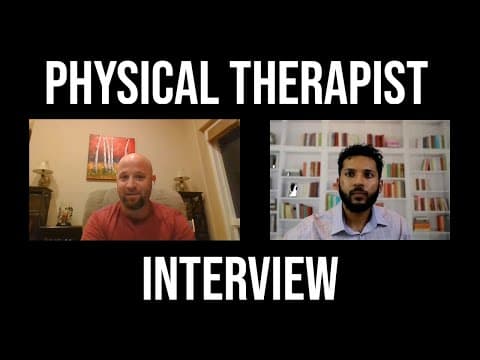
[0:03]Hi everyone, today I'm here with Nate, a physical therapist and a manager of inpatient rehab in a hospital of the greater Sacramento area. So thank you Nate for being a part of this interview. Thanks for having me. And uh, before we get into the details of physical therapy, what exactly is physical therapy? And uh, what are the sub specialties of physical therapy? Physical therapy is uh, a really broad profession. Um, we help restore function of individuals and the uh sub specialties range from many, many specialties such as pediatrics, impatient, outpatient, burns, neuro. I mean, the list goes on, so I could I could sit here and and tell you about uh, tons of sub specialties. Uh, you know, what's amazing is now physical therapy is breaking into non-clinical roles as well. So the profession is actually growing. What are the most common cases that you see in a day, um, on the inpatient side and maybe the outpatient side since right now you're more on the managerial side of things? Um, maybe you could take us back to like when you were on the inpatient side and, um, maybe your colleagues on the outpatient side as well. Yeah, so when I met you, I was working in a surgical intensive care unit, so I saw a lot of thoracic surgery patients the day after they had surgery. So early mobilization is a very important thing within a hospital setting, the sooner people are able to move once they're medically stable to move, um, the better the outcomes. So that was my last clinical role. Um, so now as a manager, you know, I I am a manager of 38 employees, speech therapists, occupational therapists and physical therapists, we see everything from, you know, cardiac to orthopedics and neuro. So yeah, wide range every day. What is the scope of a physical therapist versus let's say, um, another healthcare professional like a P and R doctor or a sports medicine doctor who's like a primary care physician or even like a massage therapist or chiropractor. Oh, that's very loaded question. So, uh, similar to I I would say a physical therapist, we cannot prescribe medicine, but we could prescribe, uh, exercise under, um, the direction or under the supervision of a, uh, physician. So we need to receive an order first and then we, uh, would assess a patient and prescribe, um, so that's the difference. I mean, there's a big difference between a physician and a physical therapist, but, um, we're independent clinicians. So, uh, doctors don't come to us and say, this is what you're going to do with our patient. We're going to give you an order, but they trust her judgment based on our skill level to assess and determine what functional impairments there are or mobility impairments and then set some goals and try to eliminate those and restore normal function. Uh, massage therapists were, there's a significant difference between a massage therapist, um, you know, they may, uh, help with tissues, but we're restoring, you know, we're going to measure range of motion. We're going to measure strength, we're going to measure sensation and neurological, uh, deficits and then help restore function based on the, those impairments. Could you kind of walk us through maybe like the general methodology of physical therapy, like how you guys approach problems in general with like rehab or, um, let's say a post-op patient or a sports injury or things like that? How do you just kind of like assess the situation and proceed from there? I remember you talking, um, to me when I was in on the med surge unit about, um, I think even the difference between chiropractors and a physical therapist being like one is like loosening I think and one is more like building support and stability. So could you kind of give us an overview of like the general methodology of physical therapists and how they approach these things like rehab or, um, uh, sports injury versus like a post-op patient? There's so much to talk about there, I don't even know how to address that, but, you know, again, it goes back to assessing for impairments and trying to restore normal function based on what our findings are. So if, you know, let's say a joint, uh, is stiff, we're going to help mobilize and stretch that joint, or, you know, maybe stable on one side and, uh, lax on the other side. So we're going to have to provide stabilization on the side that's loose and we're going to probably have to stretch the side that is, uh, shortened. So, uh, finding the right, um, symmetry and then also strength is very important. Um, and that's just speaking to the specifics. Um, the chiropractic versus physical therapists, um, I get that question a lot. Um, I have a lot of respect for chiropractors and chiropractors have their place. Um, the business model is, is, you know, significantly different from a physical therapists business model and a outpatient setting. Uh, physical therapists generally, um, have a short-term plan of care. Um, anywhere from three to six weeks over, you know, two sessions per week with the ultimate goal of making the patient independent in their plan of care. So if they have pain or if they have mobility mobility impairments, the goal is to restore that function and then teach them how to do it on their own with the ultimate goal of them not needing to come back. Um, on the flip side of that, the, um, chiropractic, uh, business model, I keep losing my screen, so let me get my screen back up. Sorry about that. Um, they, they are a quick fix, you know, they, they do a lot of manipulation and so if you, you know, you have a rib that's just bugging you and you they can manipulate you.
[6:39]Um, but sometimes that creates a laxity and I think one thing and not, not to have a slant on chiropractic, but one thing that is common is when people patients go or clients go to chiropractic care, they typically are reliant on chiropractic care. And that's kind of the business model too is to have you keep coming back. So, um, I don't know if that's being mean, but I mean, um, again, I've been to chiropractic care and I've been helped by chiropractors. So I I know they have their place. Why did you choose physical therapy and your specific sub specialty if you have one? I was a baseball player, I heard my shoulder, uh, in college. I was going into my junior year, had shoulder surgery.
[7:33]Um, the, uh, the rehab process did not go as quickly as it should have. Um, so I needed a lot of physical therapy and at that time I was going to a sports med clinic at University of Nevada, Reno, um, and I was just in awe of the clinic of the profession and, you know, I was taken back. I'm like, this is actually a career. This is amazing, you know, like it it was super cool environment, so it kind of planted the seed.
[8:06]And then, uh, I went back, you know, actually I I dropped out of school at that time, um, because I stopped playing baseball. So I I felt kind of lost, I went into sales till about 25 and went back to school because I really wanted to be a physical therapist. Um, so sub specialty, I I didn't get any advanced certifications, but I've done a lot of different things within my career. I started in an outpatient setting and then quickly went into the inpatient setting. Um, I've done home health, um, I've worked in the intensive care unit where I met you. Um, I've been a, uh, acute rehab lia on that was a non-clinical role and that's where you screen and identify patients that are appropriate for intensive therapies. Uh, it's an inpatient rehab program, so we're, where you would see spinal cord injuries, traumatic brain injuries, stroke patients. And then most recently promoted to a manager position. Okay. And since you have worked in all these different areas as a physical therapist, I think this is a good question. What is a typical day in your life like now and what was it in some of those different roles that you had, whether it was in home health or whether it was in outpatient, I'm assuming private practice or, um, in the ICU? What was your day like in each of those settings and how is it different from what it is now in your managerial role? The ultimate goal every day when I get up is to make a difference in somebody's life. So you get up bright and early and go to work and you know, I I've had a high level of satisfaction in this career. When I get in my car at the end of the day, I smile, you know, because I know I made a difference. Now, the magnitude of helping people has kind of grown over the years as I've gone into other positions. So as a manager, you actually get to impact more patients on a daily basis because you're helping your 38 employees provide care. So it gives a high degree, although it is very hard work, it gives a high degree of satisfaction. Um, so does that answer that? Yeah, and also, could you maybe not directly I guess, could you, uh, I mean, that's a good kind of microscopic overview. Could you give us maybe some like, uh, maybe hours that a physical therapist would work in either on the managerial side, but also on, let's say on the inpatient service or on the outpatient side? Outpatient setting, I typically worked 7:00 to 4:00. Um, you know, there's a lot of flexibility on the inpatient side, patients are in the hospital. Um, we do early mobilization, not only does that mean early in the morning, but it means early in their illness. Get them moving, but um, when I worked in the intensive care unit, I was working 5:00 to 1:30 shifts. Um, and there was a huge, uh, uh, what do I want to say, uh, benefit to not only the patient but the hospital. Patients that start moving early have a decreased length of stay, not only in the ICU but in the hospital, so and it actually may impact their discharge dispositions. So instead of going to a skilled nursing facility for rehab, they'll probably go home, so it's very important. Um, so yeah, there's a lot of flexibility though. I mean, in the inpatient side, I came in early in the ICU, but we also have a orthopedic pro, uh, orthopedic surgery program. Um, we see patients day of surgery, so total knee replacements, total hip replacements. We're getting them up on their feet and walking 10 or more feet on their first, uh, physical therapy session, which is the day of surgery, often times within two hours post surgery. Um, and again, that is a significant improvement in their outcomes. Uh, there's a lot of research on that as well, so the earlier patients start moving, especially after orthopedic surgery, the better the outcomes. Mortality, um, range of motion, strength, um, the health of the knee, pain, so I mean, and decrease risk of DBT. So it's very important, so those therapists typically come in around 10 or 11 in the morning and stay till like 7:00 or 8:00 at night. Okay. And and do you guys have like shift work or call days or things like that or is it like a Monday through Friday type of deal or how is it like? So hospital setting is 24/7, 365. However, physical therapy, occupational therapy, speech therapy, um, we're typically, um, anywhere from 5:00 in the morning till 7:00 or 8:00 at night. Uh, we don't work throughout the night. Um, there are some hospital settings that do, not very many and I don't think any in this in this service area. Um, so yeah, um, we do work weekend shifts. A lot of the therapists start out their career working, uh, Sunday through Thursday or a Tuesday through Saturday shifts, so we cover the weekend. And how do you say the lifestyle? I mean, we talked a little bit about this already, but how do you say the lifestyle of physical therapists is like in the inpatient outpatient setting? You mentioned the inpatient's a little bit more flexible. Um, but how is the lifestyle in general and then how is that compared to maybe other healthcare providers? I think we have a very high job satisfaction. I think we are ranked number three, the last I looked and that was probably two or three years ago, so I think generally we're very happy people. Um, you know, the lifestyle, I mean, we we don't make, uh, what doctors make, but I think we're compensated fairly well. Um, I I think recently, I think this goes for a lot of other professions, but, you know, the tuition it takes to get a degree, um, is growing and our pay is not, so I think there's a a big gap there. So we're not netting as much as probably we should, but, um, that's a whole different topic to talk about. Um, but I I think we're compensated pretty well. I think I graduated at the right time before we had this inflation in tuition, so, you know, I I do pretty well. And what's the most challenging aspect of being a physical therapist? Um, you know, getting attached to your patients. So in in the hospital setting, um, I've had a couple patients in the ICU that, um, succumbed to their illness and I think, you know, when you spend a lot of time with those patients and you you see them make progress and you you have to motivate people, you know, and it's really hard when you see them go forward and you're just almost, it's it's tough because you almost feel like you're giving a false promise. Um, but you have to find ways to motivate patients. So when patients pass away, which is not very often, it's very hard, you know. Um, I've had a couple instances that happened right around the holidays and you know, I I had a really hard time with that and I still to this day have difficulty with that. But, you know, that's that doesn't go for all physical therapists. I mean, this is, when you work in an intensive care unit, I mean, it's to be expected, so, you know, there's other discipline or there's other specialties, you know, the outpatient setting and and, uh, home health where you're not going to deal with that. What's the most rewarding aspect of being a physical therapist? Empowering somebody to regain normal function again. So people come to you with a thorn in, you know, their their hand and or a splinter and a lot of times they're desperate and if you could help them, uh, see the light and and, um, also improve their function and overall quality of life, it's super rewarding. Um, I've seen patients so sick that when I walk by their room, the nurses would tell me, don't even think about it. They're never going to have a physical therapy order and three months later, I get a physical therapy order and the woman couldn't even move her fingers. She was so weak. It was a daily project for, I would say, about six weeks, but I got her up on her feet and into a recliner and brought her outside in sunshine after four months. And that woman ended up walking about 10 feet before leaving the hospital. She went away to a subacute, um, rehab center and she came, she walked into her unit a couple months later to thank me. You know, that was amazing. That's powerful. Are there any misconceptions about physical therapy? Yes, physical therapy just PT, um, the acronym PT alone. I think a lot of people, uh, claim that it means pain and torture or physical terrors. Um, you know, sometimes, and then the no pain, no gain. I I don't believe in that, I really don't. Like even as a outpatient therapist, you know, there there are ways to, um, promote healthy mobility without inflicting pain. Now, there's, there's some things that may be a little uncomfortable, but we're not there to torture. Um, but with restoration of normal function, usually pain goes away, so I think that's probably people are reluctant to go to physical therapy because they're afraid that they're already in pain. They don't want to be in more pain. Are there certain personality types or qualities best suited for physical therapy? I haven't met very many therapists that I haven't liked. I think just generally very compassionate people that care about people, that just want to do good. Um, want to help people. Um, I think doctors are very similar in that nature, I think a lot of professions are, but, you know, I think therapists, uh, physical therapists, occupational therapists, speech therapists are just generally awesome people, good people to be around. How do you go about becoming a physical therapist? Are there certain exams or certifications that you need to get in or to have, uh, certifications or qualifications once you graduate? Yeah, so in order to apply for physical therapy school, you you must have a bachelor's of science and take whatever prerequisite courses, whatever institution you're going to be applying to.
[19:33]So I took, um, I went to California State University Sacramento. Um, I majored in kinesiology, which caters to, it's pretty much a pre-physical therapy program. Um, with the emphasis of therapeutic exercise and rehab. Um, and then there was a few other prerequisites that were required and then you you have to apply and be accepted from a accredited physical therapy school. As of 2013, all physical therapy schools are doctorate level. So that means, uh, about a three and a half year, four-year physical therapy program. You have to, um, have your doctorate of physical therapy to take a state and national board exam and pass the board exam to become a physical therapist. And what what tips would you give to get into competitive physical therapy program and I'm not sure if there are residency or specialty programs afterwards. What tips would you give to get into those programs after physical therapy, um, school? Yeah, I I would even take it a step further back. I think, you know, just like being a doctor, you know, seven years is a long time to go to school. I think it's important for people to do some observation. Go to a clinic, go to a hospital, ask the volunteers, see if you could observe to see if it's something you want to do first. I think that's important, but as far as getting into physical therapy school, it's very competitive. I highly recommend getting all A's, you know, you may have a B here and there, um, but your GPA needs to be close to 3.85 or above to be even considered. Um, be social, be interactive, volunteer, help out. Um, that looks good on your, um, your resume, um, and when you apply on your application to physical therapy school. Um, as far as specialty programs, there's so many specialty programs within physical therapy. There's a orthopedic clinical specialty, there's a neurological clinical specialty, there are, um, uh, proprioceptive neuromuscular facilitation specialty, so if you're going to do that, I highly recommend you spend a lot of time in those areas. So if you want to do orthopedics, you would probably want to work in a outpatient orthopedic setting to get hours and have somebody precept or have a preceptor, um, that could, that has that specialty to help guide you and they sign off on your hours as well. Um, since you mentioned a lot of these programs now have moved on to a doctorate programs, um, what's your opinion, seems like there's some controversy about the title of being a doctor in the healthcare setting. What's your opinion on the use of the doctor title for physical therapists versus physicians versus other healthcare providers in hospitals? Physical therapy doctorate, it's a clinical doctorate. Um, you know, I haven't met very many physical therapists that go by doctor. They go by first name. Um, it's a personal preference thing and and I get it. People, you know, they invest a lot of time and effort to become a doctor of physical therapy and there are doctors of physical therapy that like to be called doctor. Um, I don't I really don't have a personal opinion, you know, I I think that it could create confusion and I think you just have to be aware of of your situation. Is it going to confuse the patient? Is it going to confuse a family member? You definitely don't want to set an impression that you are a medical physician and you're going to be prescribing treatment. It's not a good situation to be in anyway. What employment types and practice settings are available to physical therapists and what are like the pros and cons of each? It seems like you have worked in a lot of these settings like, like you mentioned, home health or private practice or, um, outpatient, inpatient and even managerial positions. What, uh, what are the different pros and cons of each of these settings? Yeah, the the cons to the setting I work in is we operate 365 days a year, so we do have to cover Christmas, Thanksgiving and all the big holidays.
[23:56]Um, there there are different, um, levels of employment which are beneficial, but they have drawbacks as well. So I started out as a per diem employee at, uh, a hospital setting and the pay is pretty nice. But you don't get benefits, you don't get paid time off, you don't get insurance.
[24:26]Um, so it it becomes quite difficult and you burn out quickly, especially if you're working full-time hours. Um, the benefits of being full-time or part-time and having benefits is you accrue, uh, paid time off, you get benefits, so that's nice. Um, the drawbacks of home health, I found were driving place to place. So I I lived about 45 miles away from my service area, so I was driving a long ways in and then I was driving from home to home across town. Uh, so I was driving 100 plus hours or miles per day, so that made it very difficult. And then how about maybe outpatient private practice versus like the hospital setting? Good question, so outpatient, uh, setting is very fast-paced, um, very concentrated.
[25:26]You see a lot of patients in one day, um, you typically have a lot of paperwork, so at the end of the day, you're not going to get paid to do paperwork, but you may see upwards to 18 to 22 patients in a day and you have a stack of files on your desk. Well, at at the time of me being outpatient was paper-based. Now it's mostly, uh, electronic medical records, so, but still, nonetheless, it it takes a lot of time to document and coordinate and send updates to physicians for, um, for signature. Um, so that that's kind of the burden of home health as well, the the paperwork side of things. It's just a lot of, um, redundancies. Inpatient, uh, I like because you clock in, you see your patient load and whatever order you want and you clock out and you're done for the day. You don't need to go home and make phone calls and, you know, coordinate care with the physician. So, you know, that's the, the risk reward between both. Okay, and what kind of roles and opportunities can a physical therapist work in? You mentioned, for example, in terms of advancement, you're able to, um, work in, uh, different roles. Like, for example, now you're a manager of a large team. What kind of opportunities are there? Like, can you do like public health work or like, how does that work out? I I suppose you can, um, you could do I've seen people do a lot of consulting. Um, gigs, I've seen, um, care coordination. I've seen the, there's a non-clinical website, I mean, and every day I just feel like the list just keeps growing. It's insane. How many different things you can do, um, with with our degree and our knowledge and we are valuable in our profession. Um, so it's nice to see the growth. Um, from the clinical side of things, I mean, you could do wound care, you could do, um, you know, sports medicine. You could work with geriatric population, uh, balance, you know, there's so many different things. And what's what's awesome is you could dabble in and all of these. You know, so like I could work in an inpatient Monday through Friday, um, and then on the weekend, I could be a per diem somewhere and work somewhere else just, you know, just for fun, so. And I I see a lot of that, you know, like rehab without walls is is a very good community-based, uh, rehab program for for people that have had traumatic brain injuries or spinal cord injuries and they're getting, it's it's separate from home health. It's more, it's a more intensive therapy, but in the home setting. And you know, I see a lot of that too with a lot of our clinicians. And moving on to more of the employment side of things, how will a physical therapist compensated generally and how does that vary based on maybe the setting that they're in or what sub specialty they're part of? That's that's a tough question to answer, I'm it varies across the market. Um, in California, I think we're compensated better than, um, you know, Florida per se or or back East. Um, outpatient, you're going to make a little bit less. Um, inpatient, you tend to make a little bit more. The benefits are much better. Um, you get a lot more paid time off, you get a lot better health insurance.
[29:06]Uh, that that's just what I've found personally, um, so a new grad would probably start. And these numbers, I don't even know for sure, but somewhere around 40 per hour. What are ways to increase your income as a physical therapist or make more money? Is it more is working the inpatient setting and then taking up those per diem shifts like you're mentioning or are there other ways that they could do that? That's a good way to supplement the income. Um, I do know a few therapists that do private pay. Um, they specialize and let's say the shoulder. Um, I have a friend, he, um, he worked at a hospital setting outpatient, hospital setting and on the weekends, he worked for a professional fighter. Um, so not only do you see the professional fighter, but he saw his team, so he, you know, increased, supplemented his income significantly by just having cash-based payments from, uh, working with these fighters. You you mentioned that there's kind of a hole and a push kind of between, um, the physical therapy, maybe outlook because that cost of tuition are increasing, but the pay hasn't been increasing as much that you feel as maybe not adequately compensated. Um, what's the job outlook like for physical therapists and do you feel like it's going to improve or, uh, maybe worsen over the next few decades? I think over the next decade, it's going to be hard to speak to the next couple of decades, but I I've seen personally over the last five years, um, students have been pushed away from our profession as it went from a master's level to a doctorate level and the tuition costs versus the compensation, the disparity. So I I think that that trend will continue until something magical happens, I don't know what that will be, but, um, you know, I I think generally therapists that you see graduate now, just that's their identity. That's who they want to be and honestly, I think that's a good thing because we're having really top-notch therapists graduate who are very passionate about, you know, taking care of the patient. Plus with less of them, that means there's good job security, right? That's right.
[31:33]Um, so with all the advances in medicine and physical therapy, how do you stay on top of all these advances? Are there conferences that you go to or journals that you read or what other things do you do to stay on top of everything? Yeah, so I do a lot of online reading, publications and such. We are required to do 30 hours of CEUs every two years. Um, a certain amount needs to be in ethics and CPR. Um, but I've been to American Physical Association conferences across the US, uh, in Boston and Washington, D.C. Um, so it's it's very, um, very nice to go to those because you interact with a lot of different, uh, clinicians who bring a whole different perspective. And that's the beauty of our profession is, you know, all these clinicians have so many different tools to do things and we all get to the end goal just in a different way. So when you interact with these people and share your perspective and and listen to theirs, it's amazing. It just helps you grow. Okay. And with everything that you have to deal with, you mentioned some stressful times, how do you deal with burnout and maybe the stressful times and how do you recommend preventing, um, maybe a build up of that stress and burnout? Uh, you know, it's important to take time for yourself. Um, I've been through health concerns myself, um, but it's very important to exercise. I run a lot, um, it's, you know, very important that you exercise. It helps, um, free the the mind. Um, we have a very physically demanding job, so it's important to stay in shape as well. Um, keep the core strong. Um, but take take time, take time off. I'm actually on paid time off these next three days because I want to avoid the burnout. I think one of the, um, strategies I had when I knew I was not going to be able to have time off was to mix it up, you know. Try a different floor, you know, ask whoever was scheduling me, hey, you know, I'm really burned out. I've been in the ICU for the last two months. Can I just go to ortho today and just having that, um, new patient load really helps. So I I think you just need to find creative ways to tweak things sometimes if you're not able to take time off. How do you establish a work life balance and what advice would you give others to establish that balance? Take care of yourself first. Um, you know, I have three children and a wife. Um, I think it's very important that family comes first. Um, I've been fortunate to work for an organization that feels the same way and they support that. Um, so you need to find a place to work that supports that as well. How is medicine changed since you started and what future changes do you see in physical therapy in particular? Ooh, medicine is ever evolving. Technology is amazing.
[34:50]Um, I have a list of things I could probably rant on, but I would say the push from just physical therapy to early mobility has been huge over the last 10 years and the impact it has, has been amazing. Um, like I said earlier, you know, these total knee replacements, total hip replacements, a lot of them are going home the same day or the next day after surgery. Um, when I first started, patients would be in the hospital for four or five days after they had a total knee replacement, so I mean, that's a significant improvement. And a lot of them went to skill nursing facility for rehab. I would say 90% of the patients go home now, so that's a huge shift. You're seeing this in the ICUs as well, so early mobilization in the ICU, we're seeing ventilator, patients on ventilators and getting them up and walking with them in the ICUs. And that's decreasing mortality and it's also improving functional measures and decreasing length of stay in ICU, decreasing delirium, decreasing length of stay in the hospital and then ultimately hopefully sending them home rather than to a skilled nursing facility for rehab. Since a lot of physical therapy is convincing patients to adopt better behavioral changes, um, to adopt new, maybe exercise regimens to help with their recovery and rehab. Uh, what tips would you give or how do you convince patients to adopt these better lifestyle habits or to even be compliant with whatever exercise prescription you give them? Uh, since I feel like a lot of behavioral change is necessary for any healthcare provider, whether it's a physician or a physical therapist or a nutritionist. What tips would you give or what lessons have you learned that you feel would be useful for other professionals or even physical future physical therapists to help patients, uh, with these behavioral changes? I think this goes for everyone in medicine and I could tell you one word, education. You have to educate your patient to build value, you have to tell them, you have to show them, you have to explain why they are doing something. If you do not, they there is no value.
[37:18]So if you have a shoulder injury and you say, I need you to just do this 10 times and then stretch it a little bit this way, seven times, you're not going to get buying. But if you explain this is what the shoulder is, you know, you have four muscles surrounding your your humorous and those four muscles constantly drive the ball into the center of the socket, no matter where your arm is in space. So if you have any imbalance in those muscles, you're going to have a disruptive joint. So you have to explain to them why you need to do these exercises is to make sure that the rotator cuff muscles are working. So that's just one little example. Um, so I think you have to build value for the patient for them to understand. Is there anything that you would change about your career or any regrets? Any, would you maybe have considered a different kind of healthcare profession or even something completely out of healthcare if you could go back or would you have done physical therapy? Is anything you'd change? No, I'm very, very satisfied in my career. Um, you know, I I've been fortunate enough to try, um, different things every few years and they've been just as rewarding if not more each time. So I think I found a good niche and I think, um, if you like caring for people and and helping people, this is a very awesome profession. So I wouldn't change a thing. And, um, last question, how do you become a good physical therapist? Any advice on becoming a good physical therapist or even just a good healthcare provider in general if they're different? Yeah, so I I think education. I think, uh, go to school, learn the basics. It doesn't end there. I think you need to continue to expand and and collaborate with, you know, not just physical therapists, but speech therapists, occupational therapists, physicians, care coordination, care coordinators, discharge planners and nurses, you know, I think everybody has a lot to offer. Um, so healthcare in itself isn't just one wheel. It's multiple wheels moving in unison. So I think it's important to be collaborative with other disciplines. Um, to ultimately help the patient achieve the best outcome. Okay, that's good advice. So, uh, thank you Nate for being a part of this interview and thanks to everyone who watched. If you have any questions, leave them down below in the comment section. I'll ask Nate and get back to you guys. Thank you again so much for watching, I hope you guys have a great rest of your day.