[0:00]If somebody bothers you, it's not actually their fault. It is your fault if you're bothered by somebody else. You need to learn to be impossible to offend. A person who is offended by other people's words or other people's action is a person who is not in control of their own body and their own mind. And so what you need to do is build yourself into someone who is unshakable, someone who is impossible to offend. Because when you are impossible to offend, you are fully in control of yourself. And so you have to understand, if something bothers you, whether it's something that somebody does or something that somebody says, it owns you. And so, when you look at being triggered, one of my favorite things is to be triggered. Not because I enjoy being triggered, and I still get triggered.It is not. I don't anticipate ever getting to end of my life and just never being triggered again. But the reason why I like being triggered at this moment, and I used to hate it, is because it is a moment for me to learn about myself and where I am not free mentally. It's kind of like, instead of a flaw, it's kind of like a flag. It's like, hey, Rob, here's a spotlight. This is the thing that you need to work on. It marks a spot in yourself where you're not free. When somebody else's words or whatever it is that they did gets under your skin, when their tone makes you pissed off, when you feel judged, or you feel rejected, or you feel dismissed, what you need to do is pause. Right there is an amazing place to be because right there, there is a part of you that believes them. Right there is a part of you that is triggered because it reminds you of something from your past that you have not healed. They are accidentally shining a spotlight on your insecurity. You're only triggered by someone when you believe what they say to be true. They have just shown you exactly where you don't trust yourself, or that you don't think that you're good enough, or that you still hate being talk down to because it reminds you that your father spoke to you and you haven't healed that within yourself. So, in this moment, even though you want to punch him in the face, you kind of need to just give him a high five and say thank you. It is the universe coming to you through this person to show you where you need to work on yourself. And that right there is the biggest place where you're going to learn your entire life. It's better than any book, it's better than any conference, and even though I'm so glad that you're listening to this podcast, it is better than listening to this podcast. Because that is the place where you are not free and where you are not healed. And that right there is where your life class begins. So, you're not weak for being triggered, you're just kind of lost. And so, what you want to do is when somebody gets to you in some sort of way, you've got to take a step back and you've got to stop being washed in the emotions. You've got to like take yourself out of the jar, like I always say, when you take yourself out of the jar, if you're in the jar, you can't read the label, so you've got to take yourself out of the jar and look at it from like a third person and start to assess what's going on here. And like take a pen and paper and be like, what happened that pissed me off? What did I feel inside of my body? Like what part of me did that hit? Where is this thing that's going on triggering me and reminding me of something else? So like the example I gave a minute ago. Somebody talks down to you, you don't like their tone. That's not them. That is something inside of you that's reminding you of someone from your past that you're still not healed from. So it might be like, I hate that tone or I hate when someone talks down to me or talks down to someone that I love. Because rewind back in time you're like, because my dad used to talk to me and my mom that way. And you're like, whoa, this is something that I need to heal with in myself. Not saying it's easy, but it is the place where we need to go back. Hey, to the 65.6% of you who watch my videos, but are not subscribed. Yes, we see it. And if you've ever learned anything from any of the videos I've put out, please do me a favor, hit that subscribe button. It helps the channel grow and it helps me keep making more content to help you grow as well. So, with that, let's go back to the show. Because most of the time what you'll find is that you have this, this need to feel understood. Or you have this fear of being rejected, or a fear of not being good enough, or like this leftover belief that you need to be approved by other people, or that you're unlovable in some sort of way. And so what you want to do is you want to kind of like, like if you're trying to catch a butterfly inside of a net, you want to like catch it. You want to name it and actually identify this thing, and that's where you begin to get separation from it. Right? So you're no longer like inside of the trigger, you are observing the trigger. And then when you observe it, it's not running the show anymore. And you've created distance from it, and when you create distance from it, you no longer feel as many emotions around it. So then what you need to do is you need to start working on trying to detach yourself from being understood, or from being somebody who needs to be accepted, or whatever it might be. You know, if you're curious why most people stay bothered for years or even their entire lives, it's because they still feel a unconscious, deep-seated feeling of, I need people to agree with me. I need people to validate me. I need people to say you're right so that I feel better about who I am. That is a prison, if you are relying on other people to make you feel good, then you'll never be free because that always means that you need somebody else, versus being able to make yourself feel good. So here's the truth. You don't need to be understood by anybody else in order to be valid. Like, if someone doesn't get you, if you're not someone's cup of tea, let them not get you. If somebody feels deep down that they want to judge you, judge away. It doesn't matter. If somebody talks behind your back, you can talk as much as you want to. Why? It's like farting in a cave. It does nothing to me. You're just, it's just sitting there, up, there it goes. You know, somebody's talking behind your hat back. Up, there it goes. No big deal. Don't really care. When you finally mature and become a real adult is when your sense of self is no longer requiring anyone else's confirmation or agreement to make you feel like who you are is okay. Which is hard, because we were raised to, to want to be attached and have a loving attachment to our parents. And so we learned to kind of mold and shift who we are to get their love. So now as adults, we a lot of people mold and shift themselves to get other people's love. The true healing is when you don't need anybody else. You can choose other people, and you can choose to want to be in a relationship, but you want to be so full that you don't need anybody. That's true power. That's why I hate when people are like, oh, this is my better half. Like you don't want to be fifty-fifty in a relationship. You want to be a hundred percent full, and hopefully, that person you're in a relationship with is a hundred percent full as well. I don't want fifty-fifty adds to a hundred. I want 100 + 100 = 200. So, if you start thinking to yourself like, oh, you know, they don't like me. You need to start to detach yourself from it and reframe it. You know, they don't know me deeply enough to make it matter. That's a better way of saying it. Oh, they misunderstood me. Okay? Clarity is not owed. I don't care. Or, you know, they're judging my path, they're judging who I am. Well, they've never walked my path. They don't know enough about me to judge me. And so you have to let this be your mantra. Their thoughts are not my business. My truth is mine. That's when you're a fully grown adult. Right? People can think whatever they want about me, but I care what I think about me more than I think what other people think about me. That's what we really want to get to. And when you hold that boundary inside of your own mind, it starts to show up everywhere. Like in how you speak, you know, you stop speaking with trying to be taken the right way by every single person. And because you're so holy set and standing on your own two feet, instead of trying to get everyone to like you, you speak with more conviction. When you get into some sort of conflict, you don't need to win. Not a big deal. It's not a big deal if this person agrees with me or doesn't agree with me, if they like me, if they don't like me. Not saying to be a jerk, I'm saying you need to be yourself. So much of yourself that it doesn't matter if other people accept you. And so it's going to change the way that you show up in rooms. It's going to change the way that you show up in your creative work, for you to be unfiltered, for you to be yourself, for you to fully be in your alignment with your true self. Like there's something that's really attractive about somebody who is just fully 100% themselves, and they don't need anybody else, but they want to be around other people. They want to be around specific people. Because you can see like, there's something about this person's different. And so what we really need to do is we need to work on building a self-trust and self-confidence that is so deep that we don't have to look at other people or to other people to try to fill the void within us. You know, at the root of all of this is this. The only opinion that matters is yours of yourself. Not your parents, not your spouse, not anybody else. You get to decide how much weight somebody else's voice carries. You get to choose whether a comment that somebody said should affect you. You get to choose and decide if you're going to be offended, or instead of being offended, you're going to stand deeper in your own self-belief. Right? And this work isn't something that just happens overnight. This is the work that you need to do to deepen your own self-confidence and self-belief. To be the type of person when you say you're going to do something, you do it, not just for other people, but because you're watching yourself at every single moment. And if you start saying, oh, I'm going to do it and you don't do it, you start losing confidence in yourself. When you say, I'm going to do it and you do it, no matter what the end result is, you did the thing that you said you're going to do. That is how you build self-belief. And so all of this work happens before being triggered. Like it's important to become aware when you're triggered and to break it down, but you're not going to build self-confidence in yourself right after being triggered. So you have to do all of this work before. It's not built in that moment. It's built in advance. And so, what I want you to do is if you have a pen and paper around you, write down the three most common things that bother you. Like when someone does this, it pisses me off. When someone says this, I feel this way. When, you know, someone speaks to another person this way, this pisses me off as well. You know, if somebody says you're too much, or you're not qualified, or you're not good enough, or they speak in this sort of tone. And then what you want to do is the next to each one, write the truth that you'd rather believe. So, in cognitive behavioral therapy, this is called cognitive reframing. So I'm taking an old belief, or an old thing that triggers me, and now I'm going to reframe it for how I want to think about it. Instead of going back to my old defaults, which is clearly where I'm not free and I'm lost, what I'm going to do is I'm going to take my old defaults and I'm going to reframe them with the version of me right now from this moment forward and what I'm going to do and what I'm going to say. So if someone says, I'm too much, you're, you're, you're too much. Right? Too much for them just means that I am fully expressed as myself. I would much rather think that about myself, versus thinking, oh, I need to be more quiet. I need to take up less space. No, hey, that means I'm fully expressed and I'm okay with being too much for some people, because I'm 100% me. Someone says, oh, you're not qualified or you're not good enough. I don't need credentials to speak from life experience. You know, if someone's like, oh, you've, you've changed. Change is proof that I'm evolving. I want to change. I don't want to be the same person that I was a year ago, five years ago, seven years ago. And then what you're going to do is once you find these new reframes, is you're going to say them out loud to yourself with energy at least ten times. Right? You want to start believing what you want to believe. Not what's been programmed into you, not what you picked up from other people, not when you were unconsciously creating your own beliefs when you were a child or a teenager. Not your old default settings, the things that you actually want to believe from this moment forward. And so, there's a, a thing that, that most people can't really handle. And so, like if you're in a conversation with somebody and you start learning to be more grounded, you start working yourself, start becoming more confident in yourself, and you start needing people less, there's one thing that people, if you're in conflict that people really can't handle. And that is a grounded person who doesn't need to defend himself. Like when somebody says something and they expect you to argue, to explain, to fight with them in some sort of way, be an adult, don't. Stop being triggered, whenever you're triggered or whenever you start fighting with somebody, they have now pulled you into their own crazy brain that they have. Don't. Say nothing. Just let the room breathe. Let the silence be deafening. That's one of my favorite things to do. If somebody says something and they and you know, somebody will say something that just kind of like is a jab, like they're just trying to just stab the knife in, nothing. Say nothing. It will change the way this person reacts. Silence is not weakness. Silence is control. Silence is self-control. The person who can control themselves most in a conversation, or in conflict, controls a conversation or the conflict. You only need to speak if you want to, or if it serves in clarity in some sort of way, or if that speaking aligns with your truth, or, you know, if you want to, if it's for you, not to prove something to them. So you have to realize that silence and not reacting and not being offended isn't passive. It is strength. Like someone who cannot be offended, that's a mentally strong person. It's not passive at all. So the silence here isn't passive. It's a decision not to give them the reaction that they want, to be fully present and in control of yourself. So next time somebody throws a jab at you, or tries to bait you in some sort of way, or throws judgment your way, just try this, real simple. Pause, look him dead in the eyes, smile just a little bit, and then just walk away. Move on. That moment, that's somebody who's in their power. When you're somebody who gets offended too often, you're somebody who's not in control of yourself. You're somebody who hasn't fully matured. Somebody who doesn't get offended, someone who just can brush anything off, that's the type of person we want to be, isn't it? And so I want you to understand like, this, this is not about like shutting people out. It's about figuring out who you are and getting more firm in who you are. Right? Like you don't need to hate people to, you know, be unaffected by them. You don't need to be cold or any of those types of things. You just need to stop believing what other people are saying, or to need other people's acceptance. What you need is your own acceptance of yourself. Nobody else. This is your life, this is your identity, this is your truth, this is the life that you're building. You don't owe it to anyone to be anybody, or to shrink to somebody, or to explain yourself, or to justify yourself. Right? You just need to keep growing yourself into who you actually are. You just need to fully choose yourself. That's what you need to do. That is the most massive act of rebellion. And so this week, here's what I want you to try, okay? Notice where you get triggered. Catch the moment where you get triggered. And then take out your pen and paper and start working through it. What just happened? Why did I get triggered? What meaning did I give that situation? And if I were to reframe all of this and speak to myself in a different way to remove myself from this triggering, what would I need to think or what would I need to believe, or what would I need to do? And if you do that, you'll start removing yourself from your triggers and you'll start healing yourself from the things that you haven't healed from in the past. Hey, thanks so much for watching this video. Based off what you have been watching recently, YouTube's algorithm thinks this video is the one that you need to watch the most right now. So click this one, and if you want to make sure that you do not miss any more videos, click that button right there to subscribe, and I'll see you on the next one.
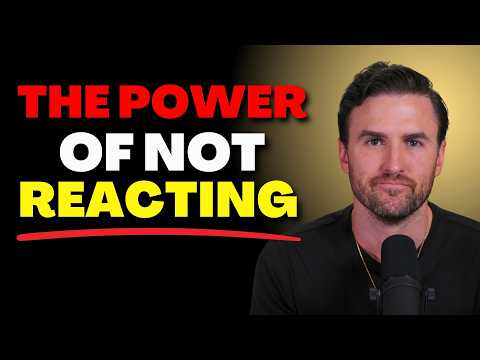
The Power of Not Reacting: How to Control Your Emotions
The Mindset Mentor Podcast
17m 34s3,315 words~17 min read
YouTube auto captions
Transcript source
YouTube auto captions
This transcript was extracted from YouTube's auto-generated caption track. The transcript below is server-rendered so it can be read, searched, cited, and shared without opening the original YouTube player.
Pull quotes
[0:00]A person who is offended by other people's words or other people's action is a person who is not in control of their own body and their own mind.
[0:00]And so what you need to do is build yourself into someone who is unshakable, someone who is impossible to offend.
[0:00]Because when you are impossible to offend, you are fully in control of yourself.
[0:00]And so you have to understand, if something bothers you, whether it's something that somebody does or something that somebody says, it owns you.
Use this transcript
Related transcript hubs
Watch on YouTube
Share
MORE TRANSCRIPTS


