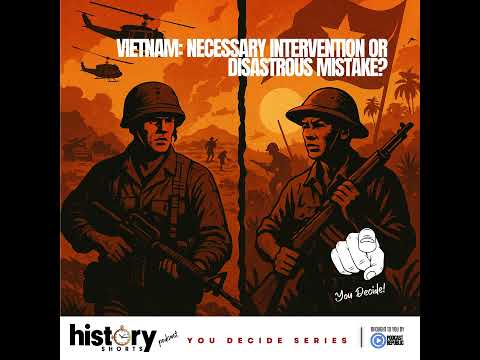
[0:00]Hey listeners, this is Peter, and welcome back to the History Shorts Podcast. This humble show is brought to you by the Podcast Republic, your ultimate listening app. Discover and subscribe to thousands of podcasts from around the globe. Yours truly included, all in one place. Download Podcast Republic now, available on Google Play and Apple App Store. Today on History Shorts. It is 1965. The United States is escalating its involvement in Vietnam, sending thousands of troops into Southeast Asia. The decision is hailed by some as a necessary intervention to protect global stability and prevent the spread of communism. While others view it as a tragic mistake, a calamity that would cost countless lives and deeply divide the nation. Across the country, debates rage in Congress, newspapers, and households. Should America be fighting this war or was it a disaster waiting to happen? Today on this episode of History Shorts new series, you decide. We explore the Vietnam War from both perspectives. Giving you the historical evidence, primary sources, and context to form your own judgment. We will examine whether the US engagement was justified as a defense of freedom and global stability or whether it was a miscalculated, destructive intervention. Yesterday, December 7, 1941, a small step for man, a leap for mankind. Mr. Gorbachev, tear down this wall. The Vietnam War, lasting from 1955 to 1975, was a conflict between communist North Vietnam, supported by the Soviet Union and China, and non-communist South Vietnam, backed primarily by the United States. The roots of the conflict stretch back to the First Indochina War between 1946 and 1954, during which Vietnamese nationalists led by Ho Chi Minh fought to expel French colonial forces. Following the French defeat in 1954, the Geneva Accords temporarily divided Vietnam along the 17th parallel, with Ho Chi Minh controlling the North and a pro-Western government installed in the South. American policy makers viewed the communist North as part of a global threat and adhered to the domino theory, fearing that if Vietnam fell to communism, other nations in Southeast Asia would soon follow. The belief drove increasing US political, economic, and ultimately military intervention. The stage was set for a war that would challenge not only American military might, but the country's political cohesion and moral compass. As is always the case with these episodes, I will provide you with two sides to the story. Side A and Side B. Side A will argue that Vietnam was a necessary intervention. Side B will argue that it was a disastrous mistake. So let us begin with Side A. This side argues that the US involvement in Vietnam was a necessary intervention to contain communism, uphold the credibility of American commitments abroad, and support an ally under direct threat. The Cold War context is critical here. By the mid-1950s, the United States had embraced the domino theory, which stated that the fall of one nation to communism would trigger the collapse of neighboring countries. The US policy makers feared that a communist Vietnam would embolden revolutionary movements in Laos, Cambodia, Thailand, and beyond. From this perspective, Vietnam was a strategic lynchpin in maintaining Western influence in Southeast Asia. American involvement began with economic and military aid to the government of South Vietnam, initially under President Diem. The US trained the South Vietnamese army, built infrastructure, and provided intelligence support. Advocates argue that without this assistance, South Vietnam would have been rapidly absorbed by the communist North, undermining regional stability and US credibility with its allies. In 1964, the Gulf of Tonkin incident, despite controversies over its details, was perceived as an act of aggression against the US naval forces, justifying escalation in the eyes of many policy makers who believed that a Vietnamese vessel had fired at American ships. Militarily, the US sought to counter the Viet Cong's guerrilla warfare and the North Vietnamese Army's conventional operations. The Battle of Ia Drang in 1965, the first major engagement between the US forces and North Vietnamese regulars, demonstrated the effectiveness of American firepower, helicopter mobility, and combined arms tactics. This battle established key operational doctrines for the United States Army and showcased a commitment to defending South Vietnam. Subsequent operations, including strategic bombing campaigns like Operation Rolling Thunder, aimed to weaken North Vietnam's logistical networks and infrastructure, reflecting a systematic attempt to achieve strategic objectives, rather than random aggression. Advocates also emphasized the moral dimension, namely US intervention was framed as defending a non-communist ally against external aggression. South Vietnam's government, while flawed, represented an alternative to totalitarian control. President Lyndon B Johnson and other officials argued that allowing communist domination would undermine democratic principles, not just regionally, but globally. The US commitment extended beyond military support, economic aid programs, civil development initiatives, and efforts to train South Vietnamese governance structures reflected an attempt to strengthen the nation from within. From this perspective, the Vietnam War was not merely a military campaign, it was a strategic, moral, and political effort to maintain internal stability, protect human rights within the South, and contain an ideology that threatened free societies. Proponents point to documents such as Johnson's speeches before Congress, highlighting communist expansion as the primary driver for action. They argue that although costly, the intervention was necessary, a necessary response to a global ideological crisis. But now let's flip the coin of that argument, and let's look at Vietnam as a disastrous mistake. Side B contends that the Vietnam War was a mistake, stemming from a misjudgment of Vietnamese politics, flawed strategic assumptions, and gross underestimation of the human and social costs. Critics argue that American policy makers failed to recognize the strong nationalist motivations driving both the North and South Vietnam. The Viet Cong insurgency and North Vietnamese army were not simply proxies for communist ideology, they were fighting for unification and independence after centuries of foreign domination. First by the French, and then in opposition to external influence, US policy makers projected Cold War binaries onto a much more complex conflict, underestimating local agency and overestimating the appeal of Western style democracy.
[8:26]Escalation exacerbated the cost of war. Following the Gulf of Tonkin Resolution in '64, US troop levels soared from approximately 16,000 military advisors to over 500,000 combat personnel by 1968. Large scale operations such as the Tet Offensive, in which North Vietnamese and Viet Cong forces launched simultaneous attacks across South Vietnam, shocked American public opinion and demonstrated that the United States and South Vietnamese governments had misrepresented the war's progress. Despite US tactical victories, the offensive undermined confidence at home and abroad. The war's human toll was staggering. Estimates suggest that over 1.3 million Vietnamese soldiers, tens of thousands of North Korean and Chinese personnel, and over 200,000 US military personnel were killed or wounded. Millions of civilians suffered from combat, bombardment, forced displacement, and chemical deflation, including widespread use of Agent Orange, which caused lasting environmental and health damage. Incidents like the My Lai massacre brought international condemnation and only highlighted the ethical failings among United States forces, fueling further anti-war sentiment and undermining America's moral authority around the world. Domestic consequences compounded the tragedy. Anti-war protests escalated nationwide, including dramatic events such as the Kent State shootings in 1970 where national guardsmen killed four student demonstrators. Divisions in public opinion eroded political consensus, strained civil institutions and provoked a broader cultural reckoning about US foreign policy, military engagement, and accountability. Economically, the war diverted billions of dollars from domestic programs, contributing to inflation and budget deficits. Critics argue that these costs outweighed any potential strategic gains. Strategically, the war revealed the limitations of American military power in an unconventional conflict. The Viet Cong's use of guerrilla tactics, tunnel systems, and knowledge of the terrain made conventional US superiority much less effective. Despite advanced weaponry, air power and technological advantage, the United States failed to secure a decisive victory, illustrating the pitfalls of intervention without clear understanding of local dynamics. And so side B emphasizes that the war represented a failure of judgment, intelligence and policy, creating enormous suffering for both Americans and Vietnamese, while ultimately failing to achieve any of its objectives. In reflection, the Vietnam War presented a profoundly complex historical debate. Side A emphasized that the US involvement was a necessary measure to contain communism, protect the sovereignty of South Vietnam and uphold commitments within the context of Cold War geopolitics. If the United States failed to prevent communists from growing in Indo-China, then could it be taken seriously by nations that still were not sure whether to side with Americans or communists? Would America be able to protect them if they sided with them? Military innovations and strategic engagements, as well as the broader air mobility campaigns, demonstrated American adaptability and commitment to allied defense. Advocates argue that without intervention, Southeast Asia would have fallen to a communist domino effect, threatening broader regional stability. Now on the other side here is side B, which highlights misjudgments of local dynamics. Protracted escalation, civilian suffering, and the moral dilemmas posed by actions such as the My Lai massacre. The war's domestic consequences including protests, political polarization and economic strain illustrate the unintended impacts of intervention. Critics contend that the war failed to achieve its intended objectives and thus undermined the moral authority and strategic position of the United States. Understanding the Vietnam War requires balancing these perspectives. Was it an essential intervention to defend freedom and prevent communist expansion around the world, or was it a tragic, costly miscalculation that inflicted widespread suffering? While in truth, elements of both are evident here. The war was a product of Cold War imperatives, yet its execution revealed a profound limitations in the United States understanding and strategy. But it's for you to decide. As is always the case, this episode just scratched the surface of the issue, and there is a plethora of sources available for analysis, evaluation, and discussion. Treat this more as an inspiration to go and dig deeper. For some further exploration, I suggest The Vietnam War, an intimate history by Jeffrey C Ward and Ken Burns, as well as the documentary, Hearts and Minds by Peter Davis. For the good of the order, this upcoming Friday's conversation series guest is Mark Lee Gardner. We talk about his latest book, Brothers of the Gun, Wyatt Earp, Doc Holiday and the reckoning in Tombstone. Hopefully today's episode has inspired you to seek out and learn more about the subject. For answers to questions, to leave a comment or check out upcoming guest announcements, visit www.historyshortspodcast.com or look for History Shorts on Facebook and X. Stay curious everybody, and I will talk to you all tomorrow.
[14:20]But a boom.