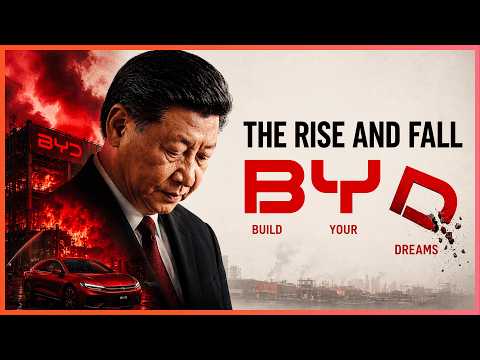
[0:00]For about 100 years, the global car industry was dominated by three countries: Germany, Japan, and the United States. Out of them came the names that define modern driving: Toyota, Volkswagen, Mercedes, Ford, Honda, BMW. These weren't just companies, they were the pride of entire nations and the backbone of their economies. But in the space of three years, it's been a bloodbath. Mercedes watches profit collapsed by 28%. Porsche lost 92% of its bottom line in a single year. Stellantis, the group behind Jeep, Peugeot, and Fiat, posted a $26 billion loss, the worst in its history. Volkswagen announced 50,000 job cuts. Behind every single one of these blows, the same name keeps coming back: BYD. A company that until 2003 was still producing nothing but simple batteries. Back then, the very idea that they could one day compete with Tesla was so absurd that Elon Musk himself couldn't hold back a laugh when asked about them on live American television. Have you seen their car? Today, Musk isn't laughing anymore. BYD sells more electric cars than anyone on the planet. How did a small battery workshop bring the entire car industry to its knees in less than a decade? What's their secret weapon? And why is nobody talking about what's really happening behind the curtain? Because BYD didn't rise out of nowhere just like that. There's a lot more to this story. That's exactly why I created this channel to talk about things people get wrong because they never set foot in Asia. I've been running businesses here for 26 years. I see what's happening from the inside. So, if you want a real picture of what's going on, subscribe. You won't get this anywhere else.
[1:37]The mistake most people make is to think this is a story about Chinese brands winning in China. That would already be bad news for Mercedes and Volkswagen. But it will still leave them the home turf. The reality is much worse. BYD and the other Chinese carmakers aren't just dominating Beijing and Shanghai. They're planting their flag on every continent at the same time, and nobody seems able to stop them. Start with Southeast Asia, where the shift has been the most brutal. In Thailand, BYD took 40% of the electric vehicle market in 18 months. Mitsubishi shut down its local factory, Mazda cut production by 60%. A region that had been a Japanese stronghold for 40 years, flipped in a few years. In Singapore, one out of every five new cars sold last year is a BYD. In Malaysia, BYD became the best-selling electric brand in 2024. Closer to home, the picture is just as ugly. Look at Europe, the place where Western carmakers thought they'd be safe. Chinese brand now come for more than 11% of European EV sales, and their share keeps growing every quarter. Renault just passed its first net loss in five years and won that margins will keep shrinking because of Chinese pressure. Stellantis is bleeding in its core markets. Even Audi, the untouchable brand of European luxury, is now losing customers in China and losing market share at home in Europe at the same time. Friedrich Merz, the German Chancellor, had to fly to Beijing with 30 CEOs behind him, not to sign contracts, but to ask Xi Jinping to stop suffocating German industry. 20 years ago, it would have been unthinkable. And there's the place nobody expected: Brazil. BYD took 72% of the Brazilian electric vehicle market in a single year and opened a factory on the side of an old Ford plant the Americans had abandoned. They're doing the same thing in Mexico, in Israel, in Norway, one of the most demanding EV markets in the world, where the BYD Tang landed straight in the top five best sellers on launch. The United States is the only major market where BYD is still blocked officially for national security reasons. And even there, the Americans know it's a holding pattern, not a victory. Because in every other corner of the planet, the trend is the same: wherever BYD shows up, the competition starts falling apart. Sometimes in months, sometimes in weeks. So, the real question is how? How does a Chinese company most people couldn't name five years ago pull off something no Western carmaker saw coming? Cheap labor doesn't explain it. Plenty of other Chinese brands had the same advantage and went nowhere. What BYD actually built is the part Mercedes and Toyota should have been studying 10 years ago. And to understand what they built, you need to know who built it. His name is Wang Chuanfu. In 1995, he was a 29-year-old engineer who borrowed $40,000 from his cousin and rented a small workshop in Shenzhen to start making rechargeable batteries. Within seven years, he was supplying Motorola and Nokia. By 2003, BYD was the biggest battery maker in the world. That same year, Wang did something nobody understood. He took the money and bought a bankrupt state-owned car factory in the middle of nowhere. His own investors tried to stop him. BYD's stock dropped by 2.7 billion Hong Kong dollars in two days. The Chinese business press called it a joke. A battery guy working into one of the most capital-intensive industries on the planet. Wang didn't even have a driver's license. But his logic was simple: the future of the car, he believed, wasn't the engine. It was the battery, and nobody on Earth knew more about batteries than him. Everyone else was trying to figure out how to electrify a car. Wang was trying to figure out how to build a car around something he already mastered. He would take him 15 years of humiliation before the rest of the world understood what he was actually doing. And during those 15 years, while journalists laughed at his cars and Musk was mocking him on television, Wang made three decisions that would quietly change everything. The first was to refuse to depend on anyone. Tesla buys its batteries from Panasonic. Volkswagen relies on hundreds of outside suppliers for chips, motors, electronics, even the glass. BYD decided to build everything in-house. The batteries, obviously, but also the semiconductors, the motors, the power electronics, the windshields, the headlights, down to the software running inside the dashboard. When the global chip shortage paralyzed the entire auto industry in 2021, BYD just turned up the dial on its own chip factories and kept delivering. When lithium prices exploded, they were already digging their own in Tibet and South America. Every crisis that hurt their competitors made them stronger. The second decision was a bet on the boring option. While Tesla and every Silicon Valley commentator was evangelizing pure electric vehicles, Wang quietly pulled resources into plug-in hybrids. Cars that run on electricity for daily commutes and switch to gasoline for longer trips. In California, it sounded like a compromise. In most of China, where charging stations were rare outside the big cities, it was the only thing that actually made sense for hundreds of millions of people. By the time BYD was selling more PHEVs than Tesla was selling EVs in total, the Western press was still debating whether hybrids were even a real technology. That compromise gave BYD access to 500 million Chinese consumers Tesla could never touch. And once that had volume, the economics of scale did the rest. The third decision was the one that closed the trap. In 2020, BYD released the Blade battery, a different chemistry, lithium iron phosphate, instead of the nickel and cobalt mix everyone else was using. It was cheaper to produce, it didn't catch fire when you drove a nail through it, and it lasted longer. That last part matters more than it sounds. It meant BYD could sell cars at a lower price than Tesla, while claiming a genuine safety advantage. Four years later, Tesla's starting buying batteries from BYD for its own cars. Let that sink in. The company must laughed at on television is now supplying the batteries inside Tesla's. Spoiler alerts, they stopped quickly. But you understand that BYD didn't just build better cars, they built a system that competitors structurally can't copy. At least, that's the official story, the one you read in every business magazine. Every Harvard case study celebrating BYD as the next Toyota, vertical integration, bold hybrid strategy, breakthrough batteries, amazing! Except, it's not the full story, not even close. If you're getting value from this, hit subscribe.
[7:53]This is exactly the kind of story you won't find on CNBC, because most people covering Asia have never actually worked here. I have, for 26 years. That's why I created this channel to share what's really happening in Asia from the inside. From day one, BYD has been playing a game nobody else on the field was allowed to play. Between 2015 and 2020 alone, BYD received roughly $4.3 billion in direct subsidies from the Chinese state. In 2016, the year they poached their star designer from Audi, the subsidies they collected from Beijing were higher than the company's entire net profit. Listen to that sentence again. Without the Chinese government writing checks, BYD wasn't making money that year, it was losing it. And it wasn't the only year. The help came in every form you can imagine: free land for factories, 0% interest loans from state-owned banks, tax breaks on R&D, guaranteed public contracts for buses and taxis in hundreds of Chinese cities, subsidies ended directly to buyers, so that every BYD sold in China came pre-discounted by the state. At its peak, analysts estimate BYD was pocketing between $2,000 and $4,000 of public money for every single vehicle rolling off the line. Now, stop for a second and think about what that means for a company like Volkswagen or Toyota. When they decide to price a car, they're competing against a rival whose margin isn't calculated the same way theirs is. BYD can sell below cost for years and still post a profit, because the Chinese state is quietly topping up the difference. That's not a fair market. This is why Mercedes can't just build better cars, it's why Stellantis can't just cut cost either. The problem isn't that BYD is smarter, or faster, or more innovative, although there are plenty of those things. The problem is that BYD is part of a national industrial strategy, Made in China 2025. The plan Xi Jinping laid out a decade ago, openly named the automotive sector as one of the 10 industries China intended to dominate globally. BYD is the instrument, the country is the player. By the time Western governments finally woke up and starting talking about tariffs and investigations, Beijing had already starting winding down the most aggressive subsidies. Not because anyone forced them to, because the job was done. The machine was built, the global supply chain was locked in, and the competition was already on its knees. The subsidies have their purpose and then quietly disappeared, leaving Western politicians chasing a problem that had already moved on to its next chapter. Sadly, for BYD, the cracks are starting to show. The first one opened up in early 2025, when a small independent research firm based in Hong Kong, called GMT, published a report that landed like a bomb in the financial press. According to their analysis, BYD's real debt isn't the 42 billion yuan the company officially reports. It's closer to 323 billion, almost eight times higher. The missing pieces are hidden inside what accountants call supply chain financing. A polite way of saying that BYD pays its suppliers an average 275 days after delivery, nine months. In an industry where the norm is 50 to 60 days. Technically, those unpaid invoices are debt, except they don't show up on the balance sheet. BYD is using its own suppliers as an unpaid bank, and the scale of it now rivals what Evergrande was doing in real estate right before the world saw its collapse. There's another practice nobody in China talks about openly, but everyone in the industry knows exists. It's called zero-mileage used cars. The mechanism is simple and ugly. At the end of each month, when sales targets are due, BYD dealership registered thousands of brand new cars in the name of shell companies they control. Then immediately resell them on the second-hand market as used zero kilometers. On paper, those cars count as new car sales. In reality, no real customer ever bought them. They ended up piling in general lots across China, sometimes for months. Images from 2024 show rows of BYDs abandoned in fields slowly rusting. A salesman in Guangzhou, admitting anonymously that at the end of every month, he was told to register 200 or 300 cars under bona companies just to meet the numbers. Which raises an uncomfortable question. When BYD tells the world it sold 4.25 million vehicles last year, how many of those were actually sold to human beings? The quality problems have been piling up in parallel. In September 2024, BYD had to recall nearly 97,000 vehicles over steering colon defect that could cause short circuits and spontaneous fires. The biggest recall in the company's history. Well, the biggest recall until October 2025, when they had to recall another 115,000 vehicles for another problem. On Chinese social media, complaints about the Seal Lion SUV, radio cutting out after three months, GPS showing roads that don't exist, wipers freezing in heavy rain, reached nearly 5,000 official filings in a single week. In Brazil, BYD is being prosecuted by the Labor Ministry for conditions described in code documents as analogous to slavery at its factory construction site in Bahia. 163 Chinese workers, passports confiscated, 14-hour days, no rest days. The case went all the way up to President Lula. And the financials are starting to wobble. Net profit for 2025 dropped by 19%. Global sales in the first month of 2026 fell 41% year on year. Geely, the rival Chinese giant, is starting to eat BYD's lunch at home. The Chinese government itself issued a public warning late last year, telling carmakers that the price war they're engaged in isn't sustainable. When Beijing tells its own champions to calm down, you know something is off. None of this means BYD is about to collapse tomorrow. The company is still massive, still profitable on paper, still selling more electric cars than anyone on the planet. But the cracks are real, and the people pointing at them aren't going away. Some of them are now openly using the world Evergrande. Whether they're right or wrong, that word alone tells you how fragile their miracle might actually be. Whatever you may think about all this, Beijing is already running the same playbook again in half a dozen other industries. If you want to know which industries are next on the list, you don't even have to guess. Beijing published it. It's called China's 15th Five-Year Plan, and it names every sector the country intends to dominate globally. Read it once, and you'll never look at the business headline the same way again. The reason I'm telling you this isn't to scare you, it's because if you're building a business in 2026, thinking the world still works the way it did in 2005, you're going to get blindsided by something you never saw coming. The rules have changed. The people playing the game best right now are not in Detroit, Stuttgart or Tokyo. They're in Shenzhen, Guangzhou, and a dozen other Chinese cities most Westerners couldn't find on a map. Whether BYD collapses next year under its own hidden debts, or becomes a Toyota of the 21st century, it almost doesn't matter. The bigger story is the one playing out behind it. And it's not going to stop with cars. If you've seen the shift happening in your own industry, drop a comment below and tell me what you're watching. I read them all. And if this is the kind of story you want more of, subscribe. That's why I created this channel to show what's really going on in Asia from the inside, not from a desk in London or New York. See you in the next video.


