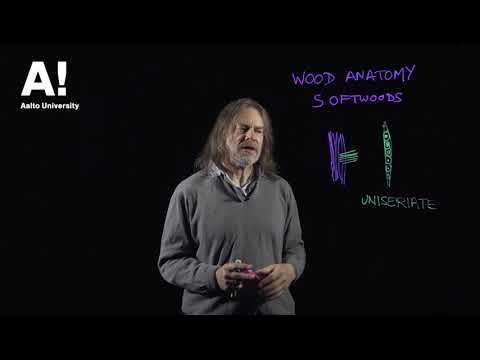
[0:16]Okay, um so we're going to talk about wood anatomy now. Um and I'm talking about softwoods still, and softwoods have got the simpler of the two structures compared with hardwoods. And they're made up of lots and lots and lots of tracheids which form this vertical structure. And then we have the ray cells that come out horizontally in this direction. Then if we look at the end of the ray cells, we look at how they're lined up. Ray cells have this sort of square blocky structure. They are hollow, just like tracheids are. But in softwoods, almost all the time, the structure that these ray cells form, they all line up in a series and it's a series of one cell on top of another and that's referred to as uniseriate. And that has important consequences, not only just for the flow of liquids through the wood, but also for the appearance of the wood when we cut it in different directions and I'll be talking about that a bit later on. So that's softwoods, relatively straightforward structure. We've got the vertical structure of the tracheids, we've got the horizontal structure of the ray cells, the parenchyma cells, and we've got these resin canals that also go down through the wood. If we look at hardwoods, the structure is more complex. Hardwoods are the wood from trees that evolved much later than softwoods. And they evolved from a different branch of plants, so they don't have the same kind of structure at all, much more complicated. They are formed of fibers which look like tracheids in a way, but they don't have any conduction function at all. So they're long, thin cells. They're not as long as tracheids and they haven't really got a hollow interior. They don't really have a conduction function, they purely have a support function. And then the liquid runs through pores which are formed within the wood structure. And we also have the ray parenchyma cells but they're much more complex. We don't have this simple uniseriate structure of ray cells in many hardwoods. But there's much more variety in the types of structures that we get with hardwoods. So if we were to look at a hardwood structure, we'd see the fibers forming this vertical arrangement. And within that, we have these conduction pathways which are formed by the pores which can be very visible in hardwoods. And the distribution of pores in hardwoods can be in series, in which case we have something called ring porous hardwood, or they can be distributed which gives you a diffuse porous, so they don't have such an obvious structure, or they can be somewhere in between the two. And then we have the parenchyma cells, so the pores are running up vertically, these channels for conduction, and then horizontally we have the ray cells. But if we look at the structure end on, when we have the ray cell structures in hardwoods, they form much more complex structures. They tend to form these bundles and these are called multiseriate. And we'll look at the consequences of that later on.
Wood anatomy (2) Hardwood and softwood structure 2
Aalto University - Wood Science
3m 54s526 words~3 min read
YouTube auto captions
Transcript source
YouTube auto captions
This transcript was extracted from YouTube's auto-generated caption track. The transcript below is server-rendered so it can be read, searched, cited, and shared without opening the original YouTube player.
Pull quotes
[0:16]Um and I'm talking about softwoods still, and softwoods have got the simpler of the two structures compared with hardwoods.
[0:16]And they're made up of lots and lots and lots of tracheids which form this vertical structure.
[0:16]But in softwoods, almost all the time, the structure that these ray cells form, they all line up in a series and it's a series of one cell on top of another and that's referred to as uniseriate.
[0:16]And that has important consequences, not only just for the flow of liquids through the wood, but also for the appearance of the wood when we cut it in different directions and I'll be talking about that a bit later on.
Use this transcript
Related transcript hubs
Watch on YouTube
Share
MORE TRANSCRIPTS


