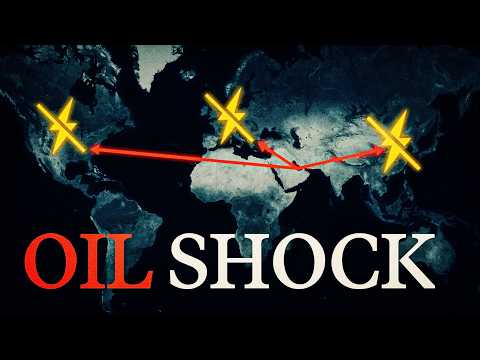
[0:00]The Iran war was supposed to blow up the world economy. The war in Iran has sent the price of oil and natural gas soaring, putting pressure on just about everyone. Ship traffic has slowed to just a dribble, and the longer it stays disrupted, the more pressure builds across the entire global energy system. But it's been a month of really severe fighting.
[0:24]and a near total shutoff of oil and gas out of the Middle East, and most of the world seems basically fine.
[0:32]You look out your window and what you see is not Mad Max. What you see is more a normal variety bad economy. attacking at least three ships moving through the Straight of Hormuz. And that translates to prices at the gas pump now at levels not seen since the start of the war in Ukraine four years ago. So, what's going on here? Was the doom saying all wrong? Are things basically fine? To figure this out, we're going to answer the question, what actually happens when the world's largest oil producing region goes to zero? Like physically, step by step from the moment the tap turns off, how does that work? How does that ripple down the supply chain to your gas pump, to grocery store? How long do the lights stay on? How long do planes stay in the air? And look, I will spoil the ending for you, the fine that you see out your window right now is fake. It's a mirage. I don't care where in the world you are. There is a 100-foot tidal wave rising above your head, and once you see why it's rising and what's going to happen when it hits, you will not be able to miss it.
[1:37]The thing we are talking about has a name, an oil shock, and we are right now in the biggest oil shock in history. Think of it like a bomb that's exploded very far away. We see the flash, but the shock wave hasn't reached us yet. Today we're going to answer what happens when that shock wave hits, what it's going to do, what will change, how it's going to play out. Which also means asking why it's taking so long to reach us. We're in this weird lull right now. As promised though, we're going to start by tracing what actually happens when the oil spigot goes from on to off. And the first thing you need to know is something that seems simple, seems obvious, but it turns out to be really, really important. This is an oil tanker, and the thing to know about an oil tanker is that it's really, really big. Four soccer fields long, carries two or three million barrels of oil, and it weighs more than a skyscraper. All of which makes it slow, 10 or 15 knots, that is no joke, the speed of a bicycle. Our global energy supply lines move at the speed of a schwinn. And let me show you on this globe why that's important. If you biked all day, how much of this globe do you think you could cross? Like maybe the width of the point of this pen, right? Maybe, if you worked really hard. Okay, now imagine hopping on your 12 speed, starting in Dubai. Where's Dubai? Here we go. Starting in Dubai, and now imagine that you have to bike out of Dubai, all the way down here, down the coast of Africa, down, down, down, across the Cape of Good Hope, back up the other coast of Africa, all the way across the Atlantic, through the Caribbean, before finally arriving at the deep water oil port in Louisiana. That would take forever on a bike, right? Which remember is the speed that these oil tankers go. Like, that is how our oil travels, as if it were on a bike. And maybe you see where I'm going with this.
[3:36]This is a map of global oil flows put together by J.P. Morgan. Don't worry about all this text, we'll explain it in a minute. These red lines show the oil coming out of the Middle East, going out to the rest of the world. This is the stuff that's been cut off. Here it is back in December before the war. There it goes, the oil is flowing, but remember it moves at the speed of a bunch of bicycles. So now it's January, and the oil is just finally breaching parts of Asia and Europe. And we're into February before it hits the US, and then it hits refineries in South Korea that then sends it on down these pink lines to Australia and New Zealand. So when the war starts and the oil stops flowing, there's actually still a ton out there taking its long, lazy little bike ride around the globe. That's a big part of why things seem weirdly normal. For most countries, the oil shutdown has not reached us yet. We're still getting shipments that were sent out before the war started. So when do those shipments stop? If you look at that map again, it says most deliveries to the US will stop around April 15th. In Europe, they stop around April 10th. Asia, April 1st, so it's just getting started. But here in parts of Africa, it's March 20th. We're already well into it. And to be clear, these places aren't out of oil. Every country has emergency stock piles. So let's see what that looks like. Gas lines are the first thing to show up. Not enough fuel at the pump. And these are already everywhere, South Africa, Pakistan, Vietnam, a bunch of places. And Laos, they ordered schools closed for one day a week, so there'll be fewer people on the roads. The Philippines and Ethiopia did the same thing for government offices. And Sri Lanka is making everybody take every Wednesday off of work now. There are also restaurant curfews, mass flight cancellations, air conditioning shutoffs. It's not that these countries are running out of oil. I mean, they are, but that's not the real issue exactly. Imagine this is the global oil supply. It's all sold in one big market. And that means all the producers sell to that same global supply. And then all the oil consuming countries buy from that same supply. You could also call these exporters and importers. It's the same idea. Anyway, the Iran war cut off 1/5th of global supply, about this much. So when deliveries stop showing up at those countries we talked about, they can't actually buy from other producers, but they've got to do it by outbidding whoever would have bought that oil otherwise, and that pushes up the price for everyone. And that's even hitting places like the US where we are still receiving oil from before the war started. Countries whose shipments ran out are creating this big surge in demand. So anytime you go to the pump or pay your power bill, you are bidding against them and they are bidding against you. And all of this is going to get significantly worse when China and Europe start running out of shipments too and surge demand to replace it, which is really close to happening. But all of this raises a question. If these shortages are just days or weeks from reaching everywhere, then why are we in a lull? Every government in the world can see that same map that I showed you earlier. They know catastrophe is bicycling their way, so why doesn't it feel like it? Sir, could you foresee a deal in Iran this upcoming week? I do see a deal in Iran. It could be soon. When he said this, the price of oil dropped right away. War's ending, right? Everything back to normal. Except he'd been saying the same thing for weeks. We have had very, very strong talks. We'll see where they lead. We have point, major points of agreement, I would say almost all points of agreement. Iran has said that there are no talks and Trump is making it all up. Iran's foreign ministry says you're not telling the truth when it comes to productive conversations to end the war. They're gonna have to get themselves better public relations people. He's been doing a ton of this. Like a few days earlier, he'd posted the US was very close to meeting its objectives in the war and might soon start winding down. So why does he keep doing this? Well, to understand, go back to that graphic of the global oil market. We left something out before. A lot of oil gets bought up by speculators who sell it secondhand. This all takes place through something called an oil future. It sounds scummy, but it actually serves a pretty useful function in stabilizing prices. You know, it doesn't matter how it works. The point is, those speculators set their price by what they think oil will cost in the future, which means if Trump comes along and says peace in our time, speculators conclude prices will drop and sell their oil futures for cheap, which helps to balance the price rise in the regular market. That's part of the lull. Even though Econ 101 says oil prices should be going up way more than they have, like crisis levels, six, seven dollar a gallon territory. All of this market manipulation is tapping those prices down. But that sounds good, right? Except that it means that the global economy is consuming oil and gas as if they were still priced and flowing normally. It's like if your city were running out of water and everybody in town decided to take two showers a day. And there's another thing propping up this weird artificial lull we're in. IEA countries have unanimously decided to launch the largest ever release of emergency oil stocks in our agency's history. Remember earlier when I said that all countries keep oil stockpiles? Well, a bunch of those countries got together recently and agreed to sell off 400 million barrels from their reserves. That's like if 200 of those oil supertankers suddenly materialized out of the Bermuda Triangle all at once. And then atop of that, the US also agreed to allow Russia, and this is kind of hard to believe, Iran to sell off some of their sanctioned oil. And releasing these stockpiles has added oil to the market, equivalent to about half of what was cut off by the war, which has helped to balance out supply and prices and all of that. But here's the catch, and it's a big one. The stockpile release and the speculator games, these are both one off tricks. They only work for a few weeks, and when they're used up, they're gone, man. That artificial lull that we have been holding up, it is going to come crashing to an end just as those last shipments of Middle Eastern oil dry up. the final uh vessel carrying jet fuel into the United Kingdom's going to get here in 48 hours and there's no more after that. So when that oil shock hits, it is going to hit us all at once. Okay, so now we understand what that oil shock is, how it's going to get here, how it's forming. What is it going to look like? And when people picture this, they tend to talk about it in terms of rising prices, $200 barrel oil, $8 a gallon at the pump, $1,000 domestic flights. But this misses something much larger and much more consequential that is already starting to happen. To understand what that is, imagine if instead of talking about energy supplies, we were talking about food. Now, if I told you that one or 2% of the world's food supply was going offline, you'd probably worry. You might expect to see food prices go up some, some hardships on the margin, but you would think it's basically survivable. But now, if I told you the world was losing, had already lost 20% of its food supply, you would think, well, we are about to have fewer people on earth. The name for this is demand destruction. It's when the supply of something drops so severely that whoever or whatever relies on it, the demand, permanently withers away. And that is what is going to happen to any global economic activity that uses energy, which is like almost all of it. Factories, technological development and production, car and airplane travel, air conditioning, building homes or cities. I'm not saying that those things are going to go away, but there is going to be a lot less of them, like about 20% less once things really bottom out. The economic shocks caused by this war will be with us for months. How we emerge from this crisis will define us for a generation. Let me give you a few specifics that are already starting to manifest. Airlines say they cannot afford to operate and are shutting down many of their flights. So it'll be harder to explore the world. European governments are telling their citizens not to travel for vacation this summer. There's just not enough fuel for it. A number of factories are already closing worldwide, especially in Asia. Semiconductor factories in particular are closing, both for lack of power and because semiconductors use helium, which is a byproduct of natural gas production, so is also going away. Importers expected to become prohibitively expensive to ship some things abroad, so we'll have fewer foreign goods, less off-season produce, and we'll export less too, so fewer jobs. Construction supplies like lumber are getting too expensive to harvest or import, which means fewer homes getting built, which means existing homes getting more expensive and harder to afford. Many of the essential components to fertilizer also come through the Persian Gulf, things like phosphorus. There are already fertilizer shortages in Asia, so, yeah, there will also be less food in the world. All of these things also contribute to inflation. Prices go up, harder to afford things, our standard of living goes down. And the thing is, even if the war ends today, this process, this demand destruction, is actually going to continue. It's because American, Israeli and Iranian missiles have left much of the region's energy infrastructure in ruins. Things like refineries, gas terminals, that will take years to rebuild, which means years before that oil and gas comes back online. This winter is probably going to bring the first big wave of hardship. Right now, spring and summer is a time of year when countries are usually stockpiling oil and gas so that they can get their people through the cold months. But instead, those countries are burning their stockpiles down to zero. That means December and January are likely to bring a whole new oil shock, when a billion people across Europe, Asia, and North America, go to turn on their winter stoves or heaters and find that there is not enough gas to go around. Now look, I'm not saying all this because I want to scare you, and we are not on the verge of some great collapse. I promise you that Mad Max is going to remain a thing that you watch just on your TV and not out your window. I'm telling you all this because the architects of this war want you to believe that this, the way things are right now, today, that that's the worst of it. That we just have to write out a few weeks of high gas prices, and we're going to come out the other side of this war, basically unscathed. But what's happening right now is a trick. This lull is it's fake. It's hiding the real consequence of this war, which are coming. The people in Iran and in neighboring countries who go to sleep under falling bombs are already living in this war. The thing is, is that I'm not saying it's the same, but pretty soon, we are going to be living the consequences of this war too.


